CloudX 2026: How Do You Forecast Hardware at Billion-User Scale?
I spoke on the CloudX Main Stage in Santa Clara on 1 September, co-located with API World and AI TechWorld, on why infrastructure forecasting fails at scale and the playbook that replaces guesswork with business intent.

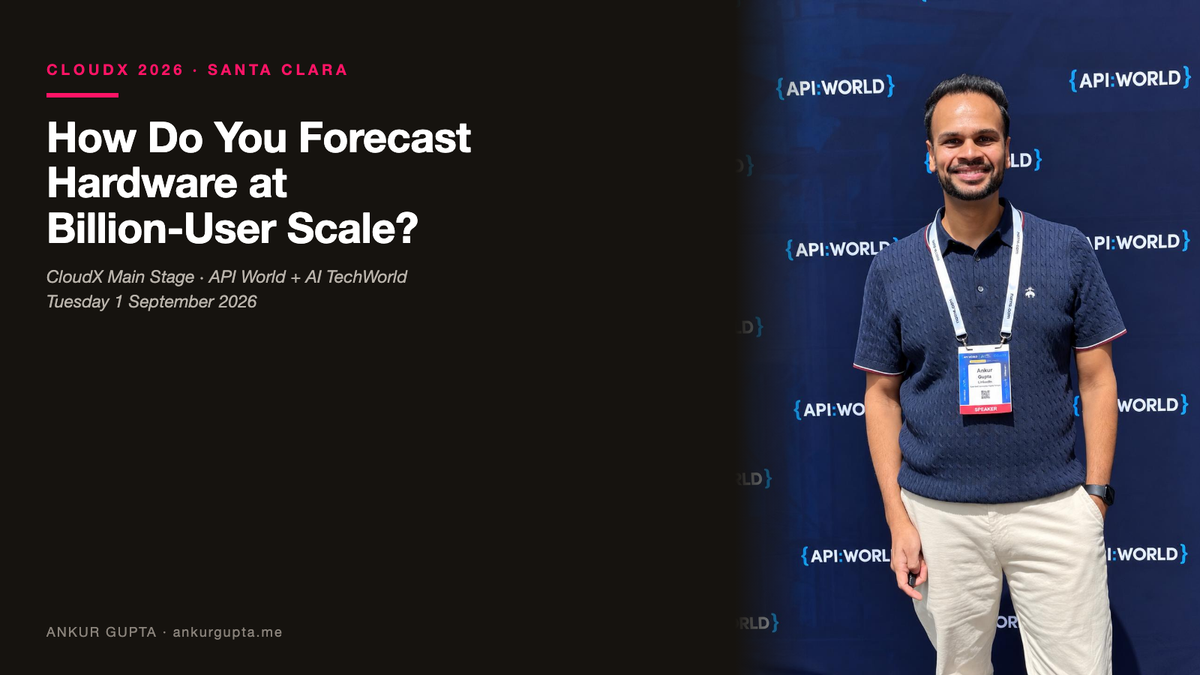
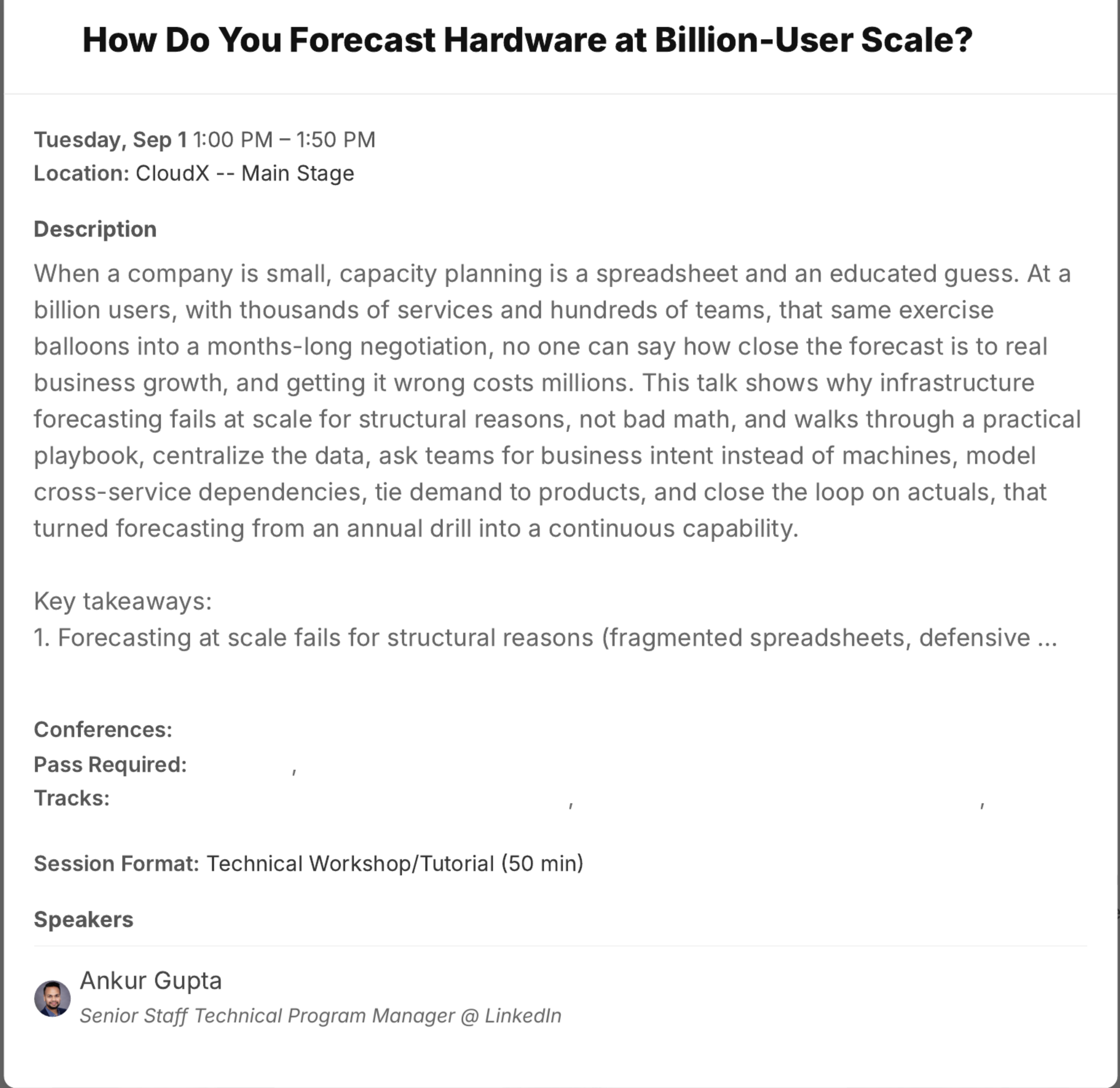
I spoke on the CloudX Main Stage at the Santa Clara Convention Center on Tuesday 1 September, 1:00–1:50 PM, on how to forecast hardware capacity for AI infrastructure at billion-user scale. CloudX 2026 ran 1–3 September, co-located with API World and AI TechWorld.

The argument of the talk was that infrastructure forecasting fails at scale for structural reasons, not bad math. When a company is small, capacity planning is a spreadsheet and an educated guess. At a billion users, across thousands of services and hundreds of teams, the same exercise becomes a months-long negotiation in which nobody can say how close the forecast sits to real business growth – and getting it wrong costs millions.
The failure is usually one of units. A central team asks service owners for machines. Service owners do not think in machines; they think in members, queries and launches. So they guess, pad the guess, and the padding compounds at every hop until the number that reaches procurement has no traceable relationship to anything the business actually plans to do.
The playbook I walked through inverts that: centralise the data, ask teams for business intent rather than hardware, model cross-service dependencies so one team's growth shows up in another team's footprint, tie demand back to products, and close the loop on actuals so the forecast is scored rather than believed.
What I covered
- Why traditional capacity planning models break once GPU and MIG-based inference enters the picture
- A replica-centric approach to forecasting hardware demand
- Balancing headroom against cost at billion-user scale
- The signals that predict a capacity crunch before it reaches production
Thanks to the API World, CloudX and AI TechWorld team for the invitation, and to everyone who stayed back afterwards to argue about lead times.