CSCE 2026: A Two-Track Framework for Cutting Time-to-Mitigate
My solo-authored Springer paper at CSCE 2026 in Las Vegas proposes a two-track chaos and mitigation engineering framework for reducing time-to-mitigate in large-scale distributed systems.

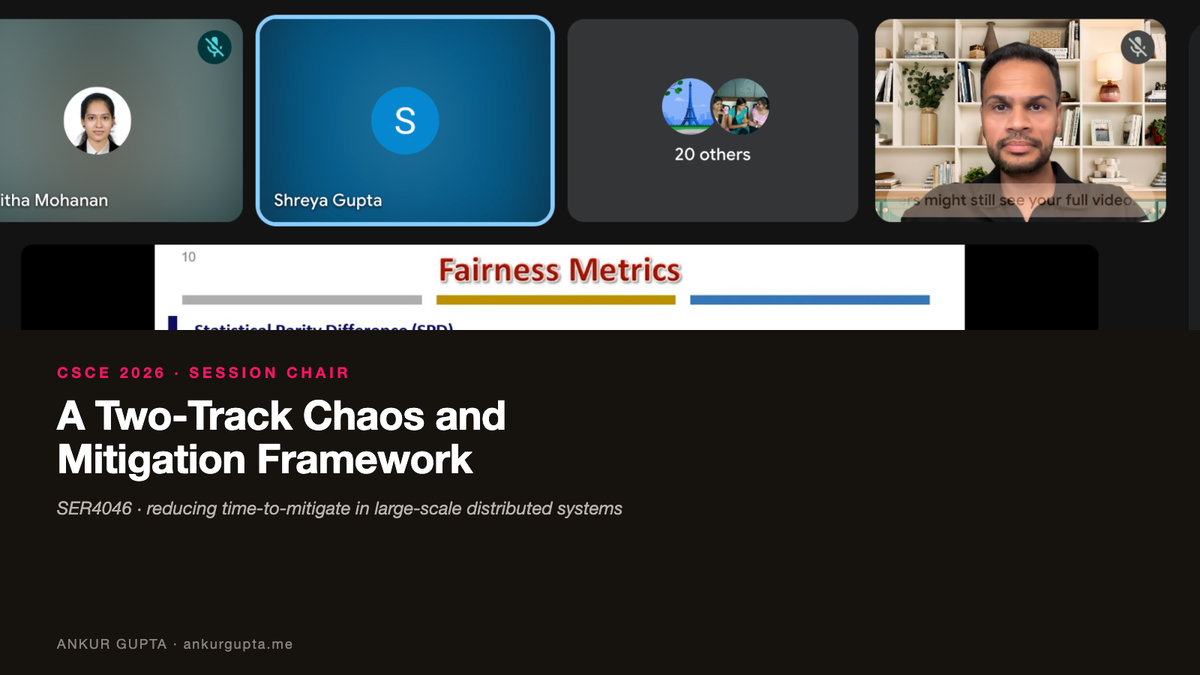
I presented a solo-authored paper at CSCE 2026, the World Congress in Computer Science, Computer Engineering, and Applied Computing, published by Springer. The paper is SER4046, “A Two-Track Chaos and Mitigation Engineering Framework for Reducing Time-to-Mitigate in Large-Scale Distributed Systems.”
Most chaos engineering programmes optimise for discovery: inject a fault, find a weakness, file a ticket. That is useful, and it is only half the loop. The metric that decides whether an outage is a blip or a headline is not how many weaknesses you found – it is how long it takes to mitigate once something breaks in production at three in the morning.
The framework runs two tracks in parallel. The discovery track does what chaos engineering normally does. The mitigation track treats the response itself as the system under test: is the runbook current, does the responder have the access they need, is the mitigation lever reachable without a deploy, and how long does each of those actually take when measured rather than assumed. Injecting a fault and then timing your own recovery tells you far more than injecting a fault and reading the alert.
I also served as a session chair at the same conference. I wrote about that separately.