Graph Databases: When the Connections Are the Point

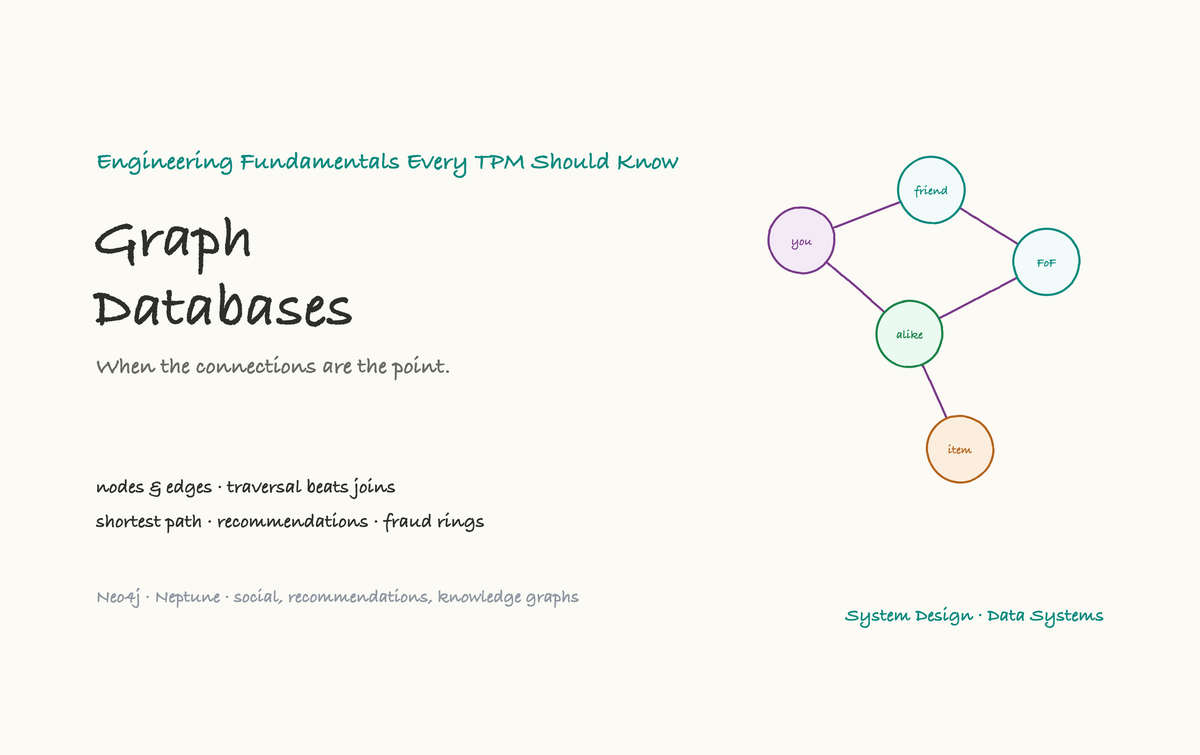
Every database family we've covered so far treats relationships as a secondary concern. Relational databases reconstruct them with joins at query time. Document databases mostly avoid them by nesting data. Key-value and wide-column stores barely acknowledge them. But for a whole class of important problems, the relationships are the data. The interesting question isn't "what is this user's name?" but "who are they connected to, how, and how far?" That is the world of the graph database.
This deep-dive, the fifth in the data systems series, covers the family built specifically to store and traverse connections. If your hardest questions sound like "friends of friends," "shortest path between," "people who also bought," or "is this a fraud ring," a graph database answers them in a way nothing else can match. Neo4j and Neptune are the names you'll hear. Let's see why connections deserve their own kind of database.
The model: nodes, edges, and properties
The graph model is refreshingly intuitive because it matches how we naturally draw things on a whiteboard. It has just three pieces.
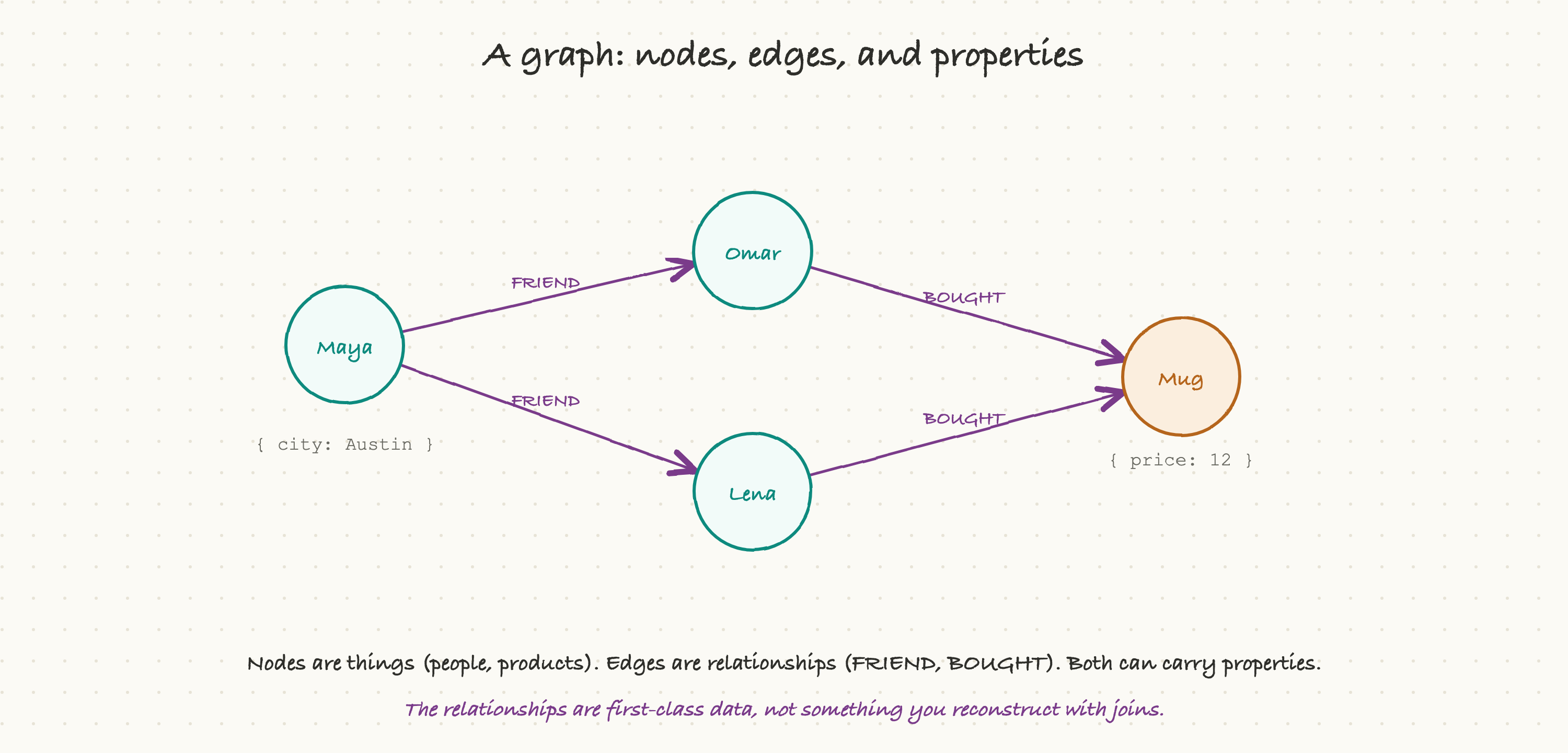
Nodes are the things: a person, a product, an account, a place. Edges are the relationships between them: Maya is a FRIEND of Omar; Omar BOUGHT a Mug. And both nodes and edges can carry properties, key-value details like a person's city or the price of a product or the date a friendship started. This is called the property graph model, and it's what most graph databases use. (There's a more formal alternative called RDF, used in knowledge-graph and semantic-web circles, but the property graph is the mainstream, approachable version.)
The profound difference from everything else is this: in a graph database, relationships are first-class data, stored directly. The edge between Maya and Omar is a real, stored thing you can attach properties to and traverse instantly. You're not reconstructing the connection by matching foreign keys at query time, as a relational database would. The connection simply exists, as concrete as the nodes it joins. That single design decision is the source of everything that makes graph databases special.
The killer advantage: traversal beats joins
To feel why this matters, take the most natural social-network question there is: who are my friends-of-friends? Watch how the two worlds handle it.
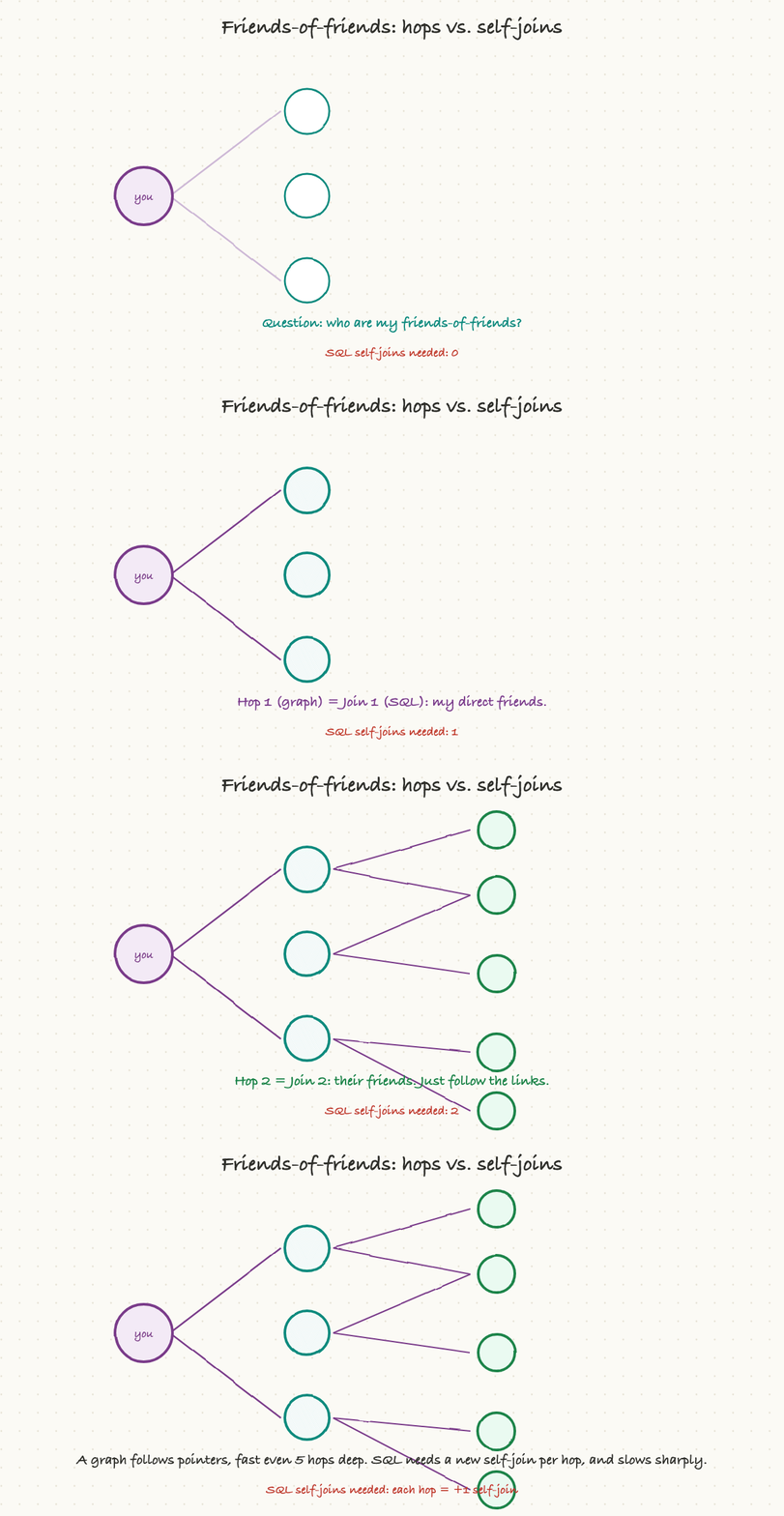
In a graph, you start at your node and "hop" along FRIEND edges to your direct friends, then hop again to their friends. Each hop is just following the stored links outward. Want to go three or four or five degrees deep? Just keep hopping. The work per hop stays small and constant.
In a relational database, the same question means joining the friendships table to itself, once for each degree of separation. One hop, one self-join. Two hops, two self-joins. And here's the killer: each additional join multiplies the work, so these queries get dramatically slower as you add hops or as the data grows. A "six degrees of separation" query that's trivial for a graph can bring a relational database to its knees.
The reason graphs stay fast is a property called index-free adjacency.
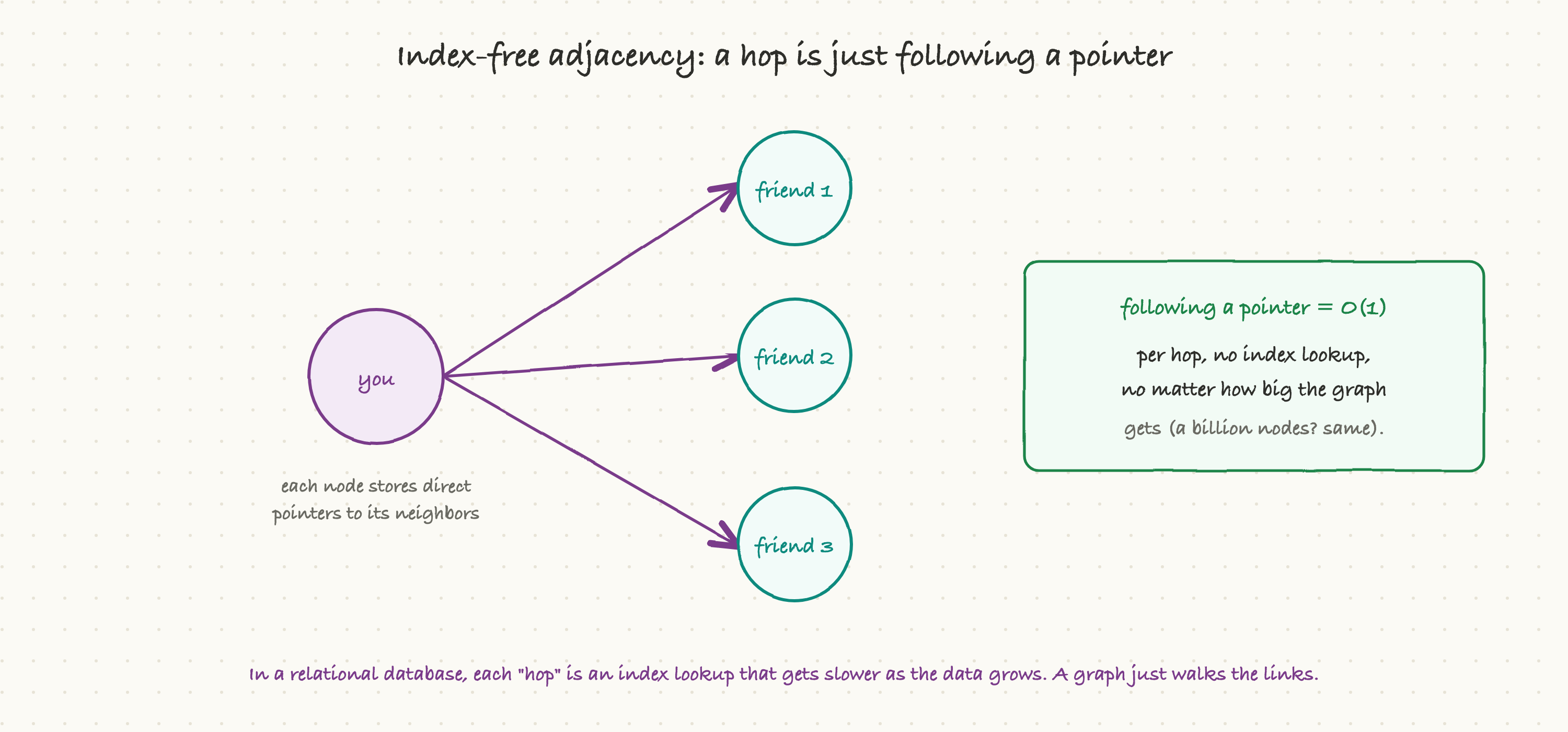
Each node physically stores direct pointers to its neighboring nodes. So traversing from one node to its neighbor is just following a pointer, an O(1) operation that takes the same tiny time whether the graph has a thousand nodes or a billion. There's no index to search on each hop, no growing table to scan. A relational database, by contrast, has to do an index lookup for every single hop, and those lookups get slower as the data grows. The graph just walks the links it already has. For deeply connected queries, this is the difference between instant and impossible.
The questions graphs were born to answer
Once relationships are first-class and traversal is cheap, a whole category of questions becomes easy that would be nightmarish elsewhere.
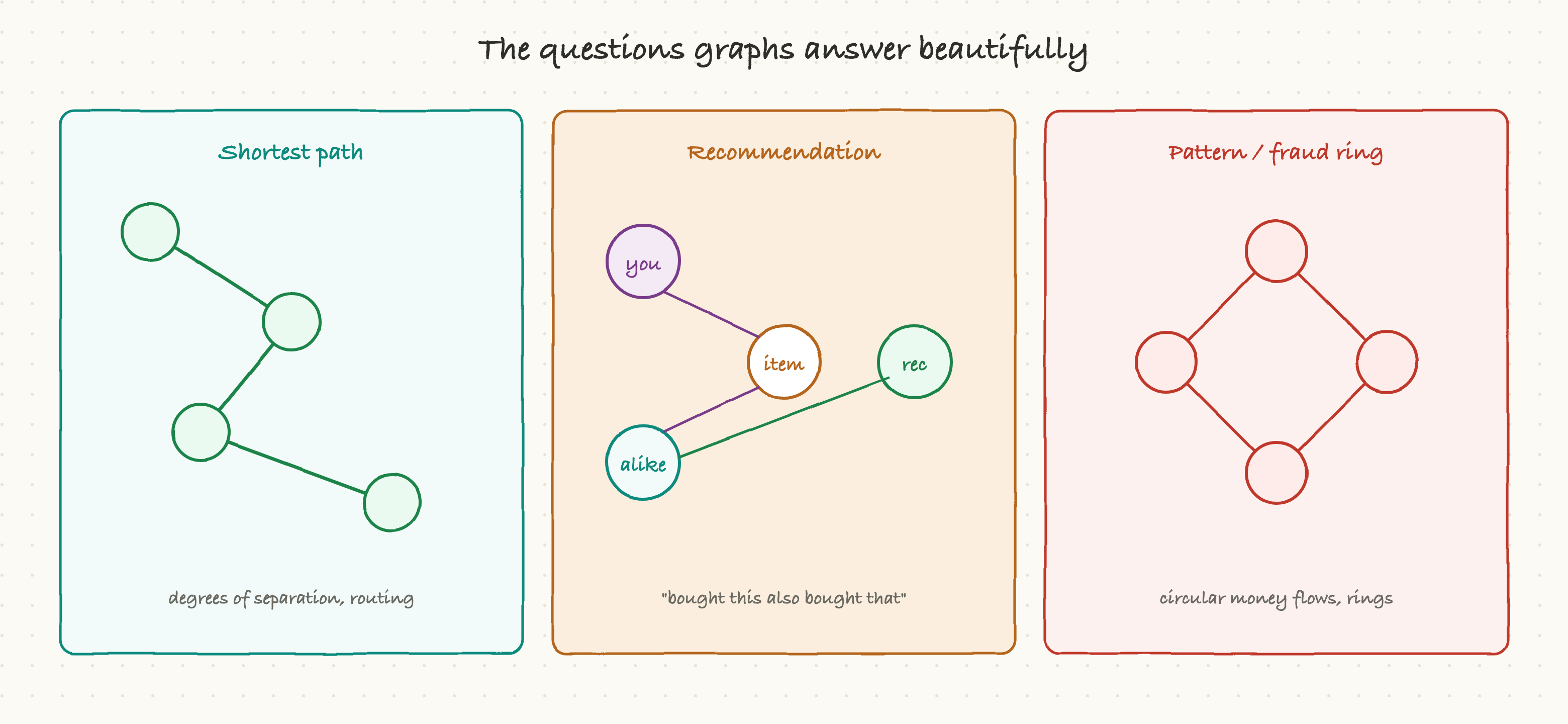
Shortest path: how are two people connected, and by the shortest chain? This is degrees-of-separation, but also routing, supply chains, and dependency analysis. Recommendations: the engine behind "people who bought this also bought that" and "people you may know."
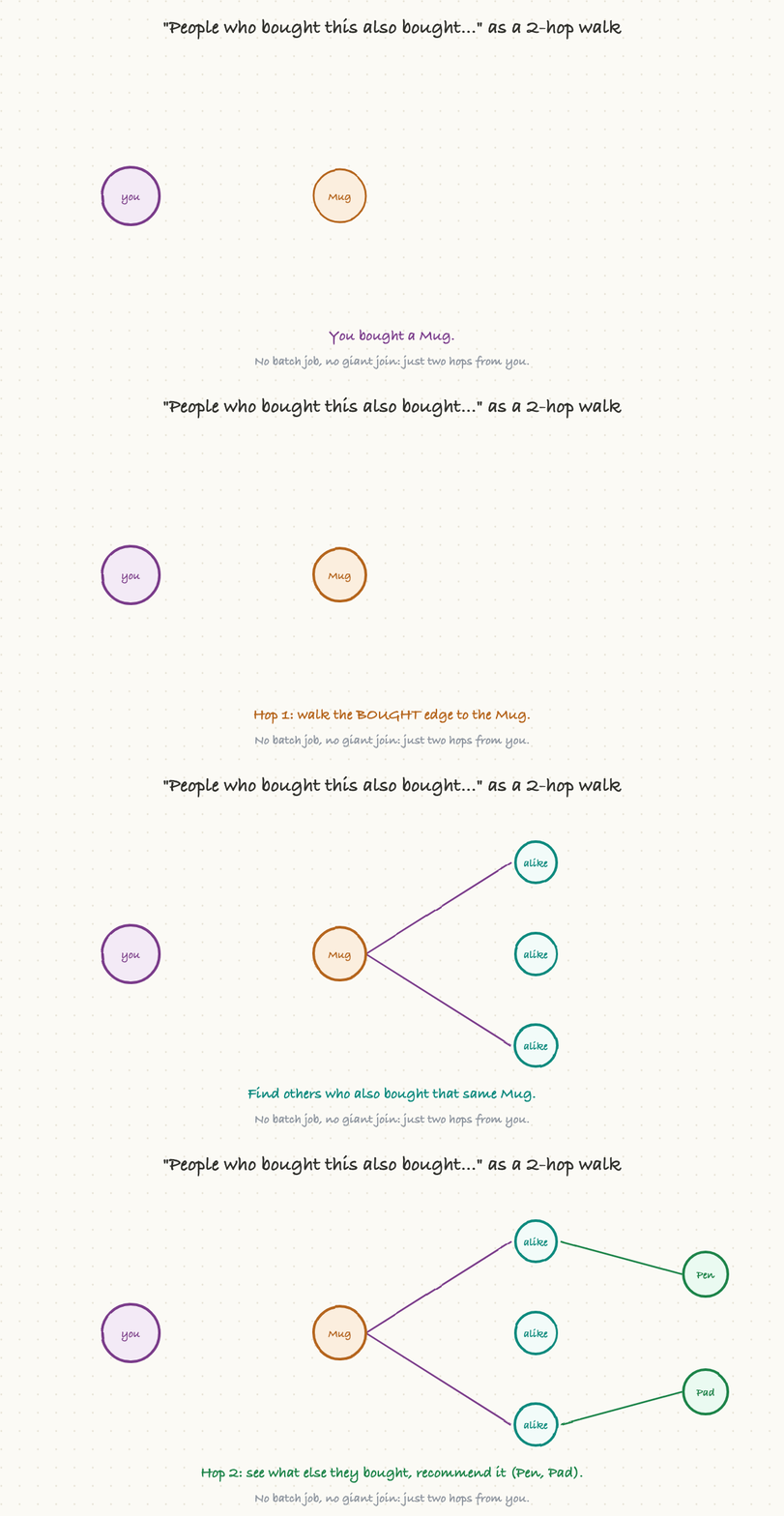
Look how naturally that recommendation falls out of the graph. You bought a Mug; hop to the Mug, hop to everyone else who bought it, and see what else those people bought. Two hops from you, and you've got a recommendation, no nightly batch job, no giant join across millions of rows, just a quick walk through the connections. Pattern matching: finding specific shapes in the data, like a ring of accounts passing money in a circle, which is exactly how fraud detection works. These shapes are almost invisible to a relational database but jump out of a graph.
Where graph databases shine
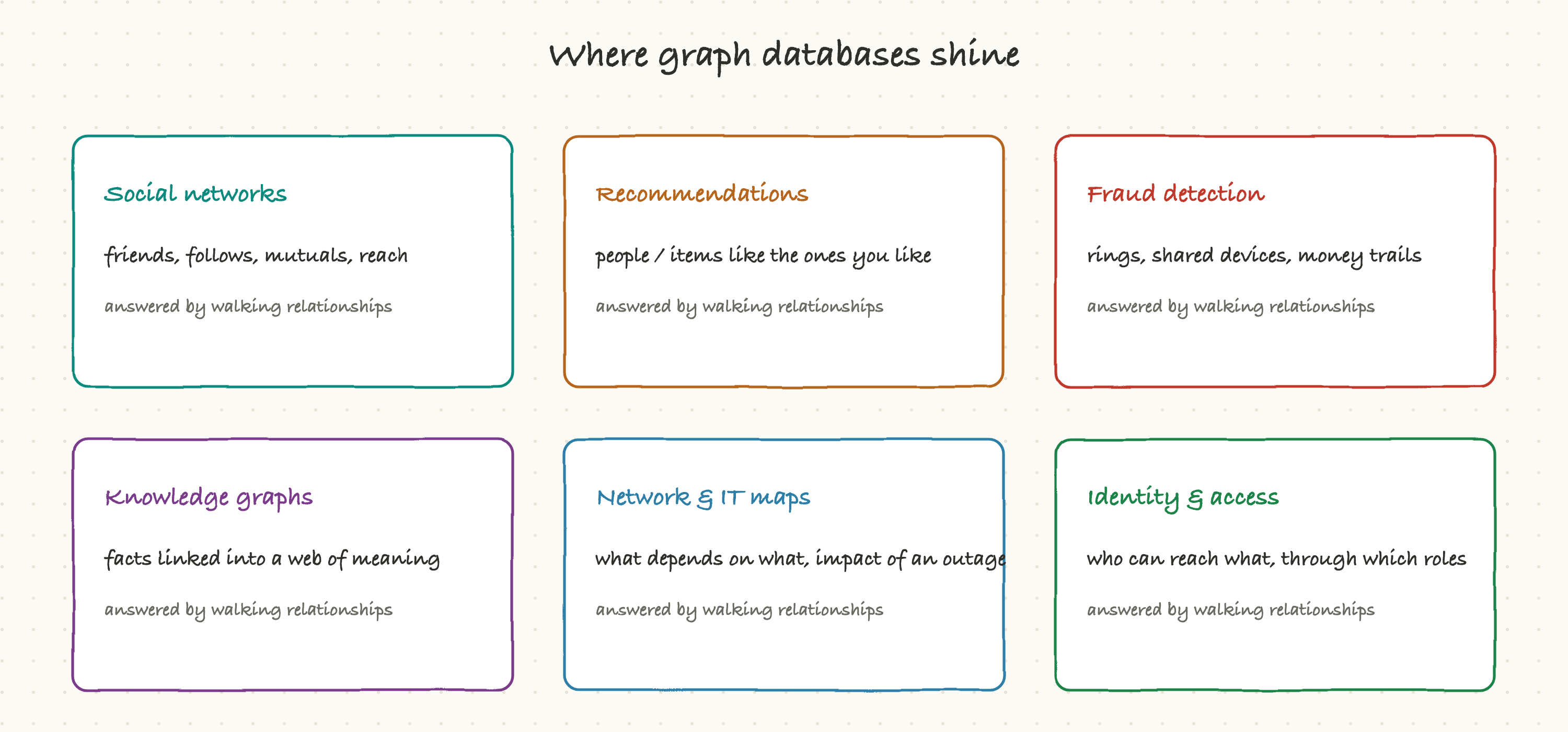
The use cases all share one trait: the value is in the connections. Social networks (friends, follows, mutual connections, reach). Recommendation engines (items and people similar to the ones you like). Fraud detection (rings, shared devices, suspicious money trails that form telltale patterns). Knowledge graphs (facts linked into a web of meaning, the kind of structure that powers smart assistants and search). Network and IT maps (what depends on what, so you can see the blast radius of an outage before it happens). Identity and access (who can reach what, through which roles and groups). In each, the killer question is about how things relate, and that's the home-field advantage of the graph.
When to reach for one, and when not
Graph databases are specialists, and using one where you don't need it adds complexity for no benefit, so the fit really matters.
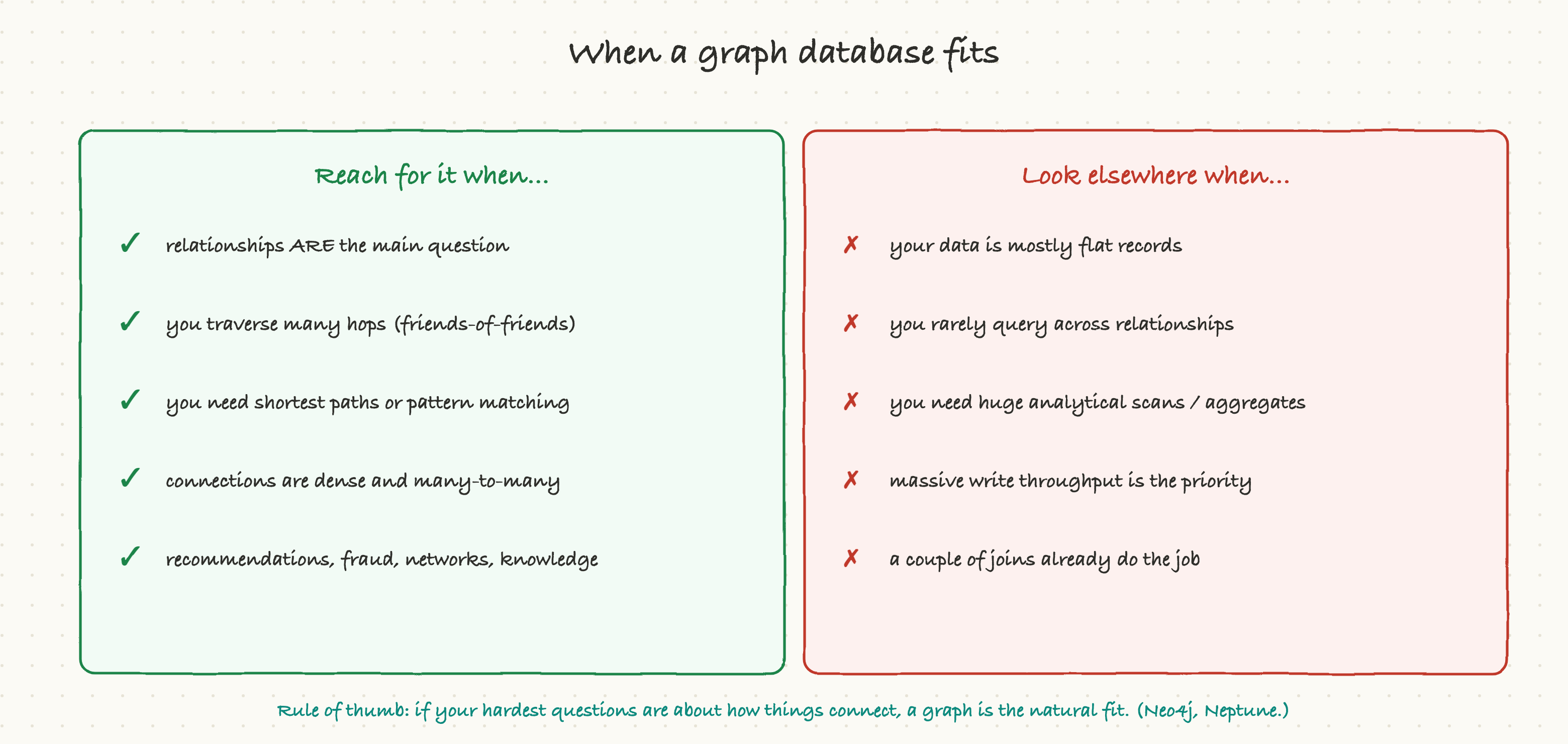
Reach for a graph database when relationships are the main event: when you traverse many hops, need shortest paths or pattern matching, and your data is densely interconnected in many-to-many ways. Social graphs, fraud, recommendations, knowledge, and network topology are the sweet spots.
Look elsewhere when your data is mostly flat records you rarely connect, when you need huge analytical scans and aggregations (a warehouse is better), or when massive write throughput is the priority (a wide-column store wins). And here's an honest caveat: if your relationship questions only go one or two hops deep, a relational database with a couple of joins handles that perfectly well. You don't need a graph database just because your data has relationships, everything does. You need one when traversing those relationships, deeply and flexibly, is the core of what your application does.
Why a TPM should care
Graph databases are less common than the other families, so when one shows up, it's usually a deliberate choice worth understanding:
- A graph database is a signal about the problem. When a team chooses one, it usually means the product's value genuinely lives in connections, social features, recommendations, fraud, knowledge. That's a useful lens on what the system is really for, and it tells you the hard problems will be about relationships, not records.
- "Can we just do this in our existing database?" is a fair first question. Because shallow relationship queries (one or two hops) work fine in a relational database, a new graph database is only justified when the traversals are genuinely deep or the patterns genuinely complex. It's reasonable to ask whether the need clears that bar before taking on another system to operate.
- Relationship-heavy features get cheaper once a graph is in place. If the team already runs a graph database, features like "people you may know," "related items," or "show me the connection between X and Y" are natural and inexpensive to add. That can shift what's feasible on a roadmap, in a good way.
- Fraud and risk teams love them for a reason. If your program touches fraud, abuse, or trust-and-safety, a graph database is often the right tool because bad actors reveal themselves through patterns of connection. Knowing the capability exists can reframe what detection is even possible.
The graph database completes the picture of why we have so many databases: because "data" includes not just things, but the relationships between them, and those relationships are sometimes the most valuable part of all. When connections are the point, a graph database lets you ask questions of them directly, at a speed and clarity nothing else offers. The next deep-dive shifts gears entirely, from these operational databases that run applications to the analytical world of data warehouses, Hadoop, and the lakehouse, where the job is not running the business but understanding it.