Key-Value Stores and Caching: The Simplest, Fastest Idea in Data

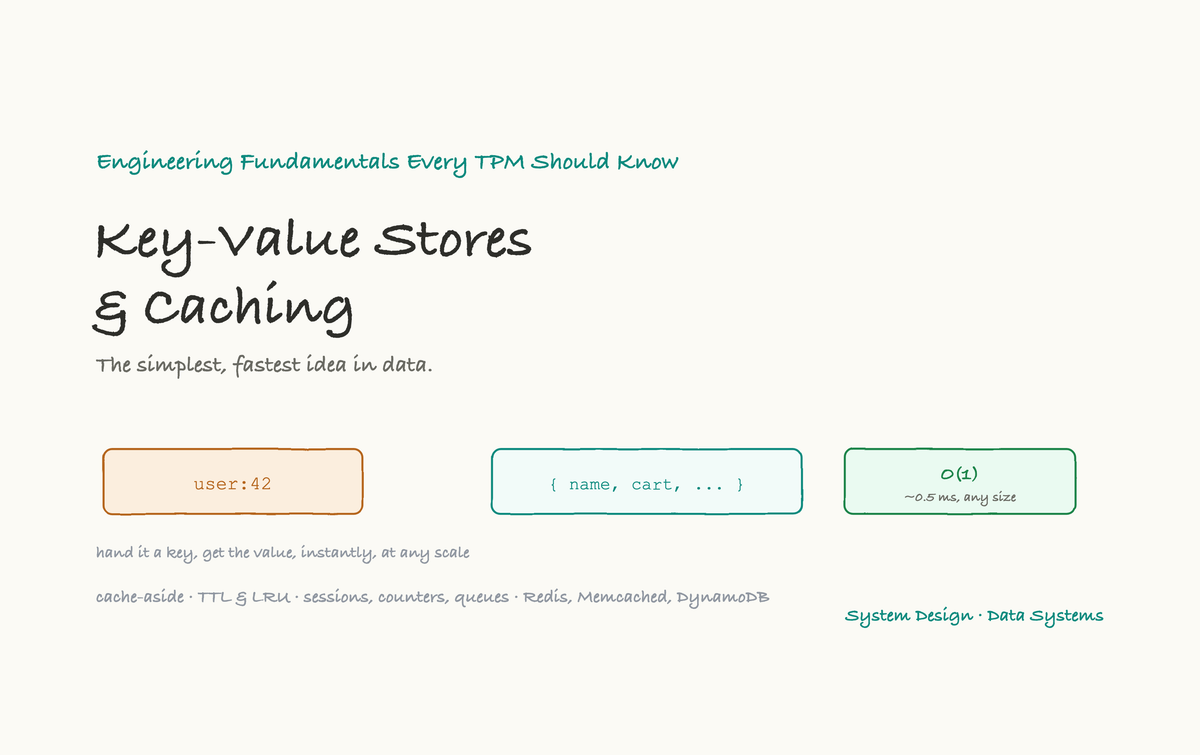
After the elaborate machinery of relational, document, and wide-column databases, the key-value store is almost a relief. It is the simplest possible database, and that simplicity is exactly where its power comes from. There is no schema to design, no query language to learn, no joins to reason about. You hand it a key, it hands you back a value. That's the whole interface.
That radical simplicity buys radical speed, and speed is why key-value stores are everywhere, usually invisibly, holding up the fast parts of systems you use every day. This deep-dive, following the evolution overview, covers both the key-value family itself and its single most important job: caching. If you've read the caching article in the broader system design series, this goes deeper on the store that makes caching work. Redis, Memcached, and DynamoDB are the names to know.
The model: a giant dictionary
A key-value store is, conceptually, one enormous dictionary (or "hash map," if you've seen the term). You store a value under a key, and later you retrieve it by that exact key. That's it.
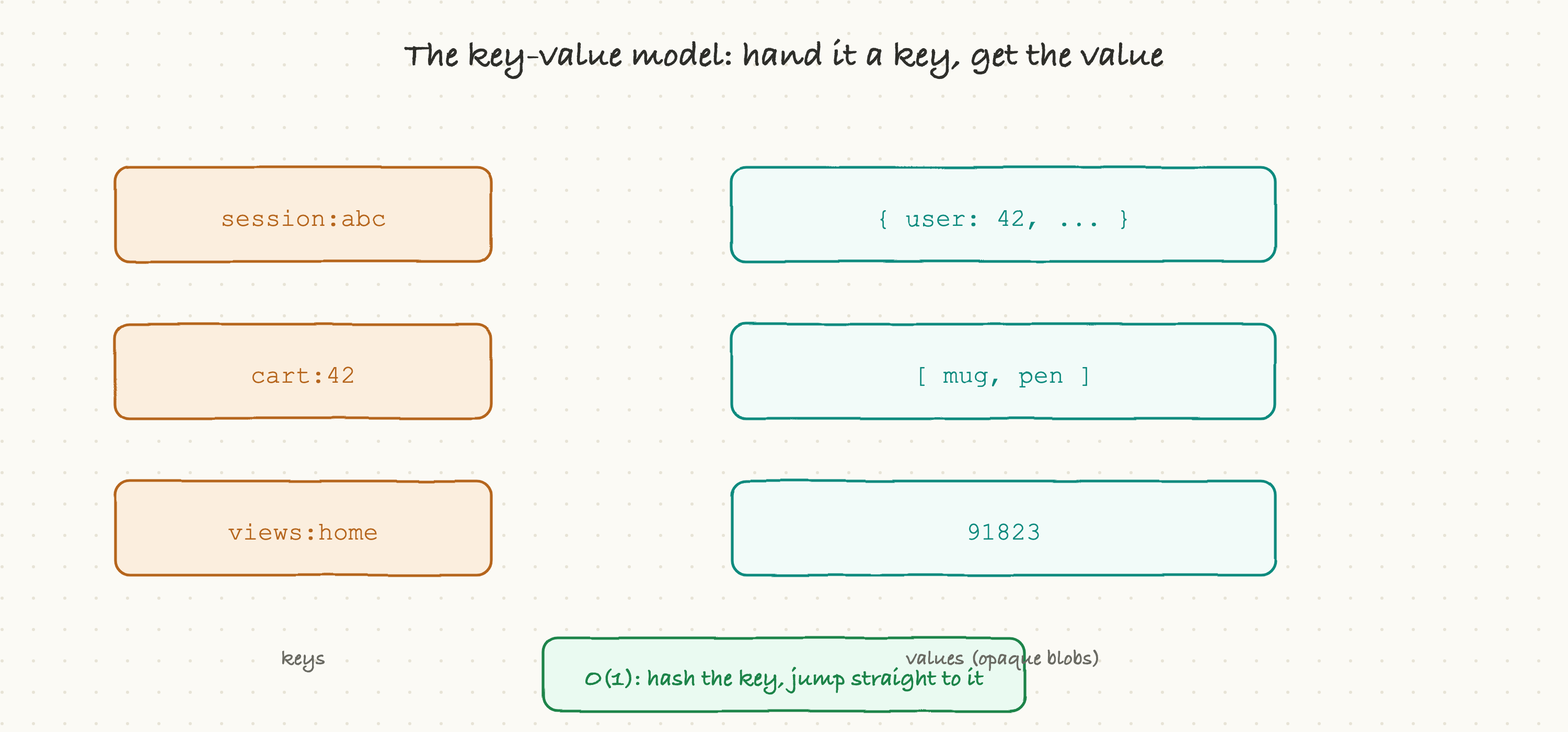
The keys are strings you choose, often structured like session:abc123 or cart:42 or views:homepage. The values can be anything: a chunk of text, a number, a serialized object, a whole blob of JSON. Crucially, to the store, the value is usually opaque, just bytes it hands back. The store does not look inside the value, cannot filter on it, and cannot search it. You can only get a value if you know its exact key.
That limitation is the whole trade. By giving up the ability to query the contents, the store gains the ability to find any value almost instantly. Because keys go through a hash function that points straight to where the value lives, a lookup is what engineers call an O(1) operation: it takes the same tiny amount of time whether the store holds a thousand items or a billion. No scanning, no index traversal, just a direct jump. That constant, predictable speed at any scale is the key-value store's superpower.
Two homes: in-memory speed vs. durable scale
Key-value stores come in two broad flavors, and the difference matters a lot in practice.
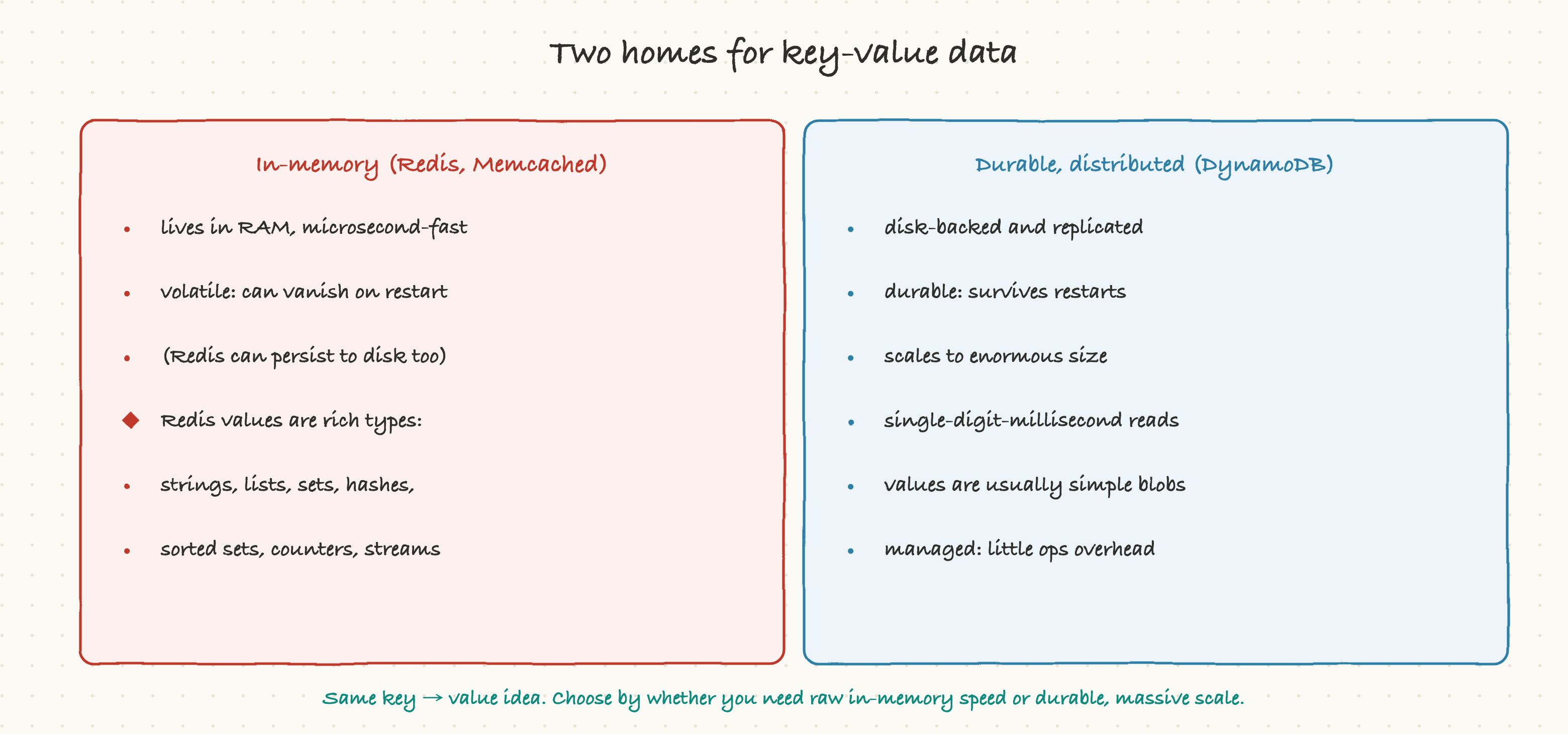
The first flavor lives in memory (RAM). Redis and Memcached are the classic examples. Because RAM is thousands of times faster than disk, these stores answer in microseconds, which is about as fast as data access gets. The catch is that memory is volatile: if the server restarts, the data can vanish (Redis can optionally persist to disk to soften this, but speed is the point). Redis adds a twist that makes it especially loved: its values aren't just blobs, they can be rich data structures, lists, sets, hashes, counters, and sorted sets, with operations built in, which is why it's used for far more than plain caching.
The second flavor is durable and distributed. DynamoDB is the prime example. These are disk-backed and replicated, so data survives restarts and scales to enormous sizes across many machines, while still answering in single-digit milliseconds. They're slower than pure in-memory stores but far more durable and scalable, and they're typically fully managed, so there's little to operate.
It's the same key-to-value idea either way. You choose based on whether you need the raw speed of memory or the durability and scale of a distributed store. Many systems use both: a durable store as the system of record, with an in-memory store in front of it as a cache. Which brings us to the main event.
Caching: the killer use case
The single most common reason teams reach for an in-memory key-value store is caching: keeping a copy of expensive-to-fetch data somewhere blazing fast, so you don't have to do the expensive work over and over. And the standard way to wire it up is a pattern called cache-aside (or look-aside).
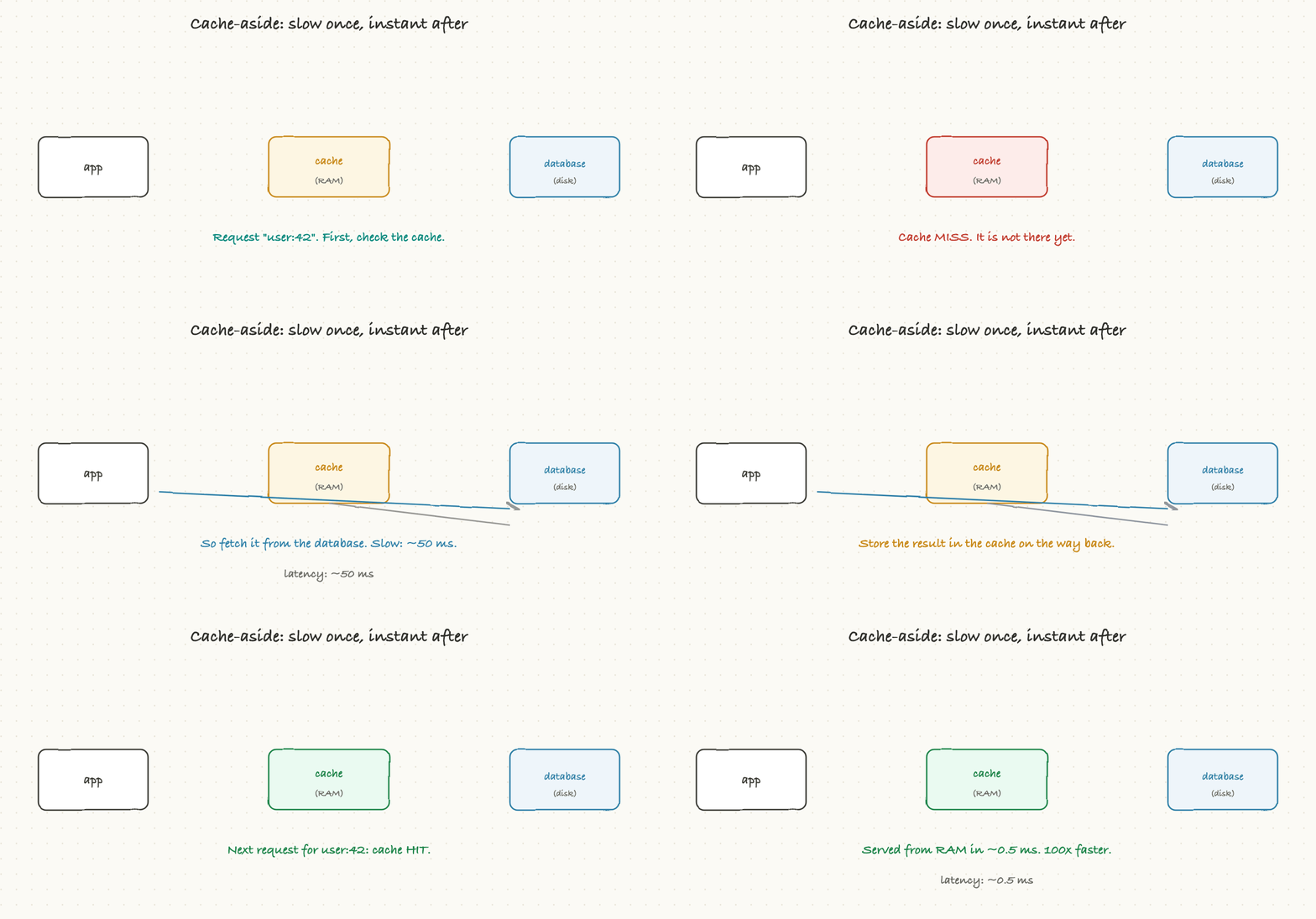
Follow the flow. A request comes in for some data, say a user's profile. The application first checks the cache. The first time, the data isn't there, a cache miss, so the app falls back to the real database, which is slow (perhaps 50 milliseconds), gets the answer, and, on its way back, stores a copy in the cache. The next time anyone asks for that same user, it's a cache hit: the data comes straight from memory in well under a millisecond, perhaps a hundred times faster, and the database is never touched.
This is one of the highest-leverage tricks in all of system design. Most applications read the same popular data over and over (the same trending posts, the same product pages, the same user profiles). A cache means you do the expensive work once and serve the cheap copy thousands of times. It dramatically speeds up responses and takes enormous load off the database, often turning a struggling system into a comfortable one for a fraction of the cost of scaling the database itself.
Keeping a cache honest: eviction and TTL
A cache is deliberately small and fast, which means it can't hold everything. So every cache needs rules for what to keep and what to throw away. Two mechanisms do this work, and understanding them explains most cache behavior.
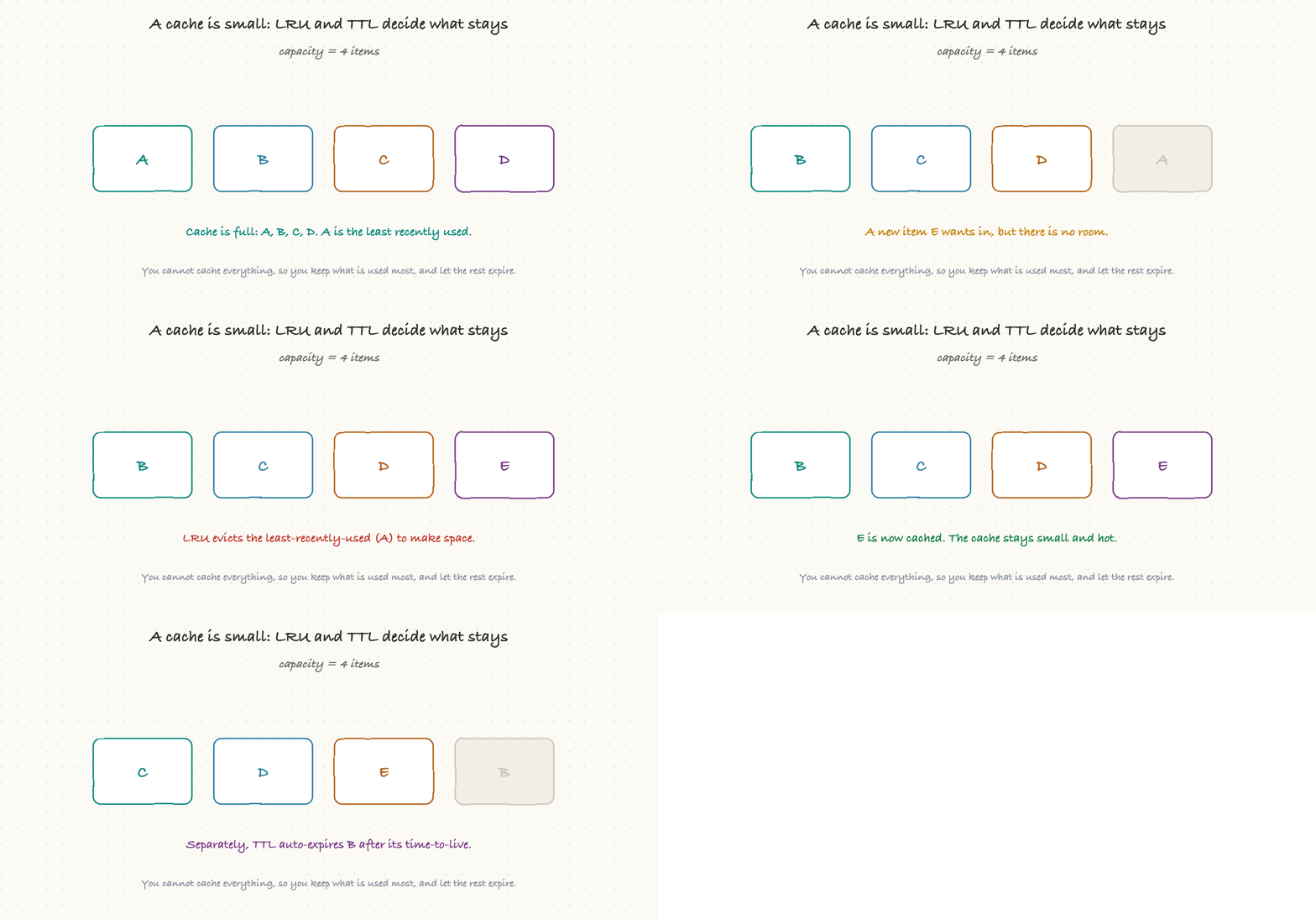
The first is eviction, and the most common policy is LRU, least recently used. When the cache is full and a new item needs space, it discards the item that hasn't been touched in the longest time, on the bet that recently used data is most likely to be used again. This keeps the cache naturally full of "hot" data and quietly drops the cold stuff.
The second is TTL, time to live. You can stamp each cached entry with an expiry, after which it's automatically removed. TTL is your main defense against the cache serving stale data. If a cached product price could be up to five minutes out of date, you give it a five-minute TTL, and after that the cache forgets it and the next request refetches the current value. Choosing TTLs is a real balancing act: longer TTLs mean better performance but staler data; shorter TTLs mean fresher data but more trips to the database.
This points at the deepest truth about caching, the one every engineer eventually quotes: there are only two hard problems in computer science, and one of them is cache invalidation. A cache is a copy, and the moment the original changes, your copy is potentially wrong. Deciding when to refresh or discard cached data, without either serving stale results or refreshing so aggressively that the cache stops helping, is genuinely hard, and it's the source of a large share of subtle bugs.
Writing through the cache: three strategies
Reading through a cache is straightforward. Writing is where teams make a choice with real consequences, because now you have the same data in two places, the cache and the database, and you have to keep them in step.
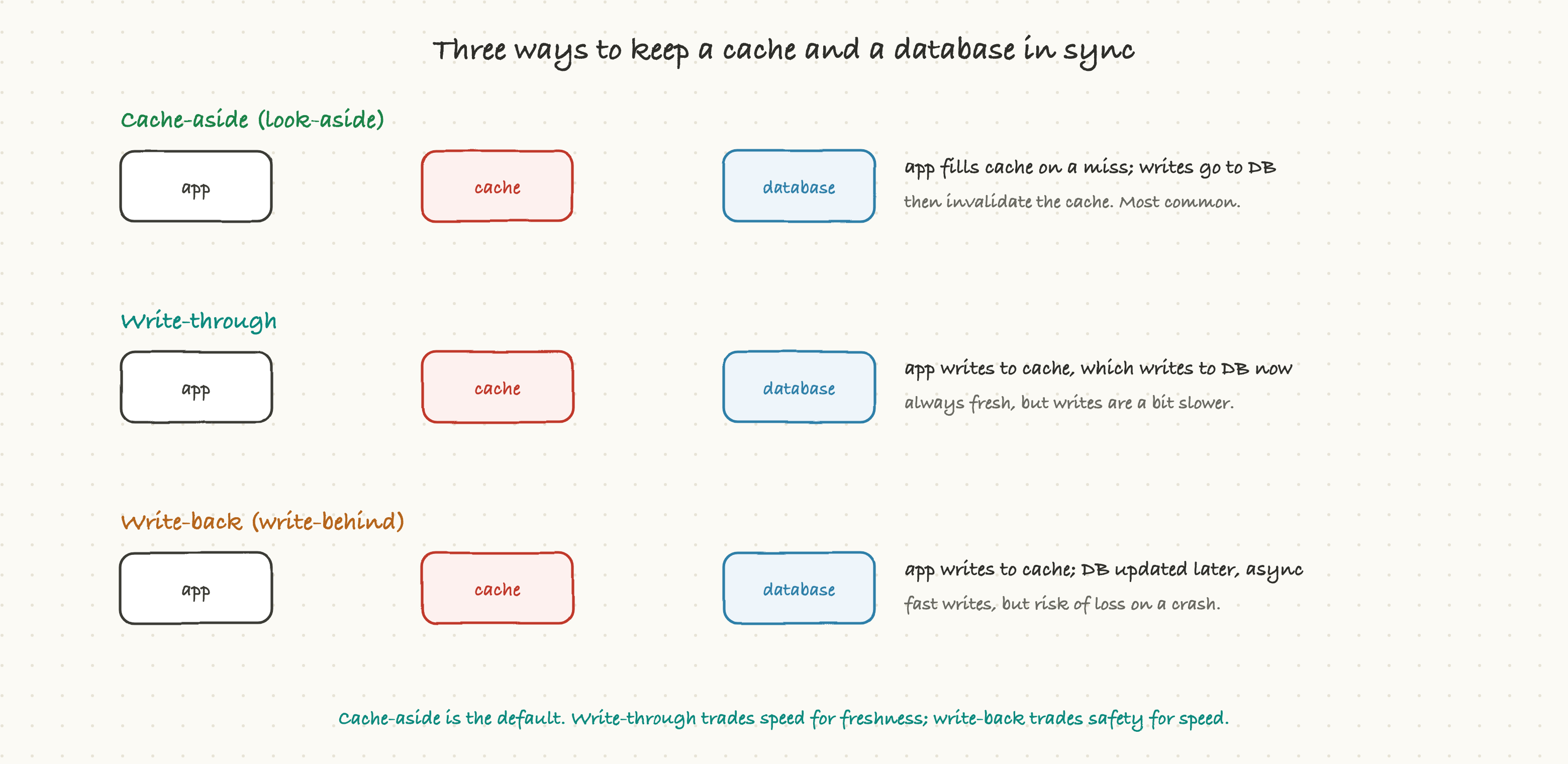
Cache-aside is the default: writes go straight to the database, and the cached copy is simply invalidated (deleted) so the next read refetches fresh. Simple and safe. Write-through sends the write to the cache, which immediately writes it on to the database too; the cache is always fresh, at the cost of slightly slower writes. Write-back (write-behind) writes only to the cache and updates the database later, asynchronously; writes are extremely fast, but if the cache crashes before it flushes, you can lose data. The right choice depends on how much you value write speed versus freshness versus safety, and most teams sensibly start with cache-aside.
Far more than caching
Because an in-memory key-value store is so fast and (in Redis's case) comes with rich data structures, it ends up doing many jobs beyond caching, and recognizing them helps you spot one in an architecture.
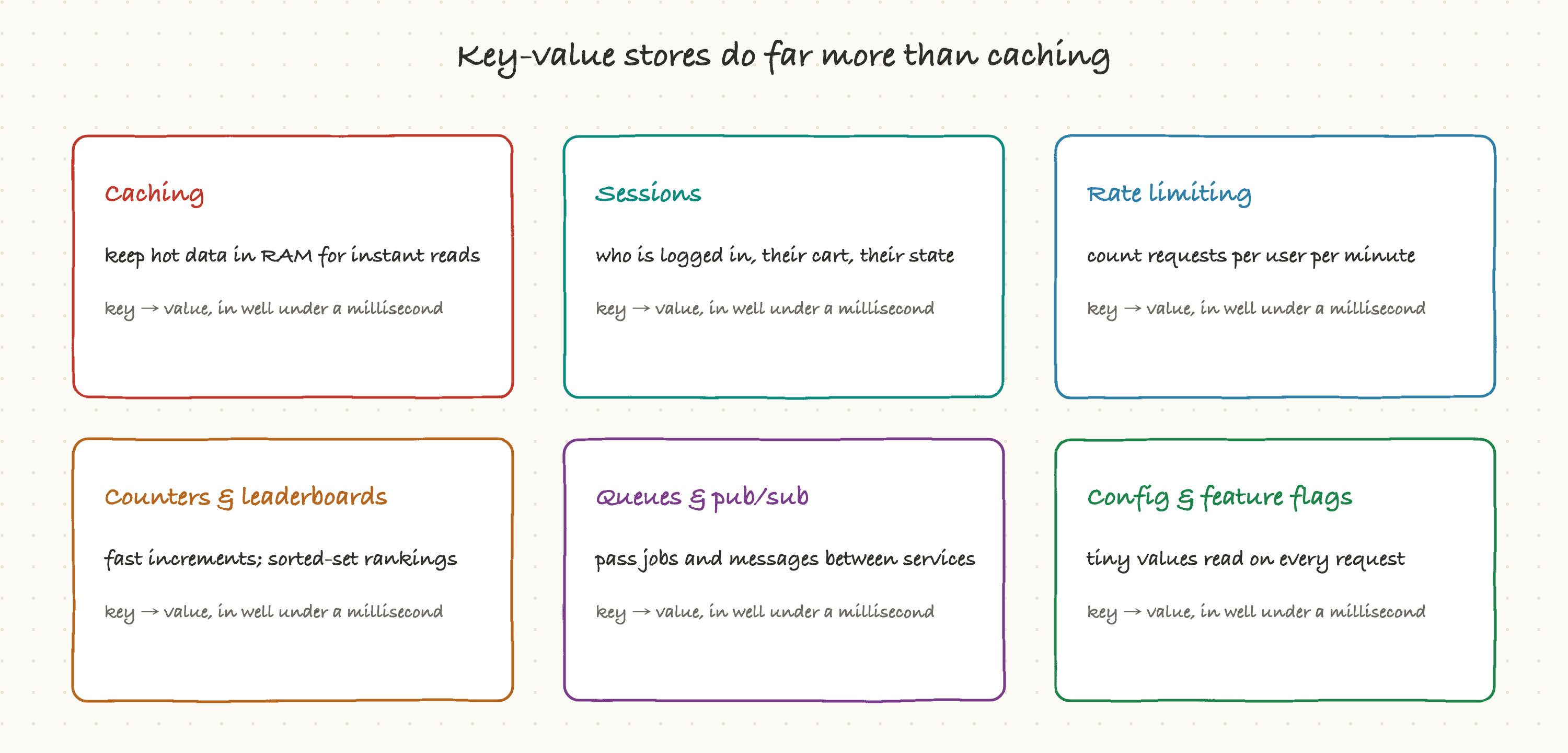
The same store often holds user sessions (who's logged in and their current state), powers rate limiting (counting requests per user per minute), drives counters and leaderboards (fast increments, and sorted sets that keep rankings in order automatically), acts as a lightweight queue or pub/sub system passing jobs and messages between services, and stores configuration and feature flags that need to be read on virtually every request. All of these share the same profile: tiny pieces of data, accessed by a known key, needed extremely fast. That's the key-value sweet spot, and it shows up all over a modern system.
When it fits, and when it doesn't
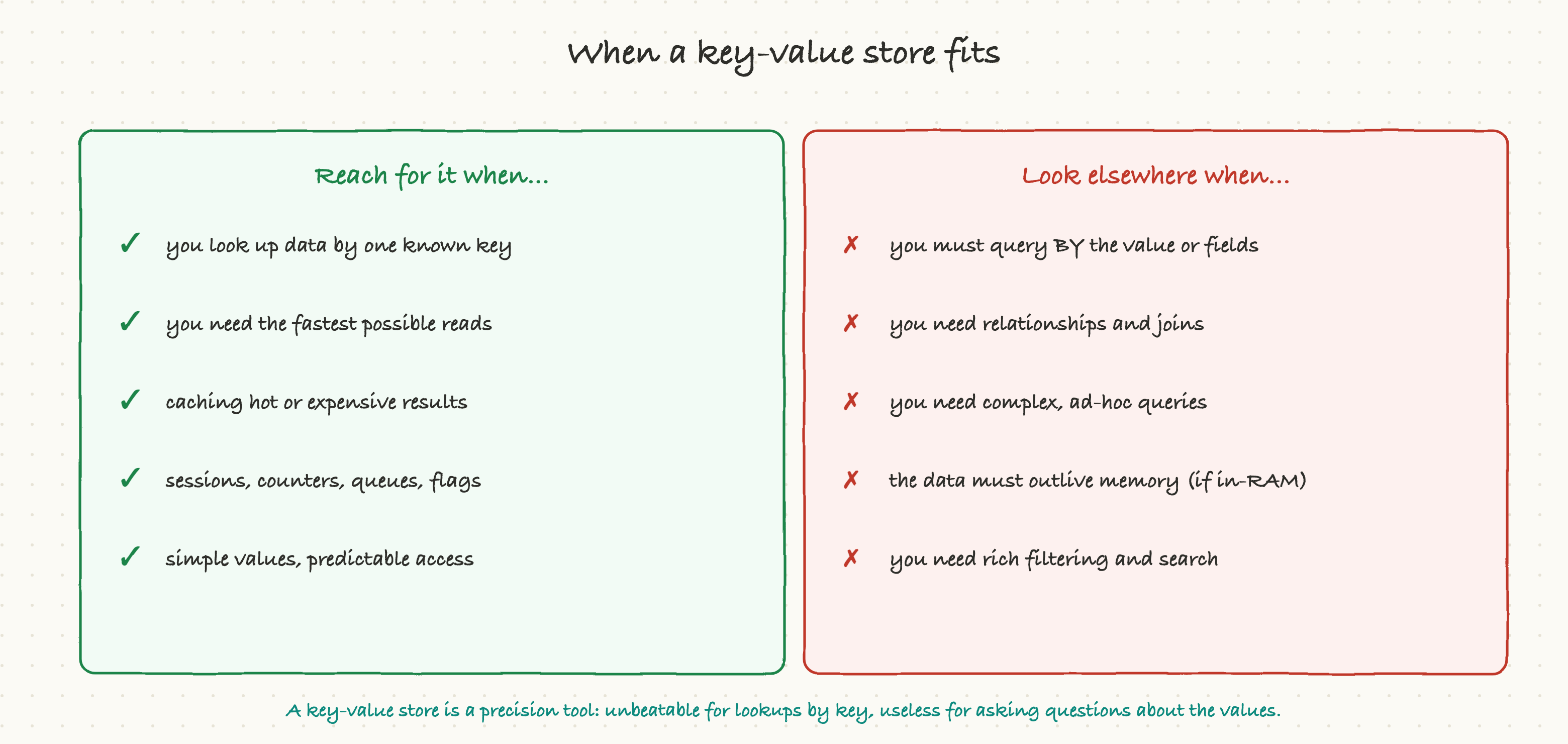
Reach for a key-value store when you look data up by a single known key, when you need the fastest reads possible, for caching, and for sessions, counters, queues, and flags. It is unbeatable at these, and reaching for one is often the simplest, cheapest way to make a slow system fast.
Look elsewhere the moment you need to query by the value rather than the key, "find all users in Texas" is impossible if users are stored as opaque blobs under their id. Key-value stores can't do relationships, joins, complex filtering, or search, because they refuse to look inside the value. And if you're using a purely in-memory store, remember that data which must survive a restart needs a durable home too. The skill is using a key-value store for what it's brilliant at, fast lookups by key, and not asking it to be a database it was never meant to be.
Why a TPM should care
Caching and key-value stores show up constantly in the systems you'll oversee, and they come with a few predictable themes worth recognizing:
- A cache is often the cheapest big win available. When a system is slow or the database is straining, adding a cache in front of hot data is frequently a faster, cheaper fix than scaling the database. If performance is a problem and no one has mentioned caching, it's a fair thing to ask about.
- Cache invalidation is a real source of bugs, so treat staleness as a design decision. "Why is this user seeing old data?" very often traces to a cache serving a stale copy. The fix is usually a TTL or invalidation-strategy decision, and it's worth making that decision deliberately rather than discovering it through a confused customer.
- A cache changes your failure modes. Teams sometimes lean on a cache so heavily that the database can no longer handle full traffic on its own. Then if the cache goes down, the database is instantly overwhelmed, a "thundering herd." Knowing whether the system can survive its cache failing is a fair resilience question to raise.
- In-memory means it can disappear. If important state (like sessions) lives only in an in-memory store with no durable backing, a restart can log everyone out or lose data. Knowing what is and isn't durable helps you understand the blast radius of a cache failure.
The key-value store proves that sometimes the simplest idea is the most powerful. By doing one thing, look up a value by its key, and doing it faster than anything else, it became one of the most-used tools in all of software, the quiet speed layer underneath much of the modern web. The next deep-dive turns to the opposite kind of simplicity, the graph database, which is all about the connections between things.