Messaging, Streaming and Search

How systems talk without waiting, and how they find things fast
So far, most of the talking between parts of a system has been a direct call: one service asks another and waits for the answer. That works, but it has a weakness. The caller is stuck until the answer comes back, and if the other side is slow or down, the caller is in trouble too. At any real scale, systems need a way to communicate that does not require everyone to wait on everyone else. That is what messaging is for. And once data is flowing between systems, two more questions appear: how do you process a never-ending stream of it, and how do you search through mountains of it quickly? This article covers all three.
You will not build a message broker. But "we should make that async," "we need a queue," and "search is slow" are everyday conversations, and understanding the shapes here lets you tell a quick fix from a real project.
Two ways for services to talk: synchronous and asynchronous
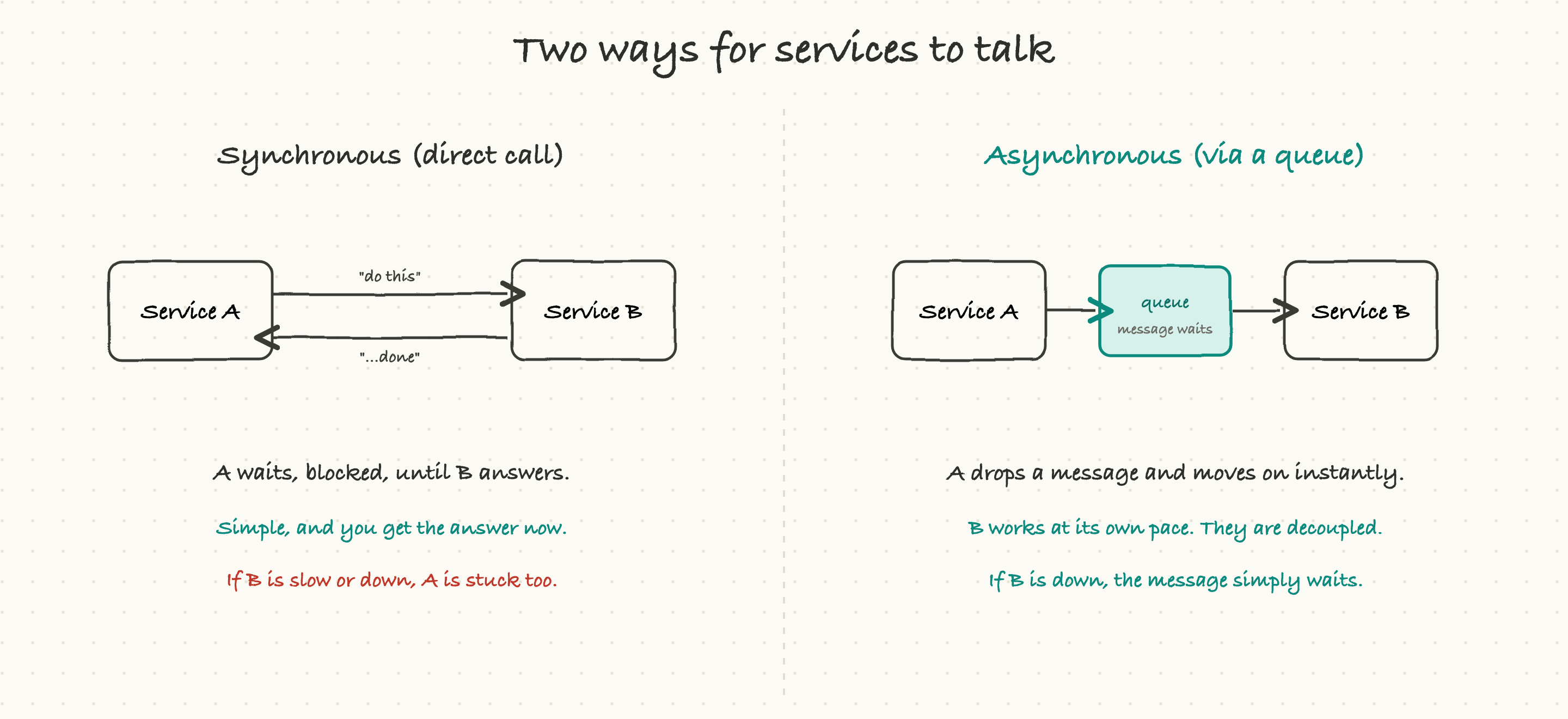
The first and most important distinction is synchronous versus asynchronous.
A synchronous call is the direct one: Service A calls Service B and waits, blocked, until B replies. It is simple and you get the answer immediately, which is exactly what you want when you need the result to continue, like checking a price before showing a page. The downside is coupling: A is only as fast and as available as B. If B slows down, A slows down. If B is down, A fails.
An asynchronous message is fire-and-continue: Service A drops a message into a queue and immediately moves on with its own work, and Service B picks the message up whenever it is ready. A does not wait, and the two are now decoupled. If B is down, the message simply sits in the queue until B comes back and processes it. The cost is that A does not get an immediate answer, so you only use this when you do not need one right away, like sending a confirmation email after an order. The order can succeed instantly; the email can be sent a moment later.
The rule of thumb: if you need the answer now to continue, call synchronously; if you are just handing off work to be done eventually, send a message.
The message queue: a buffer between services
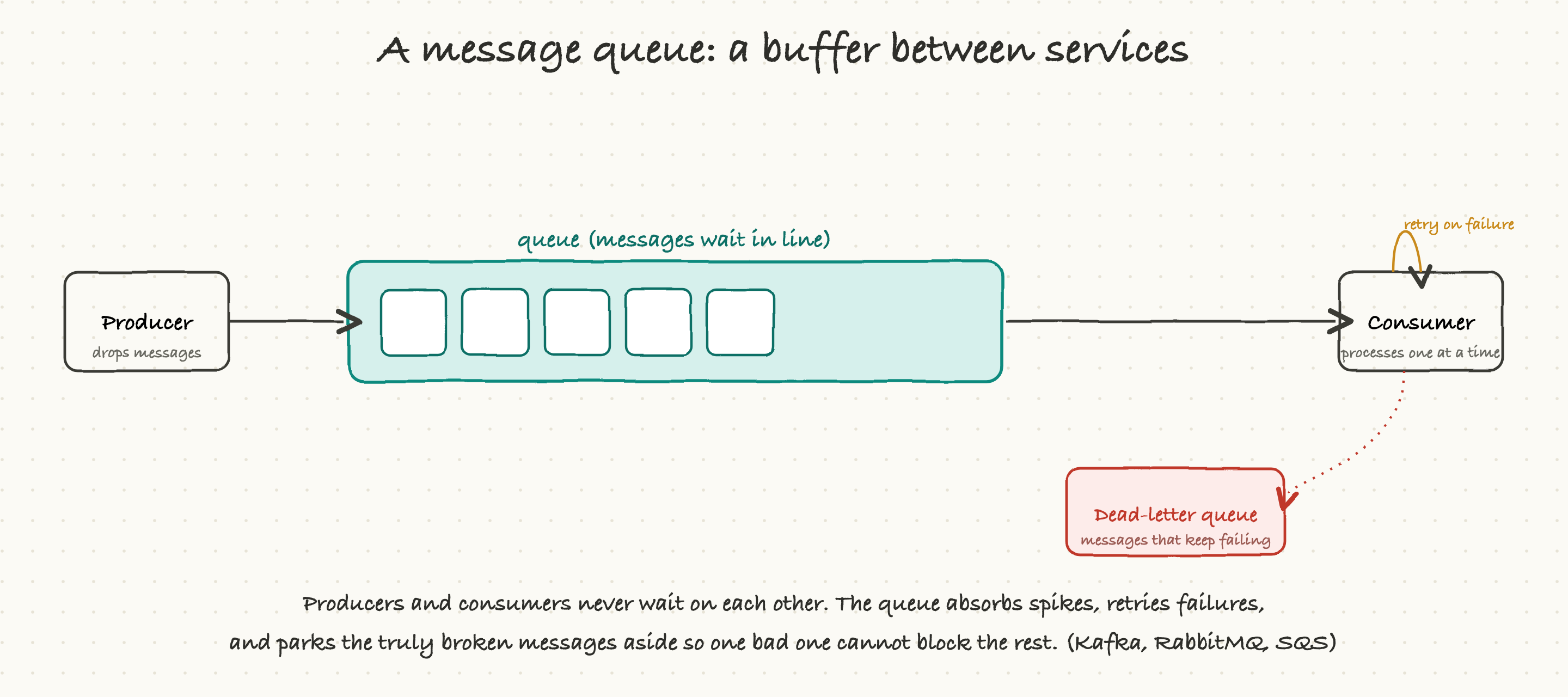
The workhorse of asynchronous communication is the message queue. A producer puts messages in, they wait in line, and a consumer takes them out and processes them one at a time. Simple as it sounds, this little buffer solves several hard problems at once.
It decouples speed. The producer and consumer no longer have to run at the same pace; the queue absorbs the difference.
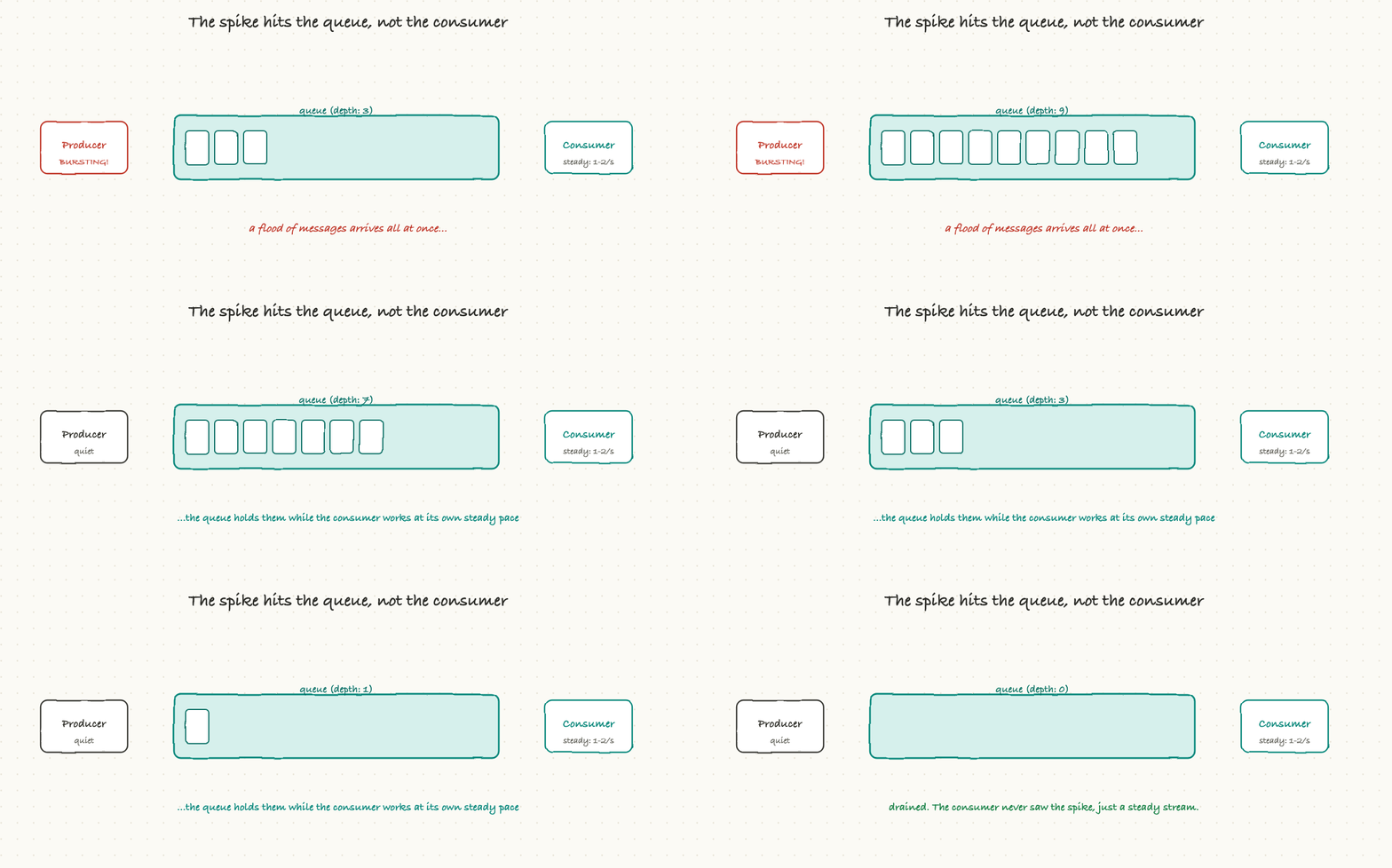
This is one of its best tricks: smoothing out spikes. If a sudden flood of work arrives, it piles up in the queue, and the consumer keeps chewing through it at its own steady rate instead of being overwhelmed. The spike hits the queue, not the service behind it.
It also handles failure gracefully. If processing a message fails, the queue can retry it. And if a particular message keeps failing no matter what (it is malformed, or triggers a bug), it gets moved aside into a dead-letter queue, a holding pen for broken messages, so that one poison message cannot block the whole line behind it. The common tools you will hear are Kafka, RabbitMQ, and SQS. When a team says "let's put a queue in front of that," these decoupling, buffering, and retry benefits are what they are reaching for.
One taker or everyone: queues versus pub/sub
There are two fundamentally different delivery patterns, and mixing them up causes real confusion.
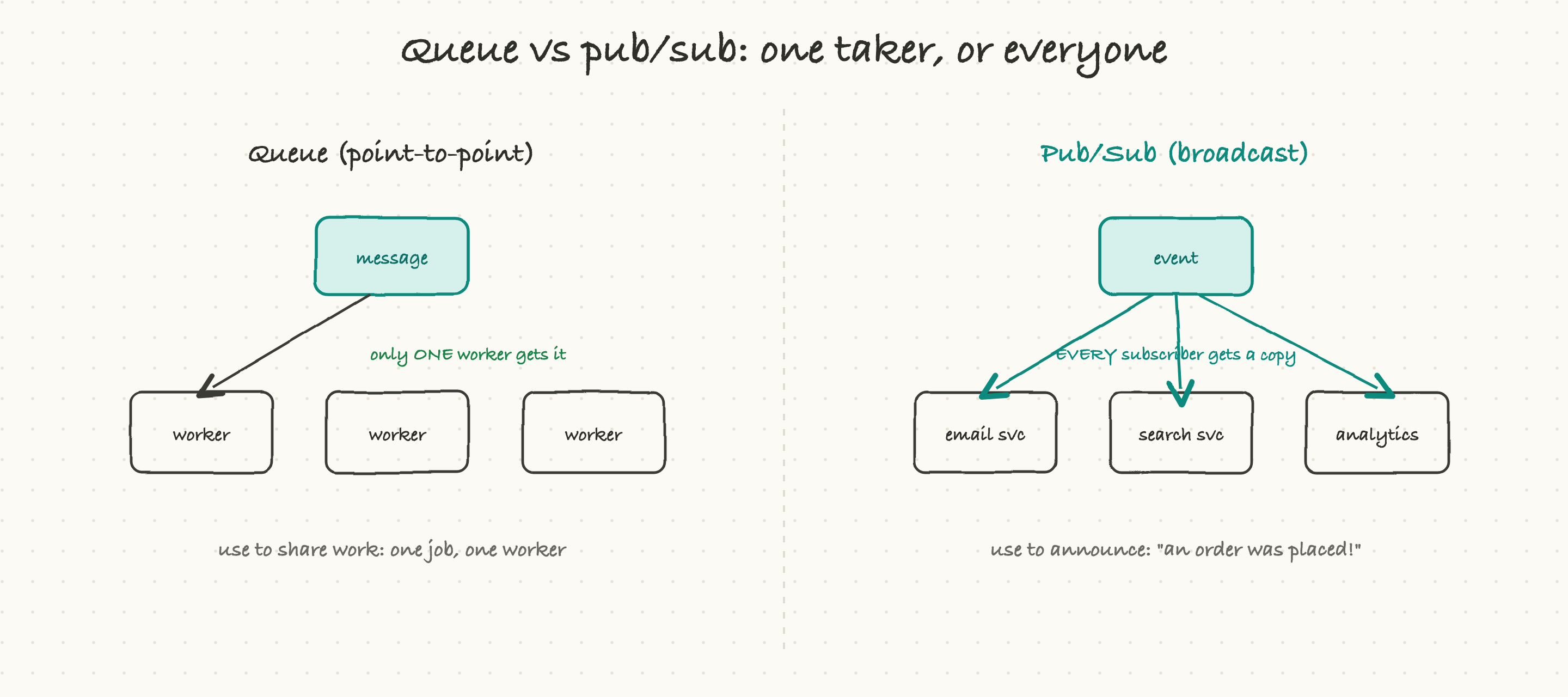
A plain queue is point-to-point: each message is taken by exactly one consumer. If you have three workers pulling from a queue, each message goes to just one of them. This is how you share out work, three workers get through the pile three times faster, and each job is done once.
Publish/subscribe (pub/sub) is broadcast: each event is delivered to every subscriber. You publish one event, say "an order was placed," to a topic, and every service that subscribed gets its own copy. The email service sends a receipt, the search service indexes the order, the analytics service logs the sale, all from the same single event.
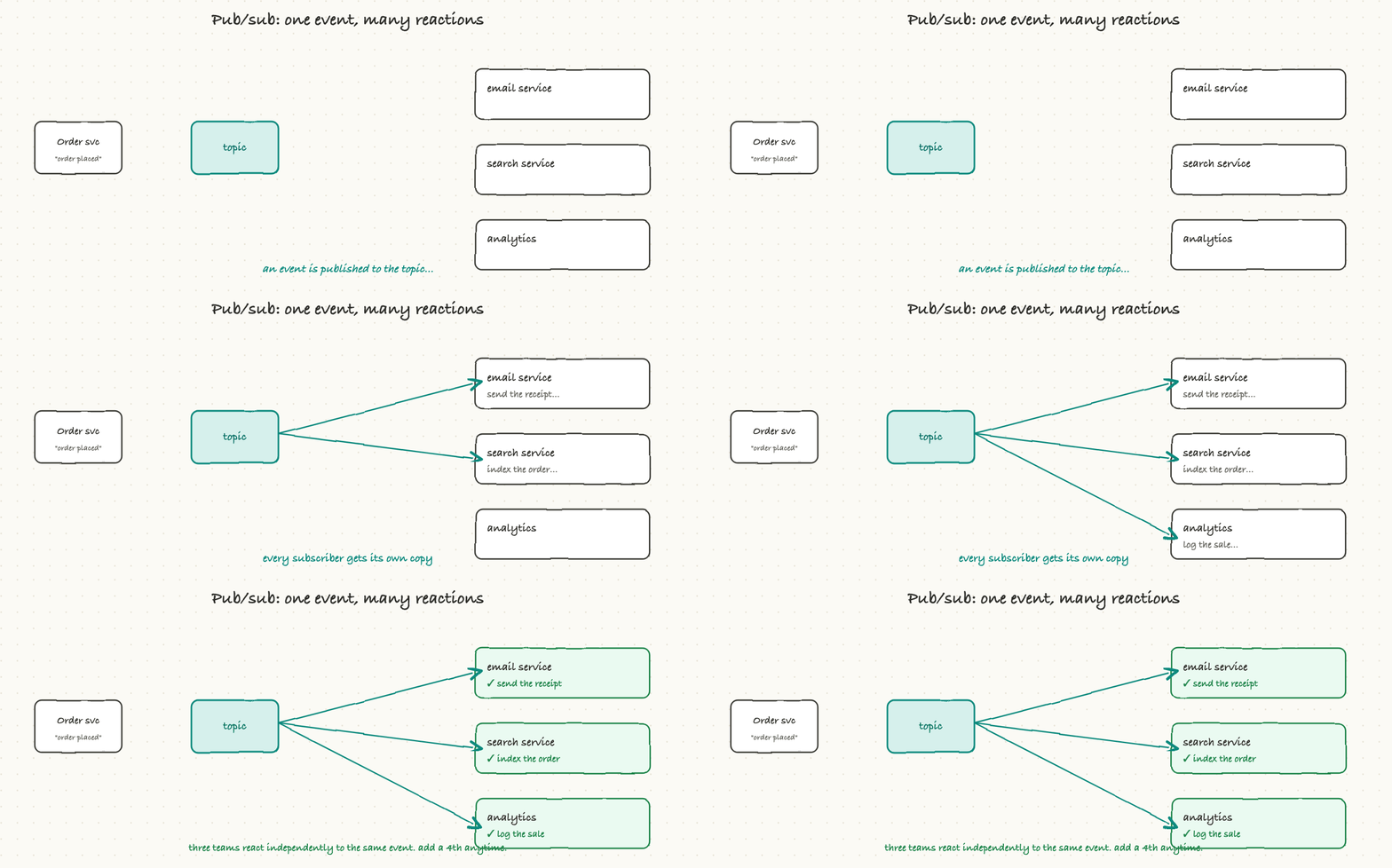
This is the foundation of event-driven architecture, and its great virtue is that the publisher does not know or care who is listening. To add a new reaction to an order, you just add a new subscriber, the order service never changes. That decoupling is why large systems lean on events: teams can build and change their piece independently, as long as they agree on the events. The mental test is simple: do you want one worker to handle this (a queue) or every interested party to know about it (pub/sub)?
Processing the flow: batch versus stream
Once data is flowing, there are two ways to process it, and the difference is timing.
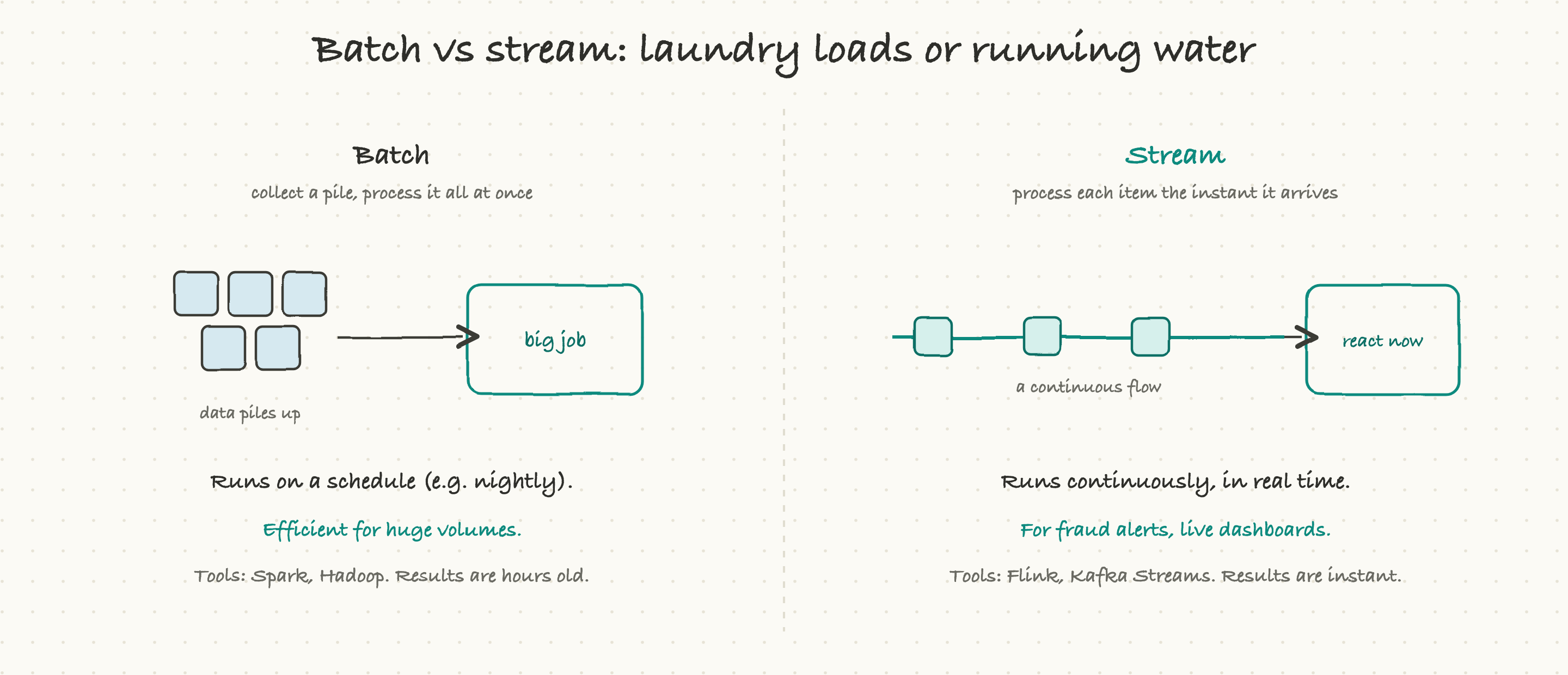
Batch processing collects data into a pile and processes it all at once, on a schedule. Think of a nightly job that crunches the whole day's data. It is wonderfully efficient for huge volumes, but the results are always a little old, you find out about today's numbers tomorrow. The classic tools are Spark and Hadoop. Batch is laundry: you wait for a full load, then wash it all together.
Stream processing handles each item the instant it arrives, continuously, in real time. This is what you need for fraud detection (catch it as it happens, not tomorrow), live dashboards, and instant alerts. The tools here are Flink and Kafka Streams. Streaming is the tap: water runs the moment you open it.
Neither is better; they answer different questions. "What were our total sales yesterday?" is a fine batch question. "Is this transaction happening right now fraudulent?" demands a stream. Many systems run both, a fast stream for real-time reactions and a nightly batch for thorough, heavy analysis.
Delivery guarantees: the fine print that matters
One detail under all of this is worth knowing because it causes subtle, expensive bugs: how hard does the system try to deliver each message, and what happens on a hiccup?
Most queues offer at-least-once delivery: they guarantee a message is delivered, but in rare failure cases it might be delivered twice. That sounds harmless until the message is "charge this card." This is exactly why idempotency (from the API article) matters so much: if a message might arrive twice, the action it triggers must be safe to repeat. Exactly-once delivery, where a message is processed once and only once, is possible but much harder and slower, so most systems choose at-least-once plus idempotent handlers. A related question is ordering: do messages have to be processed in the exact order they were sent? Sometimes it matters (bank transactions), sometimes it does not (independent emails), and guaranteeing order costs performance. When a team discusses "at-least-once" or "ordering guarantees," this is the territory, and the right answer depends entirely on what the messages do.
Finding things: search and the inverted index
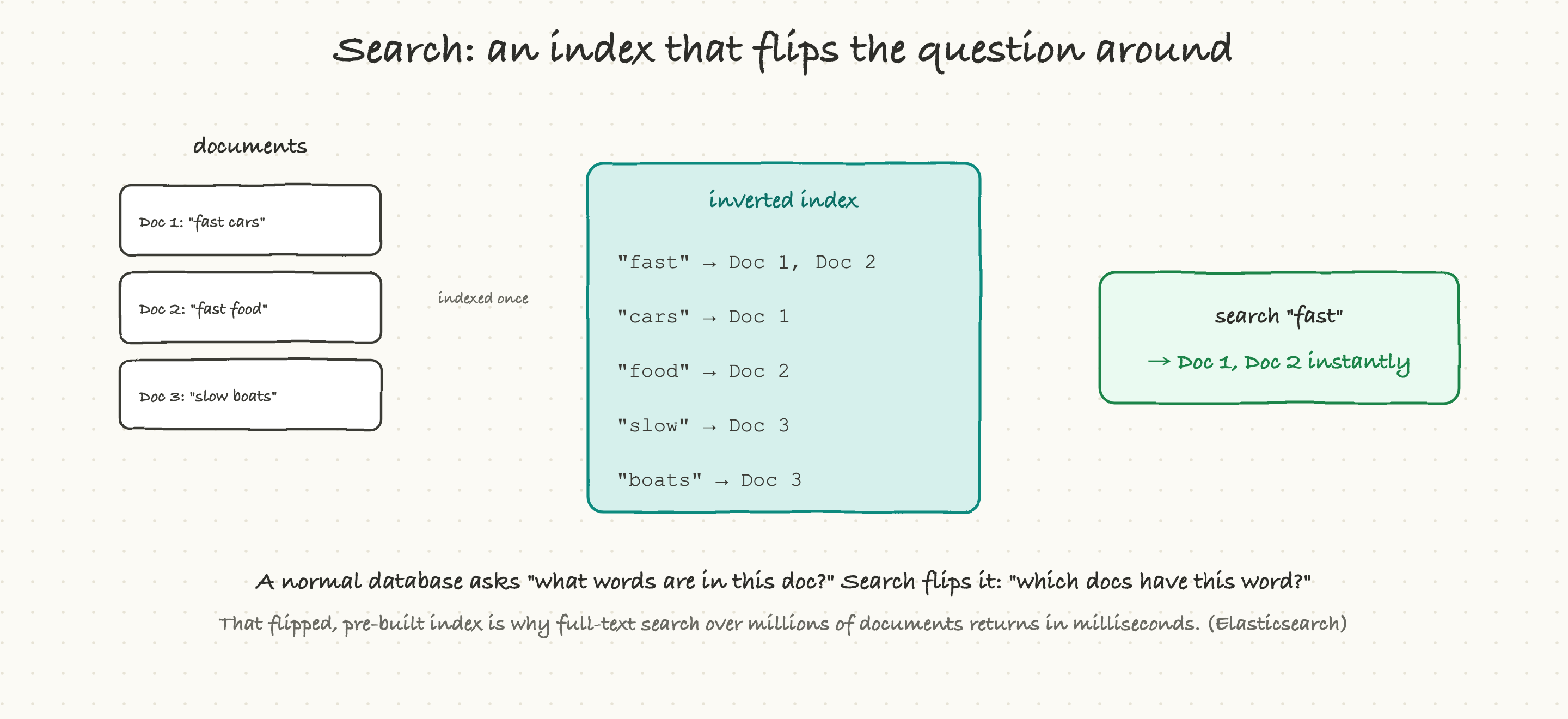
The last piece is search, because once a system holds millions of documents, products, or messages, "find everything mentioning X" becomes its own hard problem. A normal database is bad at this: to find every document containing the word "fast," it would have to read every document, which is hopelessly slow.
Search engines solve it by flipping the question around with an inverted index. A normal index answers "what words are in this document?" An inverted index answers "which documents contain this word?" It is built once, in advance: the system reads every document and records, for each word, the list of documents that contain it. Then a search for "fast" is just a lookup that returns that pre-built list instantly, no scanning required. It is the same back-of-the-book-index idea from the database article, applied to full text.
This is what powers fast full-text search over enormous datasets, and the dominant tool is Elasticsearch (with Solr as a cousin). Search engines add a lot on top, ranking results by relevance, handling typos and synonyms, but the inverted index is the engine room. When a team says "we'll put it in Elasticsearch," they mean they are building this flipped index so that searching is instant instead of a slow scan.
What actually goes wrong
The messaging and search failures are distinctive:
The duplicate-processing bug. At-least-once delivery sends a message twice, the handler was not idempotent, and a customer gets charged or emailed twice.
The growing backlog. The consumer cannot keep up with the producer, so the queue grows without bound. The buffer that was supposed to smooth a spike becomes an ever-deepening pile, and messages get processed hours late.
The poison message. One malformed message keeps failing and, without a dead-letter queue, blocks everything behind it, stalling the whole pipeline.
The stale search index. Data changed, but the search index was not updated, so search returns old or deleted results, the same staleness problem as caching, because a search index is a kind of cache.
Async where sync was needed (or vice versa). Making something asynchronous when the user needs an immediate answer, or keeping a slow thing synchronous when it should have been handed off, are both common design mistakes.
Why a TPM should care, and what to ask
Messaging is where systems get decoupled and resilient, and also where subtle delivery bugs hide, so a few questions go a long way:
Does this need an immediate answer (synchronous), or can it be handed off to happen later (a message)?
If we use a queue, what happens when the consumer falls behind, do we monitor the backlog?
Since messages can be delivered twice, are the handlers idempotent? (This is the one that prevents double-charges and double-emails.)
For this event, should one worker handle it or should many services hear about it (queue vs pub/sub)?
For this data, do we need real-time (stream) or is a nightly batch fine?
If search is slow or wrong, is it the index, is it stale, or is it being kept fresh?
Ask those, and you will catch the decoupling that makes a system resilient, and the delivery and freshness bugs that quietly corrupt data or confuse users, which is most of what messaging and search are really about.