Notes From Chairing a Session at CSCE 2026
A morning of AI research, from rocket design to AI governance, and what stood out from the chair's seat.
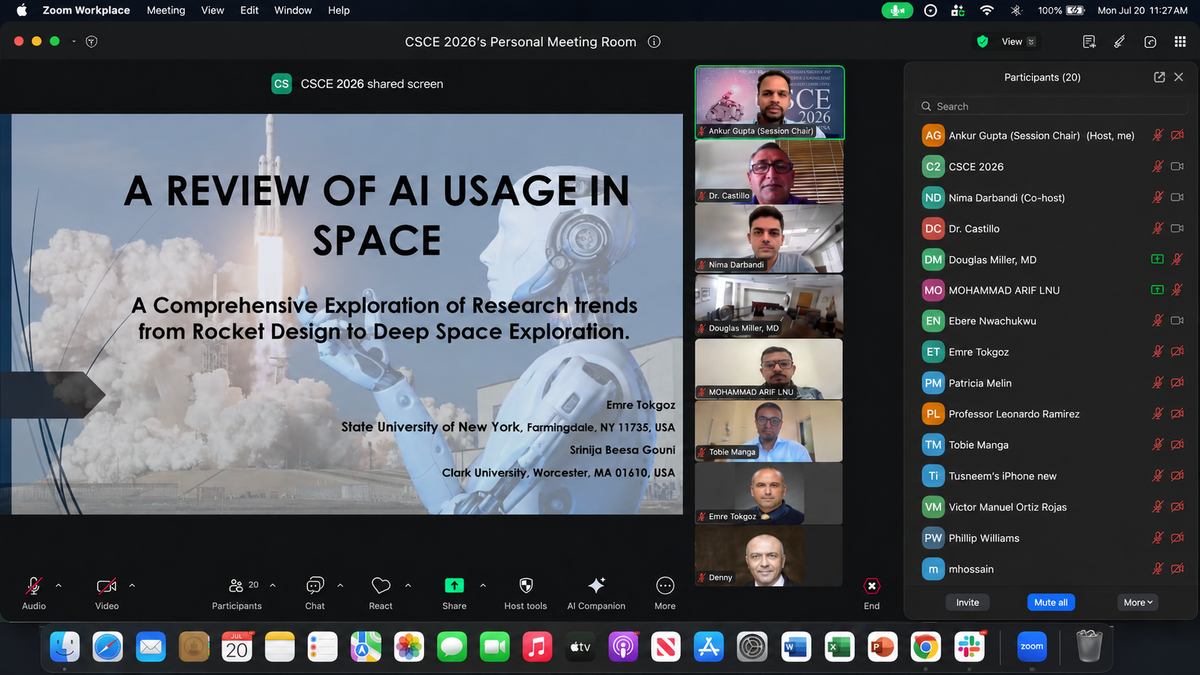
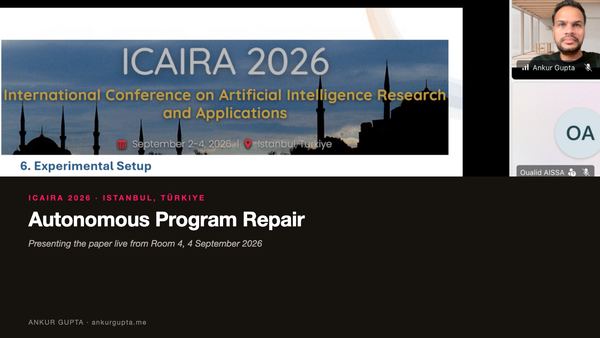
I spent a morning as a session chair at CSCE 2026, the World Congress in Computer Science, Computer Engineering, and Applied Computing. Around twenty researchers were on the call. My job was easy to describe and surprisingly hard to do well: introduce each speaker, keep everyone close to time, run the questions, and make sure every author got a fair hearing.
If you have never chaired a session, it looks like the easy seat. You are not presenting. You are not being graded. But you set the tempo for the whole room. Start late and the last speaker loses half their questions. Let one discussion run long and you quietly tell the next author that their work matters a little less. A good chair is mostly invisible, and that is the point.
One session, a lot of range
What struck me first was how much ground a single session covered. One talk was a review of AI usage in space, walking from rocket design all the way to deep space exploration. Another put human psychometric testing and large language model benchmarking side by side, asking how we measure cognition as the world keeps changing around it. A third proposed a governance framework that tied five separate AI oversight functions into one feedback loop. Different fields, different vocabularies, researchers who would rarely sit in the same room.
And yet the hard part was almost the same in every talk. It was rarely the model itself. It was trust, measurement, and oversight. How do you know the system is right? How do you keep measuring it over time as conditions shift underneath it? Who reviews the decision, and who is allowed to overrule it?
Familiar problems in an unfamiliar room
I have spent most of my career on the infrastructure and reliability side of large systems, a long way from a conference full of professors. But that recurring theme felt very familiar. The frontier of AI is drifting from "can we build it" to "can we operate it, measure it, and trust it." Those are operational questions, and they are exactly the ones that decide whether a clever system survives contact with the real world.
The paper that stayed with me was the governance one, mostly because it refused to treat oversight as five independent checkboxes. It framed security operations, risk assessment, explainability, human oversight, and policy alignment as a single loop that runs before and after deployment. That is the right instinct. In practice, the failures I have seen rarely come from a missing control. They come from controls that never talk to each other.
Chairing changes how you listen
Chairing also changed how I listened. When you are not trying to defend your own work, you start listening for the seams instead. Where does the argument thin out? What did the author quietly assume and never state? The best questions I asked all morning were not expert questions. They were curious ones, the kind anyone paying close attention could ask. That is a useful reminder for any technical review, not just an academic one. Curiosity usually travels further than authority.
There is a quieter lesson in it too. Chairing is service. Nobody remembers who ran the session. But the authors remember whether they were treated fairly, whether their time was respected, and whether the questions were generous rather than sharp. Research runs on that kind of invisible work. So does our industry. Someone has to keep the room moving so everyone else can do their best thinking.
What I took away
I left the session with a small, practical reminder. In a field moving as fast as this one, the durable advantage is not only in the models. It is in the unglamorous work around them: how we measure them, govern them, and keep them honest over time. That work does not trend on anyone's feed. It just quietly decides who is still standing a few years later.
So if you are ever offered the chair, take it. You will learn more listening carefully to twenty researchers than you would presenting to them. And you will be reminded that the person keeping time is doing more than watching a clock.