Relational and SQL Databases: The Workhorse That Still Runs the World

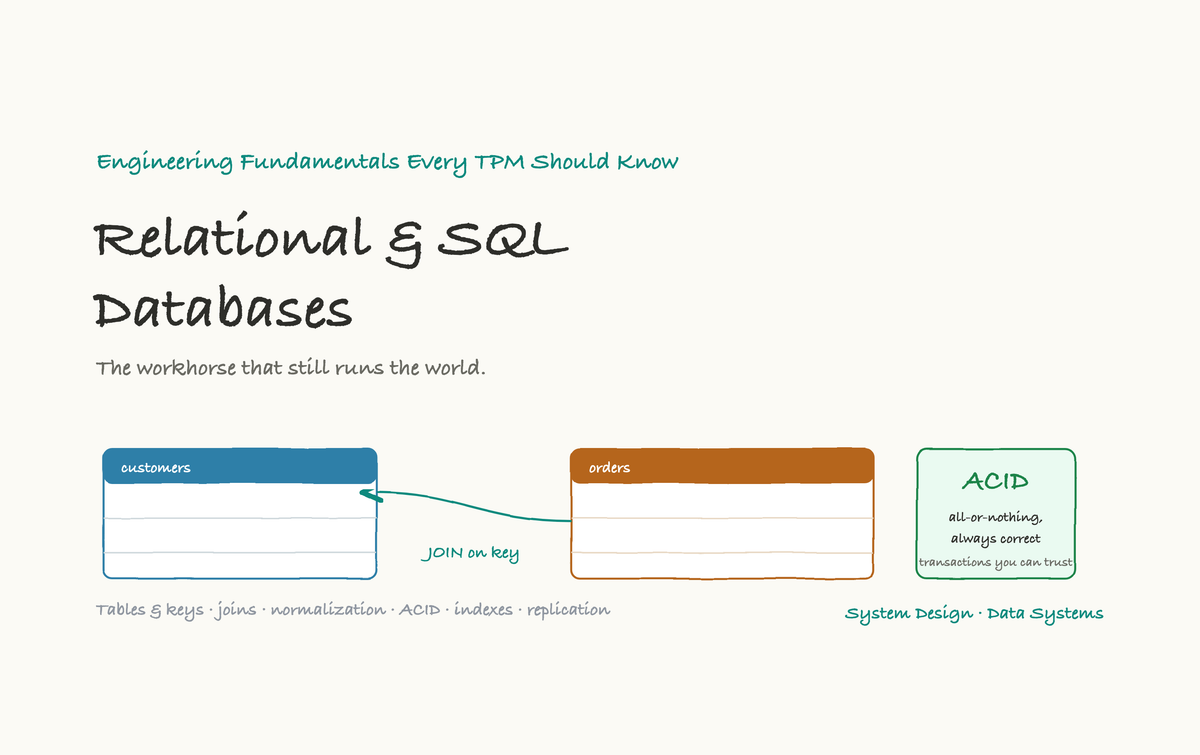
If you only ever learn one kind of database deeply, make it this one. The relational database has been the default way to store important data for over forty years, and despite a parade of trendy alternatives, it is still the right answer for the majority of systems being built today. Banks run on it. Online stores run on it. Your payroll, your flight booking, and your hospital records almost certainly run on it. When an engineer says "the database" without qualifying, they usually mean a relational one.
This is the first deep-dive in the data systems series, and it pairs with the evolution overview that explains where all the database families came from. Here we go inside the one that started it all and never left. By the end you will understand what makes it tick, why it is so trusted, where it strains, and what questions to ask your teams about it.
The core idea: data in tables
The relational model organizes data into tables. A table is just a grid. Each row is one record, one customer, one order, one payment, and each column is one attribute of that record, like a name, a city, or an amount. That is genuinely all a table is, and its simplicity is the point.
The magic is in how tables connect. Tables relate to each other through keys.
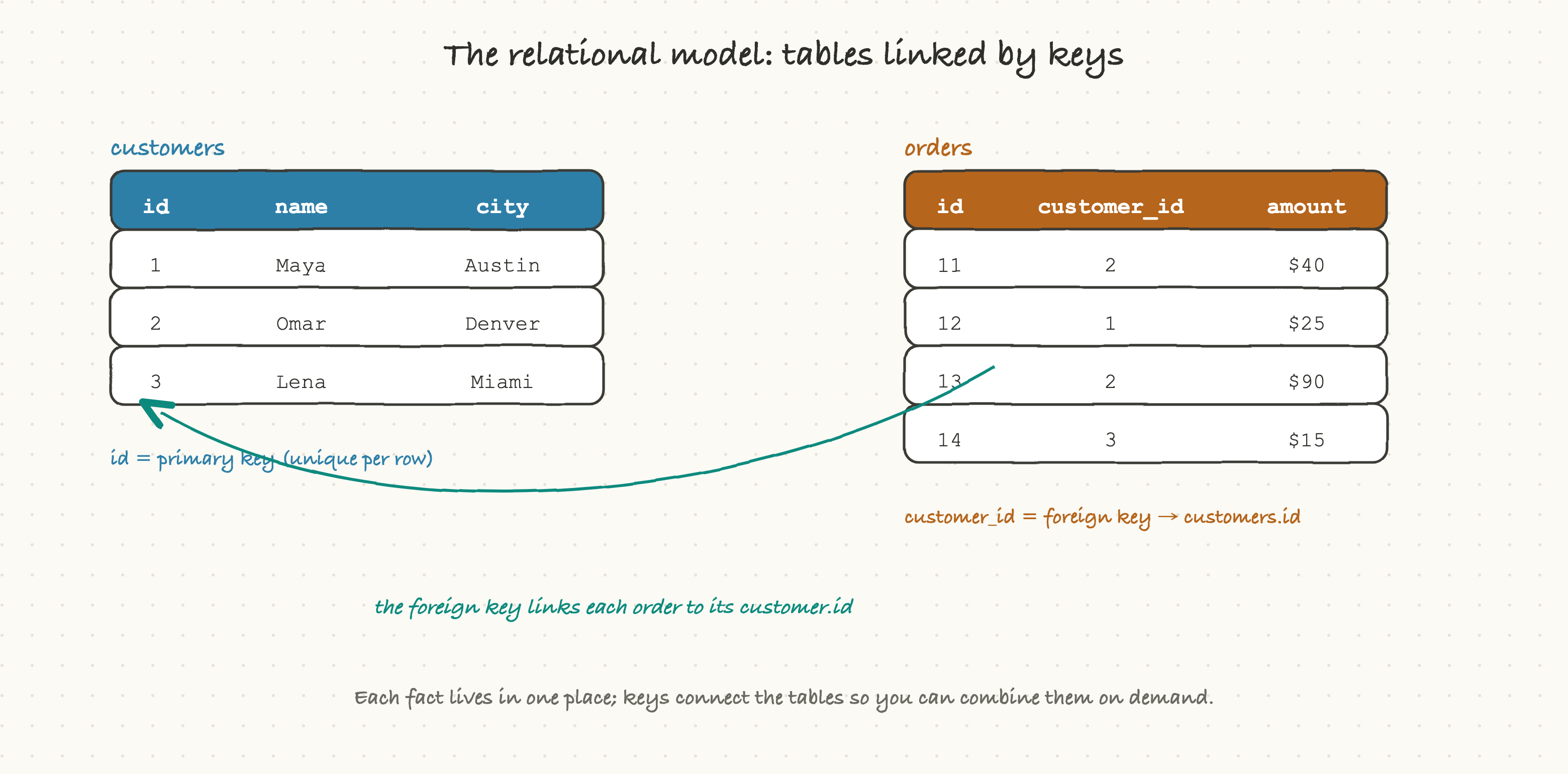
Every row in a table has a primary key, a value that uniquely identifies it, usually a simple id. No two rows share a primary key, so it is an unambiguous way to point at exactly one record. Then, when one table needs to refer to a row in another, it stores that row's key as a foreign key. In the picture, the orders table does not repeat the customer's name and city on every order. It just stores the customer's id in a customer_id column. That foreign key is a pointer that says "this order belongs to the customer with this id."
This is the whole trick that makes relational databases so powerful and so tidy. Each fact is stored exactly once, in one place, and relationships are expressed by keys rather than by copying data around. Change a customer's city once, and every order they have ever placed instantly reflects it, because the orders never stored the city in the first place. They just point at the customer.
SQL: asking questions of your data
To talk to a relational database, you use SQL (Structured Query Language). SQL is declarative, which means you describe what you want, not how to fetch it, and the database figures out the most efficient way to get it. A handful of verbs cover almost everything: SELECT to read data, INSERT to add it, UPDATE to change it, and DELETE to remove it.
The signature move of SQL, the thing that makes the relational model sing, is the join. A join combines rows from two or more tables based on a matching key, exactly the keys we just talked about.
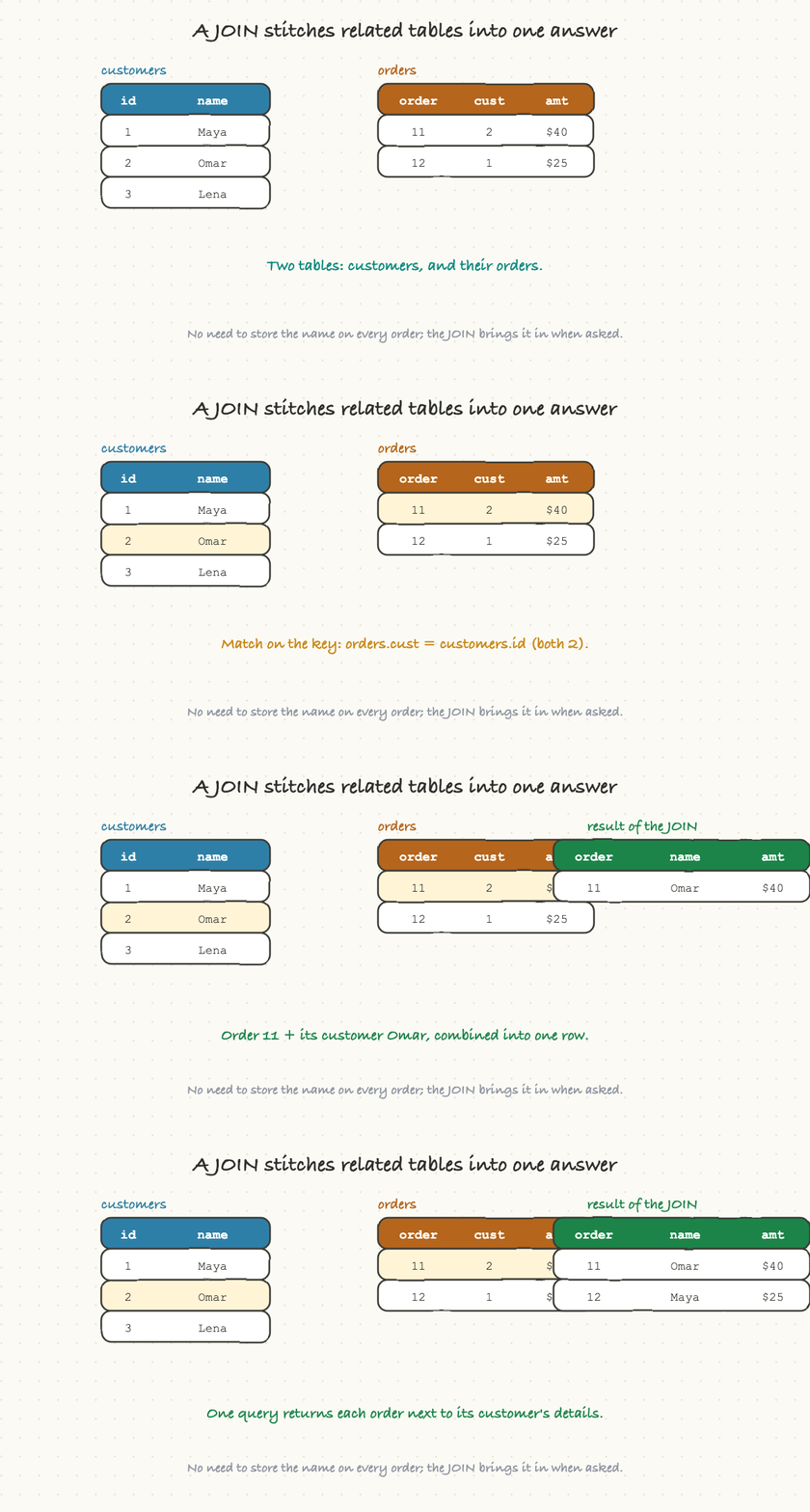
Watch what is happening there. We have customers in one table and orders in another. We ask a single question, "show me each order along with the name of the customer who placed it," and the database matches each order's customer_id to the right customer's id and stitches them together into one combined result. We never stored the customer's name on the order, yet we can produce it whenever we want. The join brings related data together on demand.
This is enormously practical. You can model a complex business as a set of clean, non-repeating tables, then answer almost any question by combining them in different ways at query time. "Which customers in Texas spent more than $500 last quarter?" is one query joining customers, orders, and maybe payments, with a couple of filters. You did not have to anticipate that question when you designed the tables. The relational model lets you ask it later.
Normalization: don't repeat yourself
The discipline of structuring your tables so each fact lives in exactly one place has a name: normalization. It is one of those ideas that sounds academic but is intensely practical.
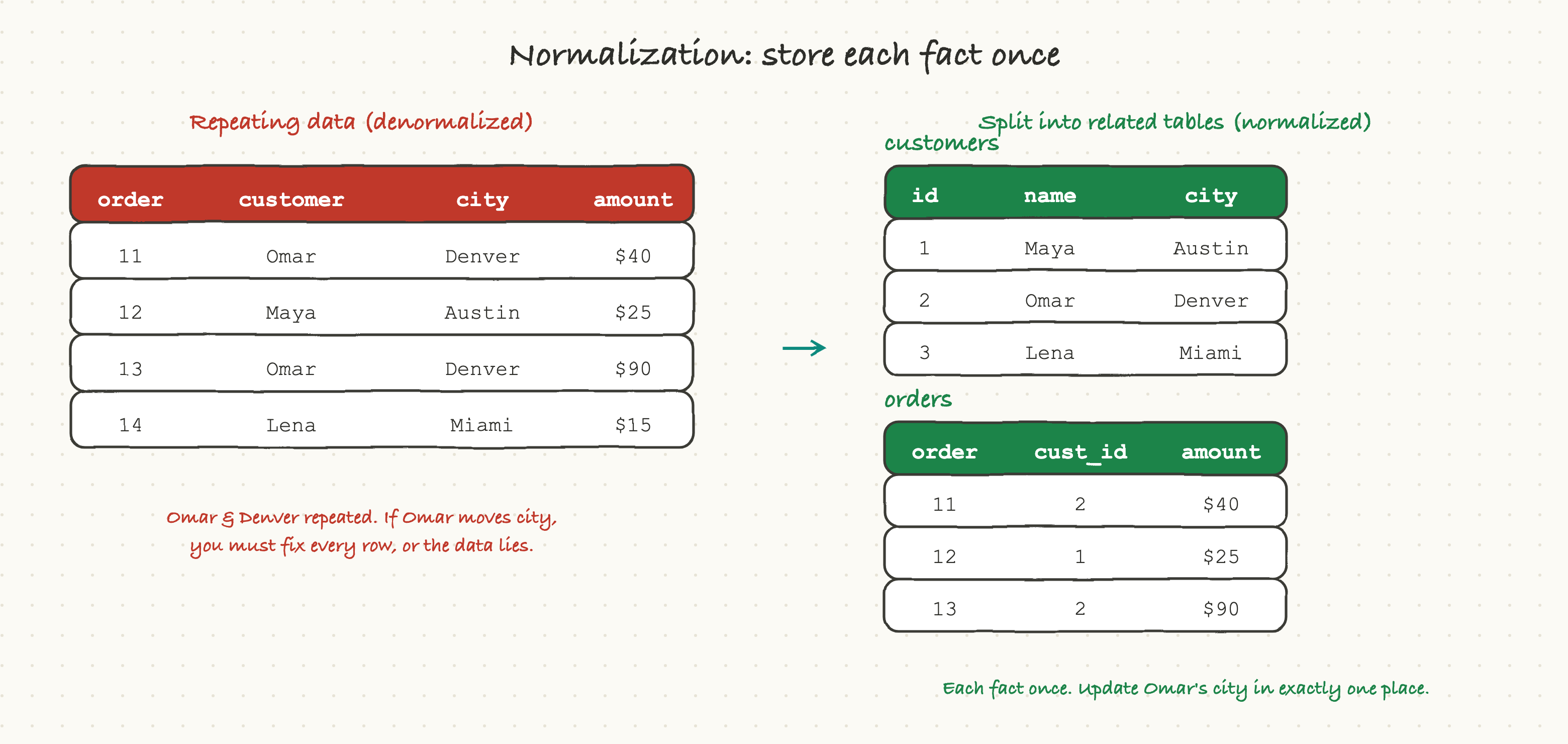
Look at the table on the left. Someone stored the customer's name and city directly on every order. It works at first, but it carries a quiet bomb. Omar's city, "Denver," is now written on every order he has ever made. If Omar moves to Seattle, you have to find and update every single one of those rows. Miss one, and your database now contradicts itself: it claims Omar lives in two cities at once. These are called update anomalies, and they are a major source of data corruption in poorly designed systems.
The normalized version on the right fixes it by splitting the data into two related tables. The customer's details live once in the customers table. Orders just reference the customer by id. Now moving Omar to Seattle is a single change in a single row, and it is instantly correct everywhere. No duplication, no contradictions, no anomalies.
In practice, engineers sometimes deliberately break normalization for speed (storing a redundant copy of data to avoid an expensive join), a trade-off called denormalization. That is a legitimate optimization, but it is a conscious decision to trade tidiness for performance, not a default. The default, and the thing that makes relational data trustworthy, is to normalize.
ACID: the promises that make it trustworthy
Structure is nice, but the real reason relational databases earned their place in banks and hospitals is trust. They make a set of guarantees about transactions, summarized by the acronym ACID. A transaction is a group of changes that should happen together as a single unit, and ACID is the promise that they really will.
The most important letter is the A, Atomicity. It means a transaction happens completely or not at all, never halfway.
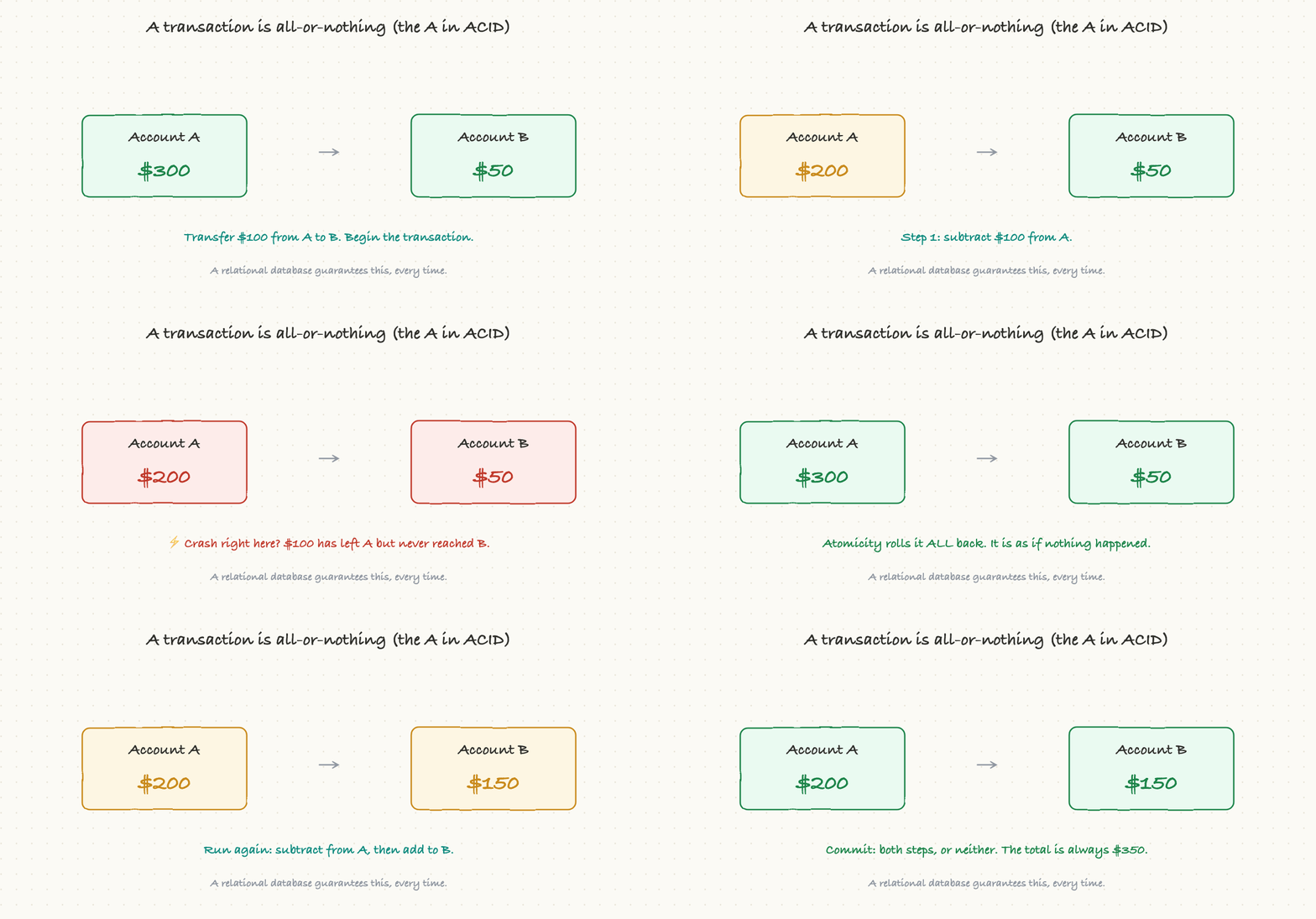
This is the classic example, and it is worth sitting with because it shows exactly why this matters. You are transferring $100 from account A to account B. That is actually two steps: subtract $100 from A, then add $100 to B. Now imagine the system crashes in the gap between those two steps. The money has left A but never arrived in B. It has simply vanished. In a financial system, that is a catastrophe.
Atomicity makes that impossible. The database treats both steps as one indivisible unit. If anything goes wrong before the transaction completes, the whole thing is rolled back, returned to exactly the state it was in before, as if it never started. Either both steps happen and the transaction commits, or neither does. The money is never in limbo.
The other three letters round out the guarantee:
- Consistency. Every transaction leaves the database in a valid state, respecting all its rules. If a balance can never go negative, or an email must be unique, the database enforces that and rejects any transaction that would violate it.
- Isolation. When many transactions run at the same time, the database keeps them from interfering with each other. Each one behaves as though it had the database to itself, so two people booking the last seat on a flight can't both succeed.
- Durability. Once a transaction commits, it stays committed. Even if the server loses power one second later, the change is safely on disk and will be there when the system comes back.
Together, ACID is why you can trust a relational database with things that absolutely cannot be wrong. This is the relational database's superpower, and it is precisely what many of the "NoSQL" alternatives gave up in order to scale.
Indexes: how lookups stay fast
A table with ten million rows raises an obvious question: when you ask for "the customer with this email," does the database really check all ten million rows one by one? Without help, yes, and that is painfully slow. The help is called an index.
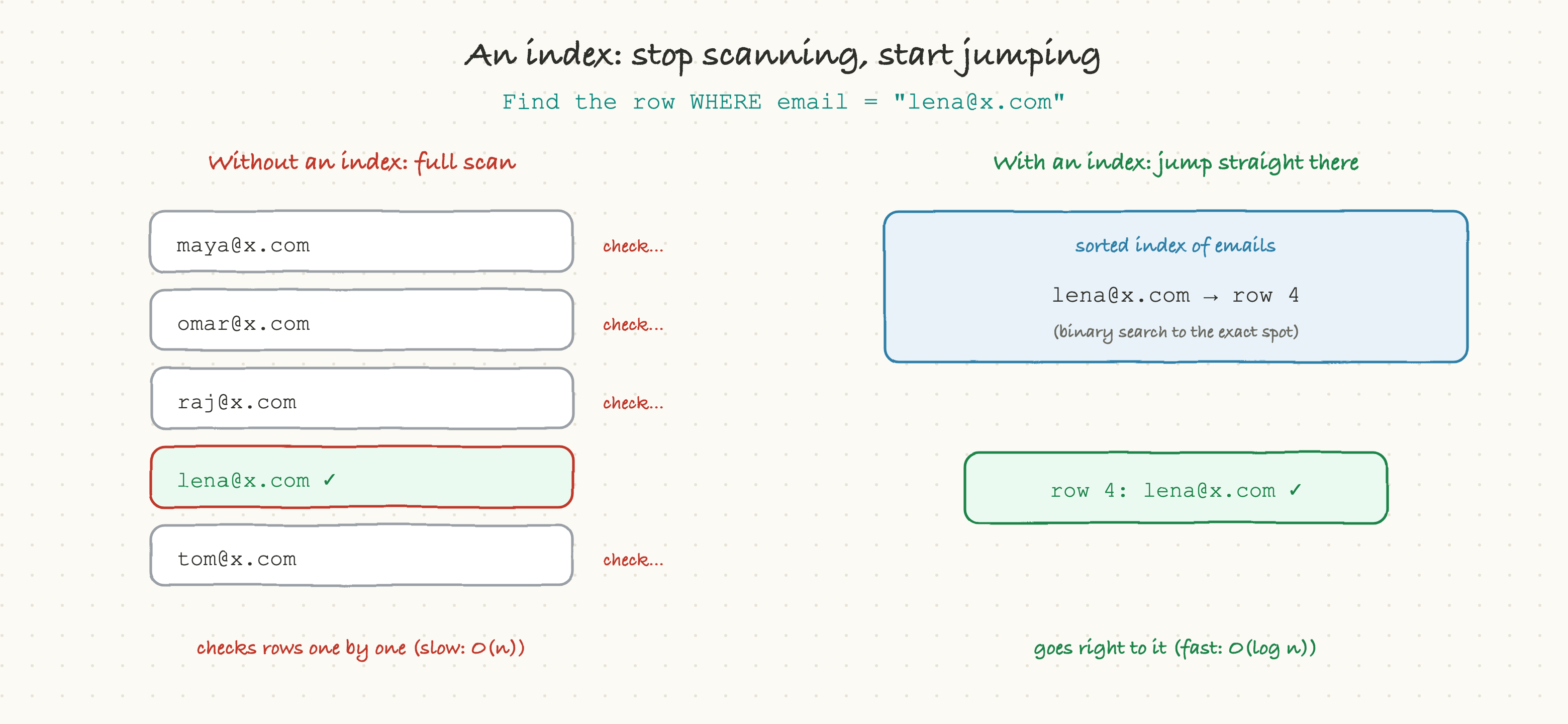
An index is a separate, sorted structure that the database maintains alongside your table, like the index at the back of a book. Instead of reading every page to find a topic, you flip to the alphabetical index, find the topic, and jump straight to the right page. A database index does the same thing: it keeps the values of a column (say, email) in sorted order with pointers to the matching rows, so the database can leap to the exact row in a few steps instead of scanning the whole table.
The difference is not small. Scanning every row takes time proportional to the table size (engineers call this O(n)): double the data, double the wait. A good index turns that into something proportional to O(log n), which barely grows at all, the difference between checking millions of rows and checking maybe twenty. This is why indexes are one of the first things engineers reach for when a query is slow.
Indexes are not free, though, and this is the trade-off a TPM should understand. Each index takes extra storage, and it must be updated every time you write to the table, so it slightly slows down inserts and updates. Index the columns you frequently search or join on; do not index everything. "We added an index and the report went from 30 seconds to instant" and "we have too many indexes and writes have slowed down" are both common, and both are about this exact trade-off.
Scaling: replication and its limits
For decades, when a relational database needed to handle more load, the answer was to scale up: buy a bigger, more powerful server. That works remarkably far, but it has a ceiling, and it puts all your eggs in one machine. The standard next step is replication.
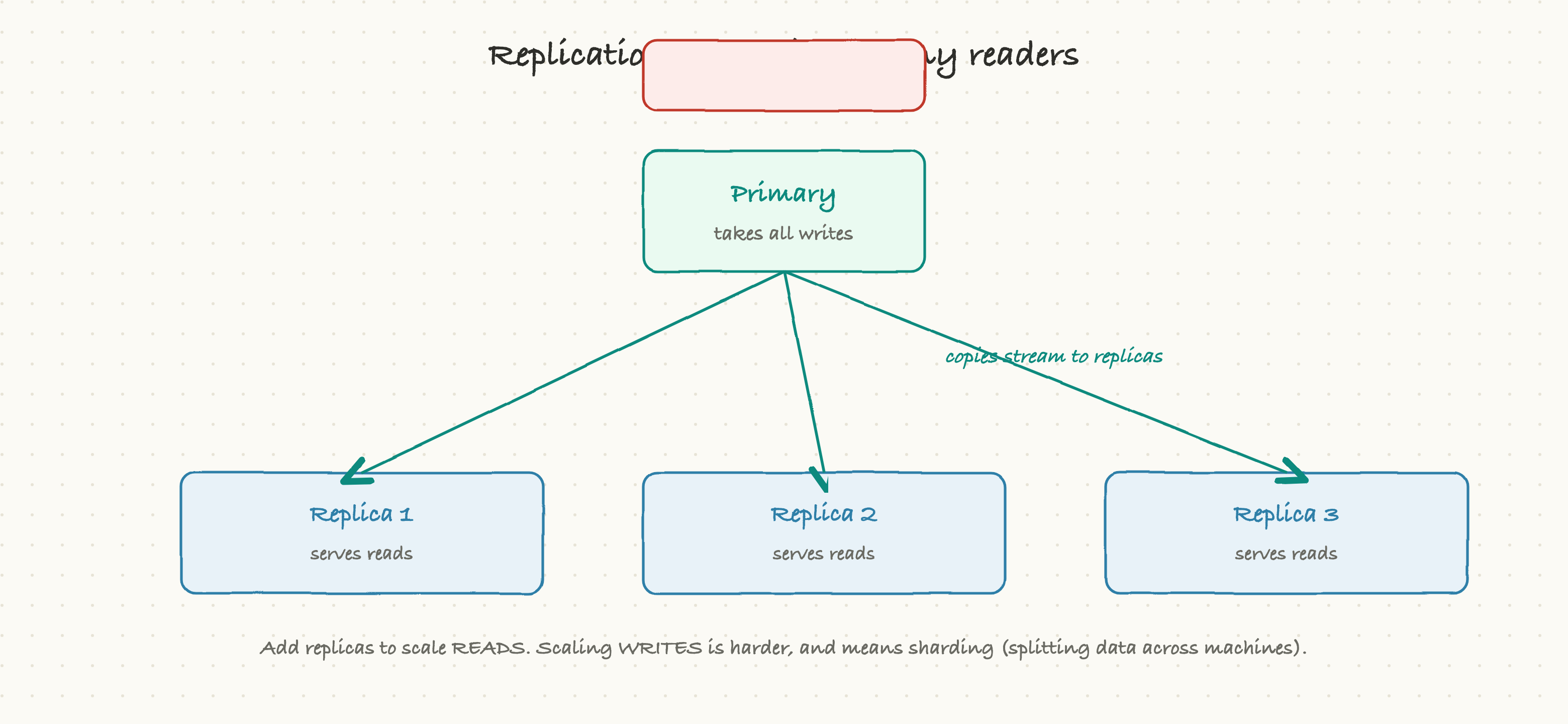
In a typical setup, one machine is the primary, and it handles all the writes (inserts, updates, deletes). Its changes are continuously copied to one or more replicas. Those replicas can then serve reads. Since most applications read data far more often than they write it, this is a huge win: you can add more replicas to handle more read traffic, spreading the load across many machines. It also gives you resilience, because if the primary fails, a replica can be promoted to take its place.
But notice the asymmetry, because it is the central limitation of relational databases at scale. Replication scales reads beautifully. It does not scale writes, because every write still has to go through the single primary. When your write volume genuinely exceeds what one machine can handle, you are forced into sharding: splitting the data itself across multiple independent databases (customers A-M here, N-Z there). Sharding works, but it is complex and it breaks some of the conveniences we have been celebrating, because a join across two shards, or a transaction spanning them, is suddenly very hard. This write-scaling wall is the single biggest reason the NoSQL families in the other articles were born.
When to reach for it, and when not to
So where does this leave the relational database in a world full of alternatives? In a very strong position, actually, as long as you match it to the right job.
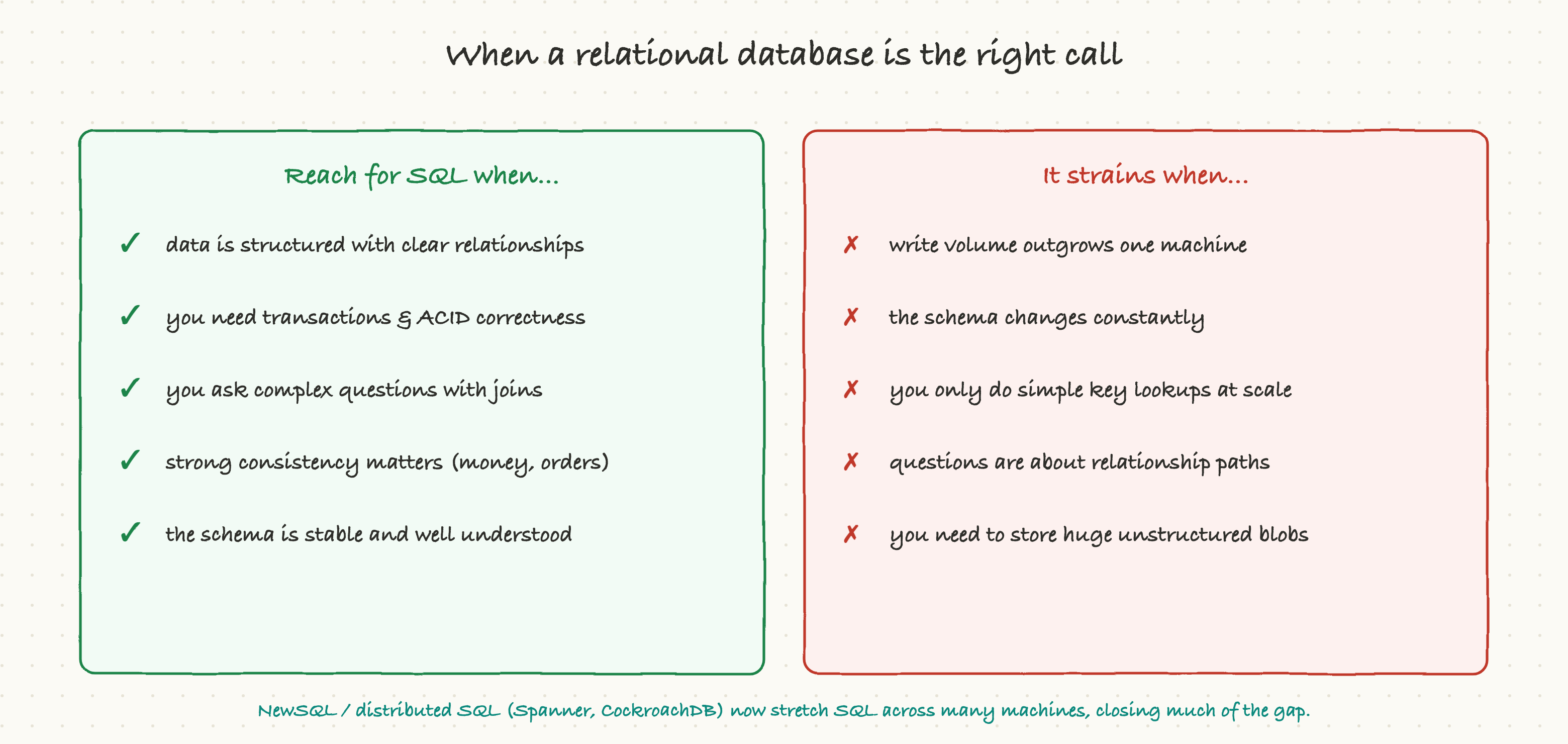
Reach for a relational database when your data is structured with clear relationships, when correctness and transactions matter, when you need to ask rich questions with joins, and when strong consistency is non-negotiable. That covers a huge fraction of all software: orders, payments, inventory, user accounts, bookings, anything where the data is relational in nature and being wrong is unacceptable. For most applications, a relational database should be your default, and you should only move off it when you have a specific reason.
It strains in the situations the other articles exist to address: when write volume outgrows a single machine, when the schema changes constantly, when you are doing nothing but simple key lookups at massive scale, or when your real questions are about relationship paths (which a graph database answers far better). These are real limits, not flaws; they are simply the edges of what one design can do well.
The story does not end there, though. A newer generation called NewSQL or distributed SQL (with databases like Spanner and CockroachDB) set out to give you the familiar SQL language and ACID guarantees while spreading across many machines, closing much of the write-scaling gap that historically pushed teams toward NoSQL. For many teams, this means they no longer have to abandon relational guarantees just to scale, which is a genuinely big deal.
Why a TPM should care
You will not be writing SQL or designing schemas, but the relational database sits under most of what your teams build, and a few things are worth carrying in your head:
- It is the safe default, and that's usually good news. When a team chooses a relational database for a new service handling important data, that is typically the low-risk, well-understood choice. Be a little more curious when a team wants to avoid a relational database for core transactional data, and make sure they have a concrete reason.
- "We need to scale writes" is a real architectural fork. Read-scaling via replicas is routine and low-drama. But when a team says they have outgrown a single primary for writes, they are facing sharding or a move to distributed SQL, which is a significant project with real cost and risk. Treat that signal seriously in planning.
- Schema changes are a thing to schedule. Because relational data has a defined structure, changing that structure on a large, live table (adding a column, changing a type) can be a careful, sometimes slow operation. When engineers flag a "migration," this is often what they mean, and it deserves a slot in the plan rather than being assumed instant.
- Index and query performance is tunable, not fixed. If a screen or report is slow, the answer is frequently an index or a rewritten query, not a bigger machine. Knowing this helps you ask "have we looked at the query plan?" before approving an expensive hardware upgrade.
The relational database has survived every wave of new technology for one simple reason: most of the world's important data really is structured, related, and intolerant of being wrong, and nothing models that better. The other database families in this series each exist because they do one specific thing the relational model can't. But the relational database remains the center of gravity, and understanding it well is the foundation for understanding all the rest.