Search Engines: Finding the Needle in the Haystack

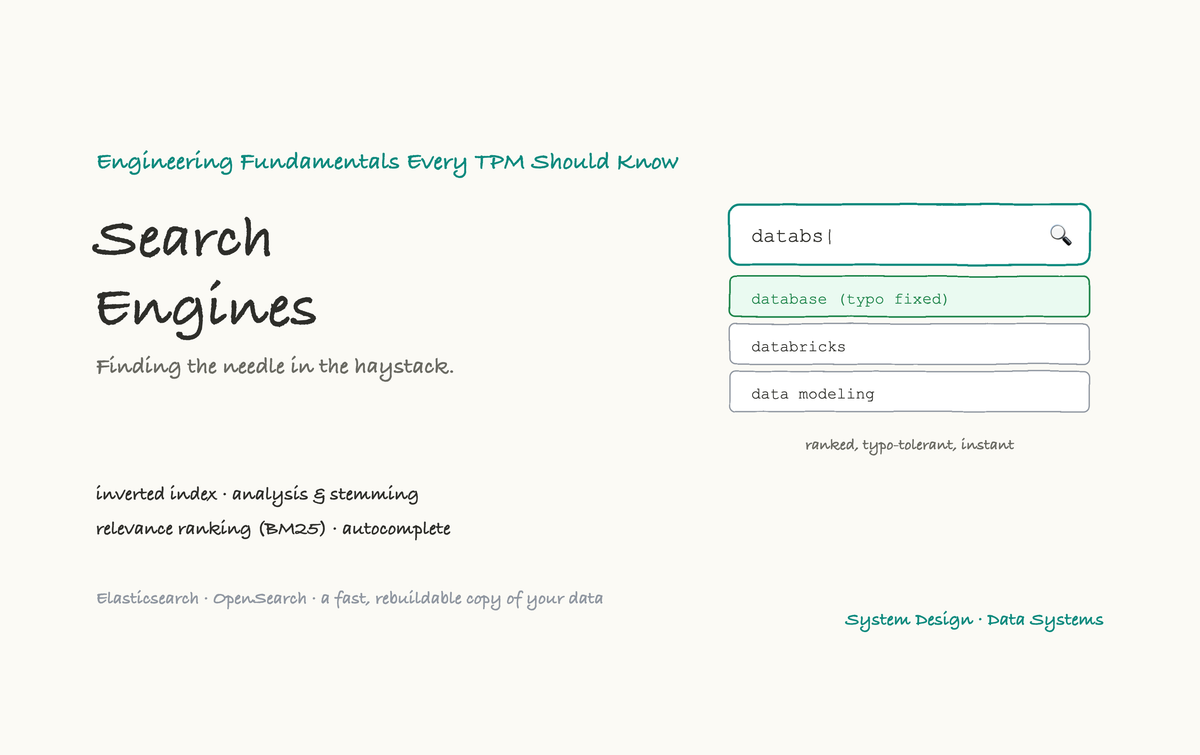
Type a few words into a search box and, in a fraction of a second, you get back the most relevant results out of millions or billions of documents, ranked best-first, with your typos forgiven and suggestions appearing as you type. We're so used to this that it feels ordinary. It is not. Full-text search is one of the genuinely hard problems in software, and it's hard enough that it gets its own specialized kind of system: the search engine.
This deep-dive covers that family, the one behind the search bars, the autocomplete, the "did you mean," and the log-searching tools you use constantly. A relational database can technically search text with a LIKE query, but that scans every row and gets unusably slow at scale, and it can't rank by relevance or forgive a typo. Search engines like Elasticsearch and OpenSearch exist because finding things by their content, fast and well, needs a completely different machine. Let's open it up.
The core trick: the inverted index
Everything a search engine does rests on one elegant data structure: the inverted index. Once you see it, search stops being magic.
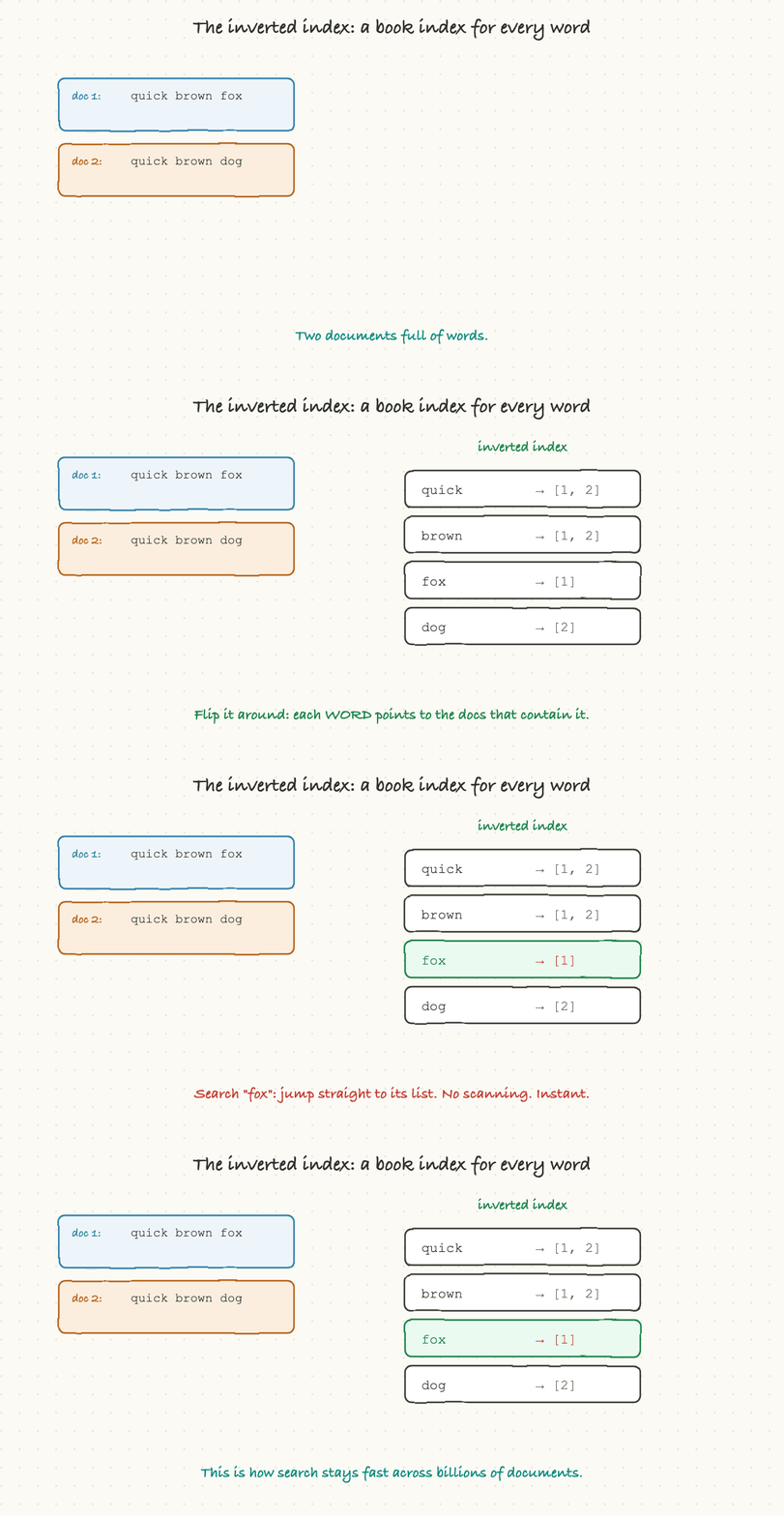
A normal index goes from a document to its words. An inverted index flips that around: it goes from each word to the list of documents that contain it. Build that once, and a search for "fox" doesn't scan a single document, it just looks up "fox" in the index and instantly gets back the exact list of documents containing it. It works precisely like the index at the back of a textbook: instead of reading every page to find a topic, you flip to the index, find the word, and jump straight to the right pages. Except the search engine builds this index for every word in every document, automatically.
This is why search stays fast no matter how much data you have. Whether you're searching ten documents or ten billion, the engine is doing a quick lookup in a pre-built index, not a brute-force scan. The inverted index is the foundation everything else is built on.
Making text matchable: analysis
Raw text is messy. "The Quick Brown Foxes!" and a search for "fox" should match, but the words don't look identical. So before anything goes into the index, both the documents and the search queries pass through a cleanup pipeline called analysis.
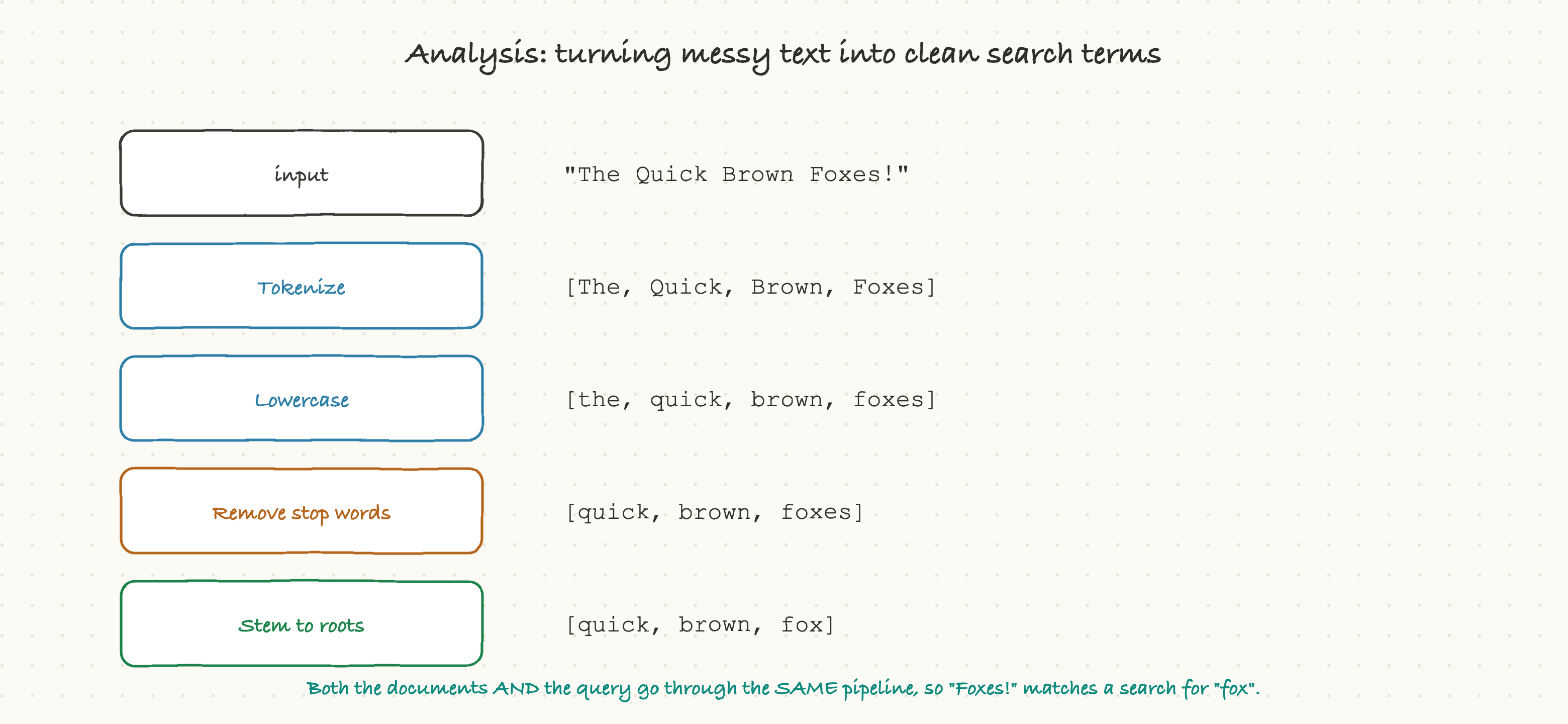
The text gets tokenized (split into individual words), lowercased (so "Quick" matches "quick"), stripped of stop words (tiny common words like "the" and "a" that add noise but little meaning), and stemmed (reduced to root forms, so "foxes," "fox," and "fox's" all become "fox"). The critical detail is that the documents and the query go through the same pipeline. That's what makes a search for "fox" find a document that said "Foxes!", they both get reduced to the same root term before matching. Tuning this analysis (handling plurals, accents, different languages) is a huge part of making search feel smart, and it's all invisible to the user.
The real magic: relevance ranking
Finding documents that match is only half the job. The half that makes search feel intelligent is ranking: out of the thousands of documents that contain your words, which ones are the best matches, shown first? Getting this right is the entire difference between Google and a useless wall of links.
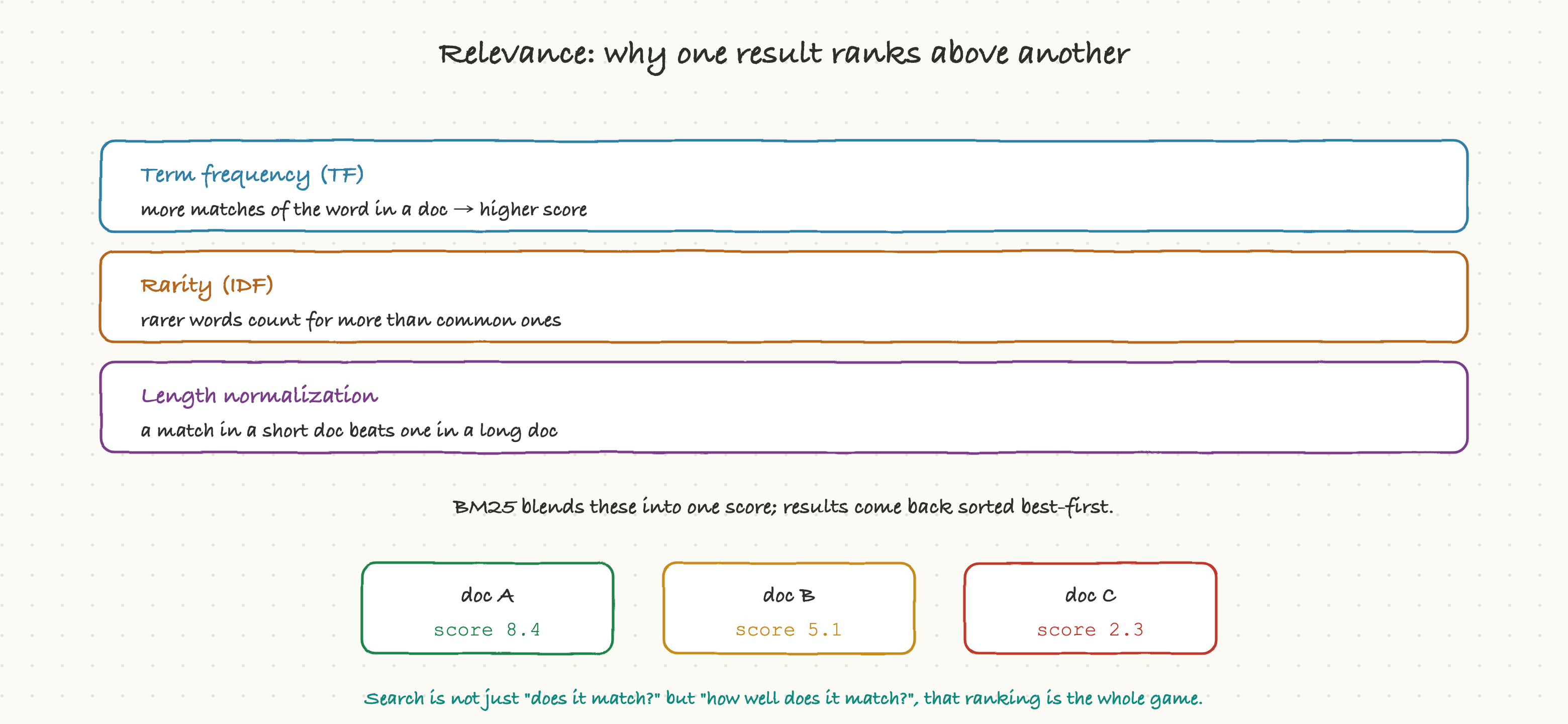
Search engines score each matching document and sort by that score. The scoring (using a classic formula called TF-IDF and its modern successor BM25) blends a few intuitive factors. Term frequency: a document that uses your search word many times is probably more about it. Rarity (inverse document frequency): rare, distinctive words count for much more than common ones, matching "database" is far more meaningful than matching "the." Length normalization: a match in a short, focused document outranks the same match buried in a giant one. The engine combines these into a single relevance score and returns results best-first. The key mental shift is that search isn't a yes/no "does it match?" but a graded "how well does it match?", and that ranking is the whole game.
Beyond exact matching
Once you have an inverted index and a ranking system, a whole set of features becomes possible that a plain database simply cannot do.
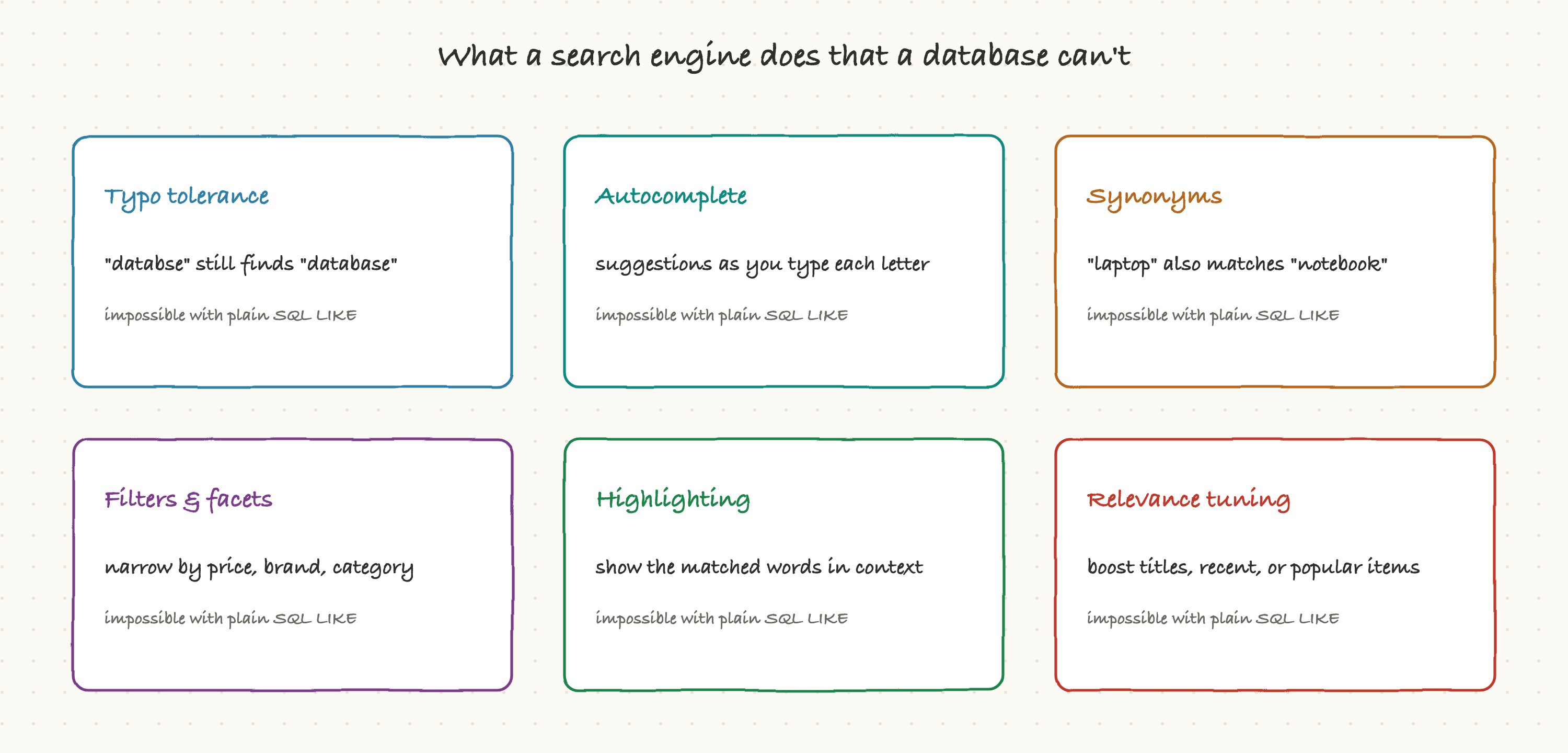
Typo tolerance (fuzzy matching) means "databse" still finds "database." Autocomplete suggests completions as you type.
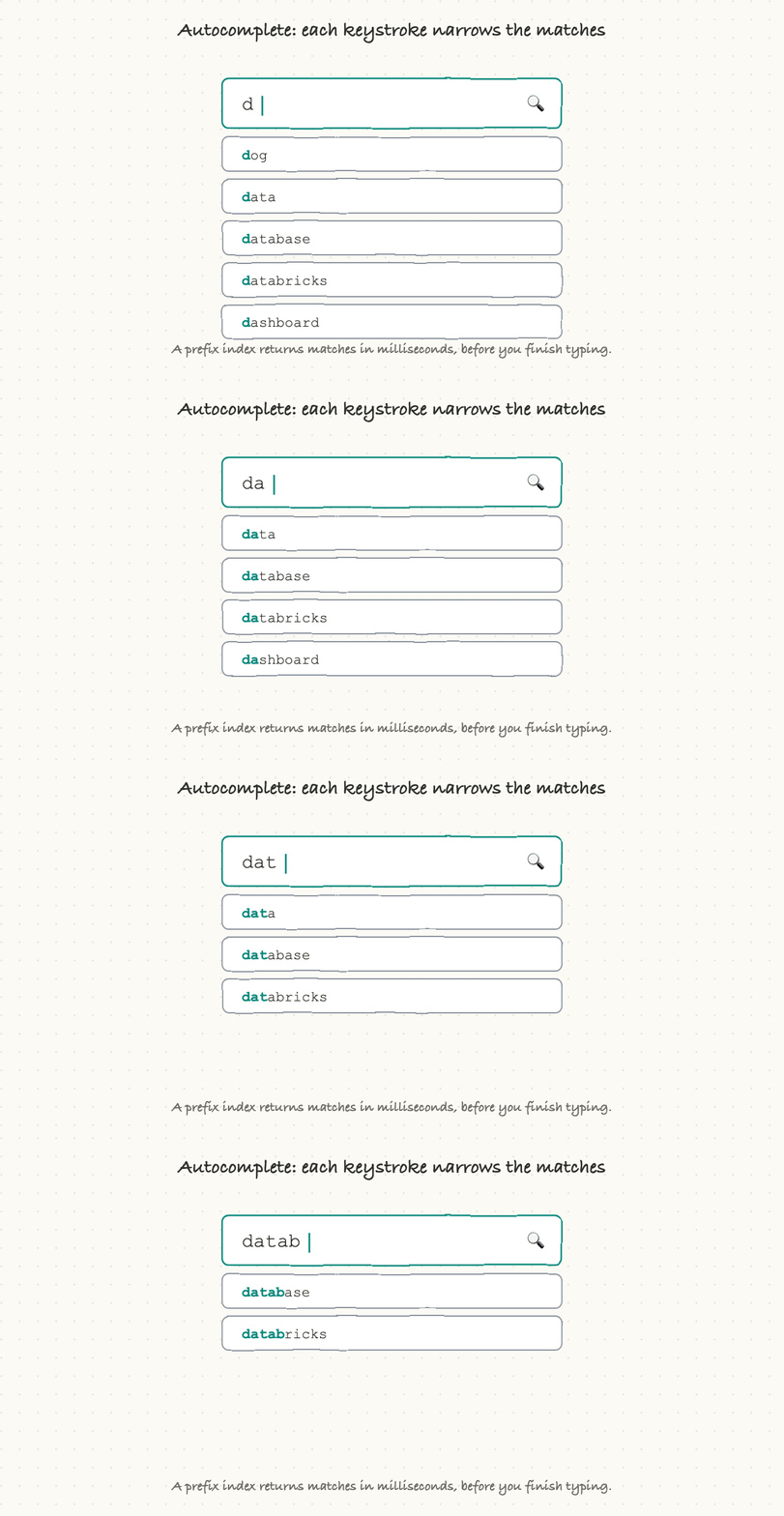
Each keystroke narrows the list of suggestions in milliseconds, using a specialized prefix index, which is why search boxes can guess what you want before you've finished typing. On top of that, search engines handle synonyms ("laptop" also matching "notebook"), filters and facets (narrowing by price, brand, or category, the sidebar on every shopping site), highlighting (showing your matched words in context), and relevance tuning (boosting titles, recent items, or popular results). Every one of these is essentially impossible with a plain SQL LIKE, and together they're what make a good search experience feel effortless.
Search is a sidecar, not your database
Here's a crucial architectural point that's easy to get wrong. A search engine is almost never your primary database. It's a specialized, derived copy of your data, optimized purely for searching, that runs alongside your real database.
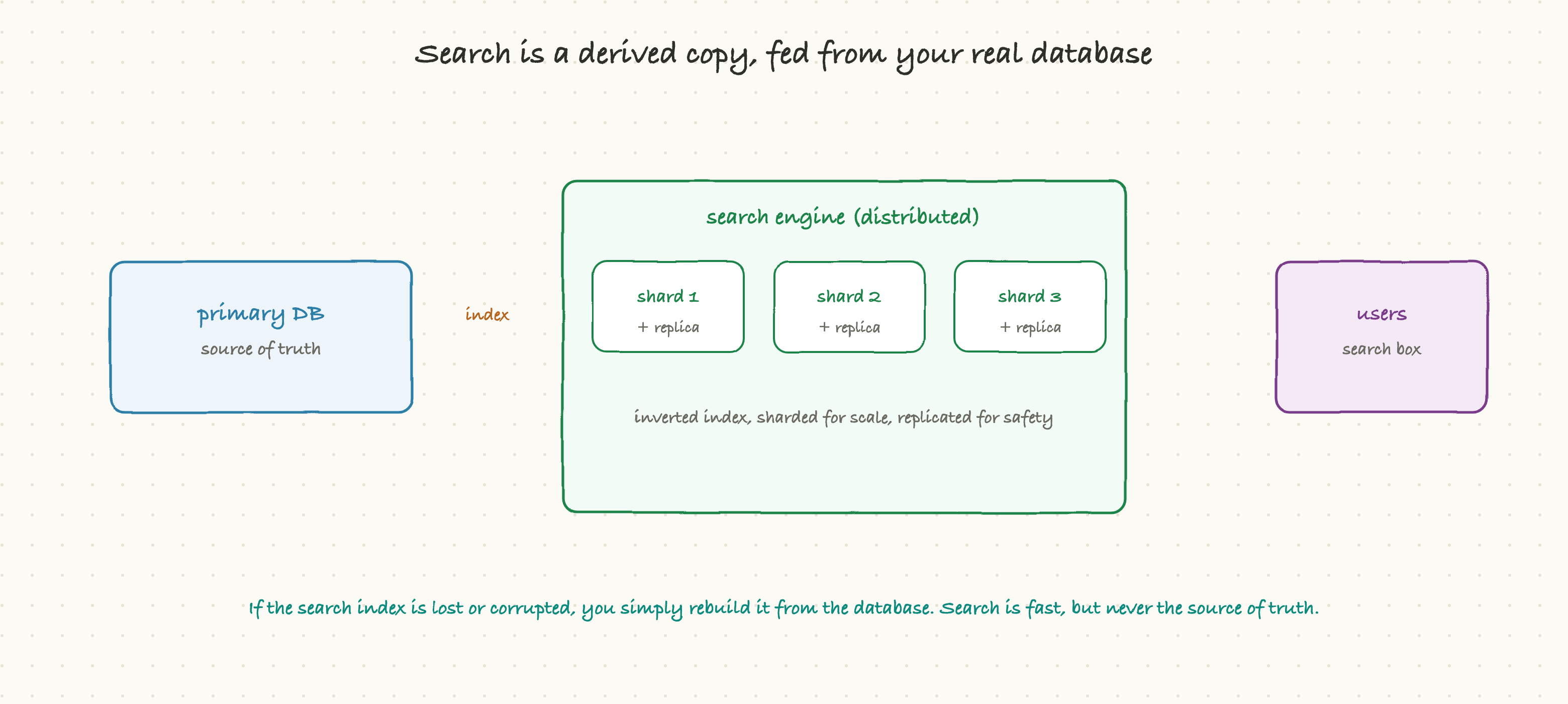
Your authoritative data lives in your primary database, the source of truth. You then index the searchable parts of it into the search engine, which keeps its own inverted index, sharded across machines for scale and replicated for safety (this is how Elasticsearch handles huge volumes). Users' searches hit the search engine; everything else hits the database. The mental model that matters: the search index is disposable. If it's ever lost or corrupted, you don't panic, you just rebuild it from the database, because the database, not the search engine, holds the real data. Search is fast and powerful, but it is never the system of record.
This is also why search results can lag slightly behind the database, there's a brief delay (search engines are "near-real-time," typically a second or so) between data changing in the database and that change appearing in search. For finding things, that's almost always fine.
When to use one, and when not
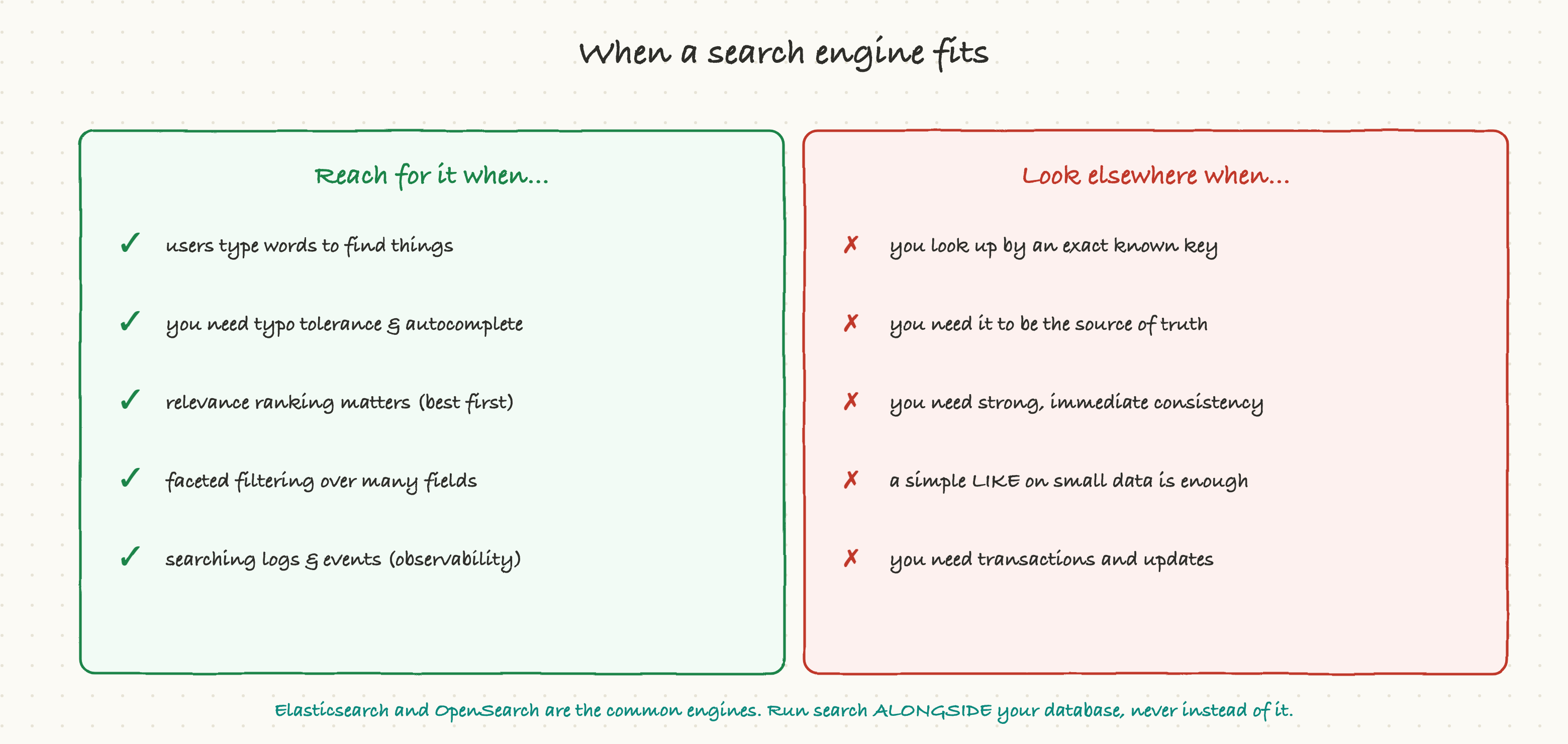
Reach for a search engine when users type words to find things, when you need typo tolerance and autocomplete, when relevance ranking matters, when you need faceted filtering across many fields, or when you're searching through mountains of logs and events (search engines are the backbone of many observability tools). These are jobs nothing else does well.
Look elsewhere when you're looking up data by an exact known key (a key-value store or database is simpler and faster), when you need the system to be your source of truth, when you need strong immediate consistency, or when a simple LIKE over a small dataset genuinely suffices. The biggest mistake teams make is treating a search engine as their primary database, it's brilliant at finding, but it's not built to be the durable, transactional home of your data. Run it alongside your database, fed from it, never instead of it.
Why a TPM should care
Search shows up in more products than almost any other specialized system, and it carries a few predictable themes:
- Good search is a real project, not a checkbox. "Add search" sounds simple but hides a lot: indexing pipelines, analysis tuning, relevance tuning, and keeping the index in sync with the database. Treat a quality search experience as genuine engineering work, because the gap between "technically searches" and "feels great to search" is large and is almost entirely about relevance and analysis tuning.
- Relevance is subjective and iterative. "The search results aren't good" is a common and legitimate complaint, and improving them is an ongoing tuning process (boosting the right fields, handling synonyms, adjusting ranking), not a one-time fix. Build room for that iteration into the plan rather than expecting perfect results on day one.
- Expect a slight lag between the database and search. Because the search index is a derived, near-real-time copy, a just-created item might take a moment to appear in search. "I added it but search can't find it yet" is usually this lag, not a bug.
- Don't let search become a second source of truth. If a team starts treating the search engine as the authoritative store of data (rather than a rebuildable index), that's a fragility worth flagging. The safe pattern is always: database is truth, search is a disposable copy you can rebuild.
The search engine is the specialist that solved a problem we now take completely for granted: instantly finding the most relevant needles in an enormous haystack, forgiving our typos and guessing our intent along the way. It does it with one beautiful core idea, the inverted index, dressed in layers of analysis and ranking. The final two deep-dives turn to the newest members of the data family, both born from modern demands: time-series databases for the explosion of metrics and sensor data, and vector databases for the age of AI.