Three IEEE Papers at ICCPCT 2026
Three of my papers were accepted and presented at the 9th IEEE ICCPCT, 6-7 August 2026, covering agent memory architectures, observability for agentic AI, and coordination cost in multi-agent systems.

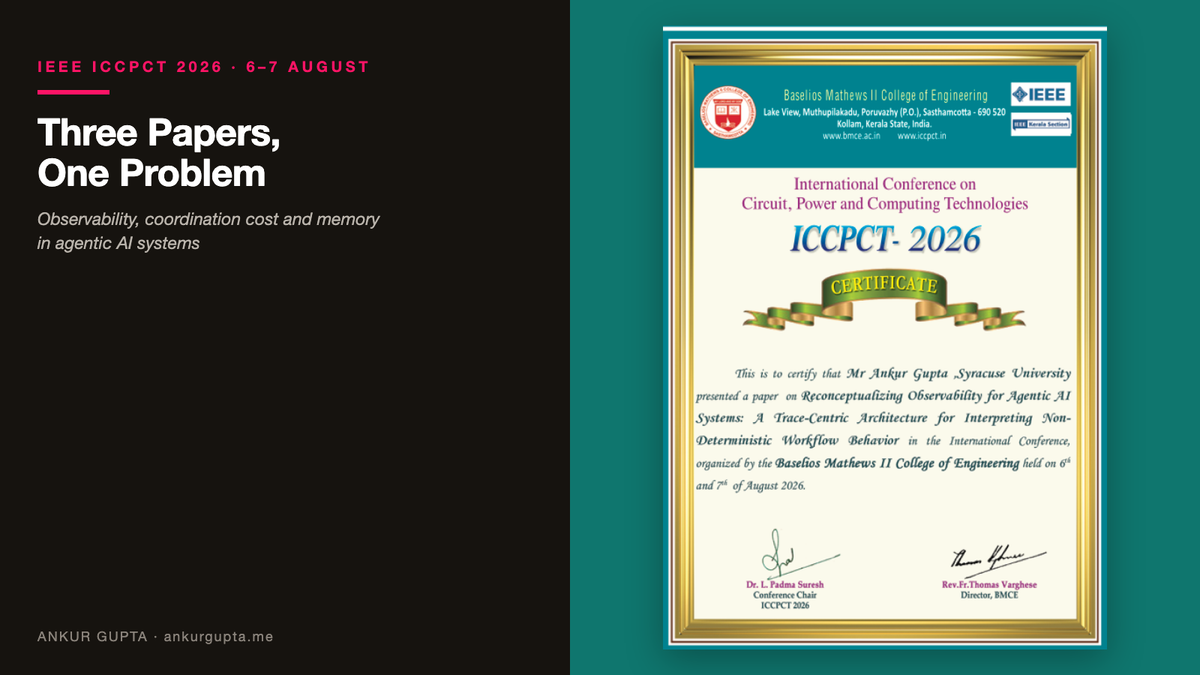
Three papers I co-authored were accepted and presented at the 9th IEEE International Conference on Circuit, Power and Computing Technologies (ICCPCT 2026), held 6–7 August 2026 at Baselios Mathews II College of Engineering, Kerala, under IEEE Kerala Section. All three sit on the same problem: agentic AI systems are being deployed faster than we have built the engineering practice to operate them.

Reconceptualizing Observability for Agentic AI Systems: A Trace-Centric Architecture for Interpreting Non-Deterministic Workflow Behavior. Classical observability assumes a deterministic call graph. Agent workflows do not have one – the same input can produce a different path on every run. This paper argues for treating the trace, not the metric, as the primary unit of observability, and sets out an architecture for doing it.
Hidden Coordination Costs in Multi-Agent AI Systems: A Comparative Study of Communication Efficiency Across LangGraph, CrewAI, and OpenAI Agents. A comparative study of what you actually pay in tokens, latency, and redundant work when you split a task across agents. The overhead is real, it is measurable, and it is rarely accounted for when teams choose a multi-agent design.
Designing Persistent Intelligence in Marketing Agents: A Hybrid Memory–Retrieval Framework for Context-Aware Knowledge Generation. A hybrid memory and retrieval design for agents that need to carry context across sessions rather than starting cold each time.
Writing three papers into one conference cycle was a useful forcing function. Ideas that felt obvious in conversation turned out to need evidence once they had to survive review.