Vector Databases: Storing Meaning for the Age of AI

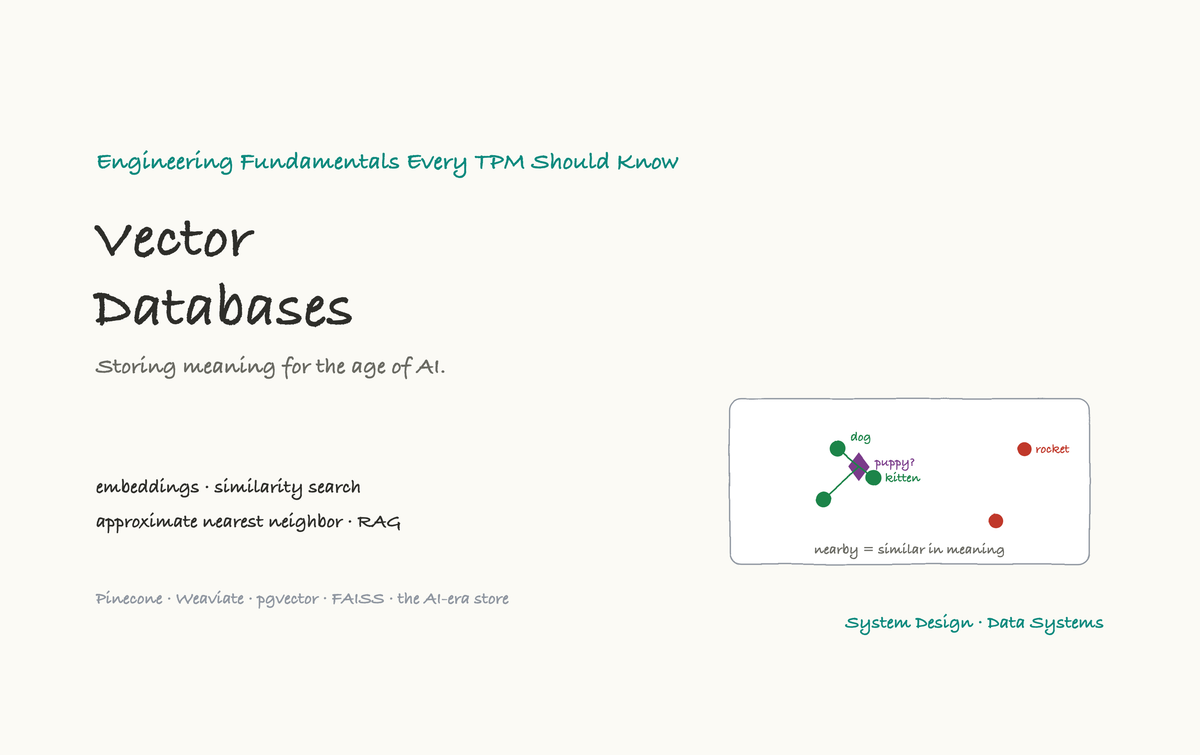
Every database we've met so far stores facts: a user's name, an order's total, a sensor's reading, a word in a document. The newest member of the family stores something stranger and more powerful: meaning itself. Vector databases are the data system born from the AI revolution, and they're behind nearly every "smart" feature you've used in the last few years, semantic search that understands what you meant, recommendations that just get you, and the chatbots that can answer questions about a company's private documents. This final deep-dive in the data systems series explains how they work, and they're a genuinely beautiful idea.
To understand vector databases, you have to start one level down, with the thing they store. Pinecone, Weaviate, the FAISS library, and the pgvector extension for PostgreSQL are the names you'll encounter.
Embeddings: turning meaning into numbers
The foundation of everything here is a concept from modern AI called an embedding. An embedding is a way of turning a piece of content, a word, a sentence, an image, a song, into a long list of numbers (a "vector") that captures its meaning.
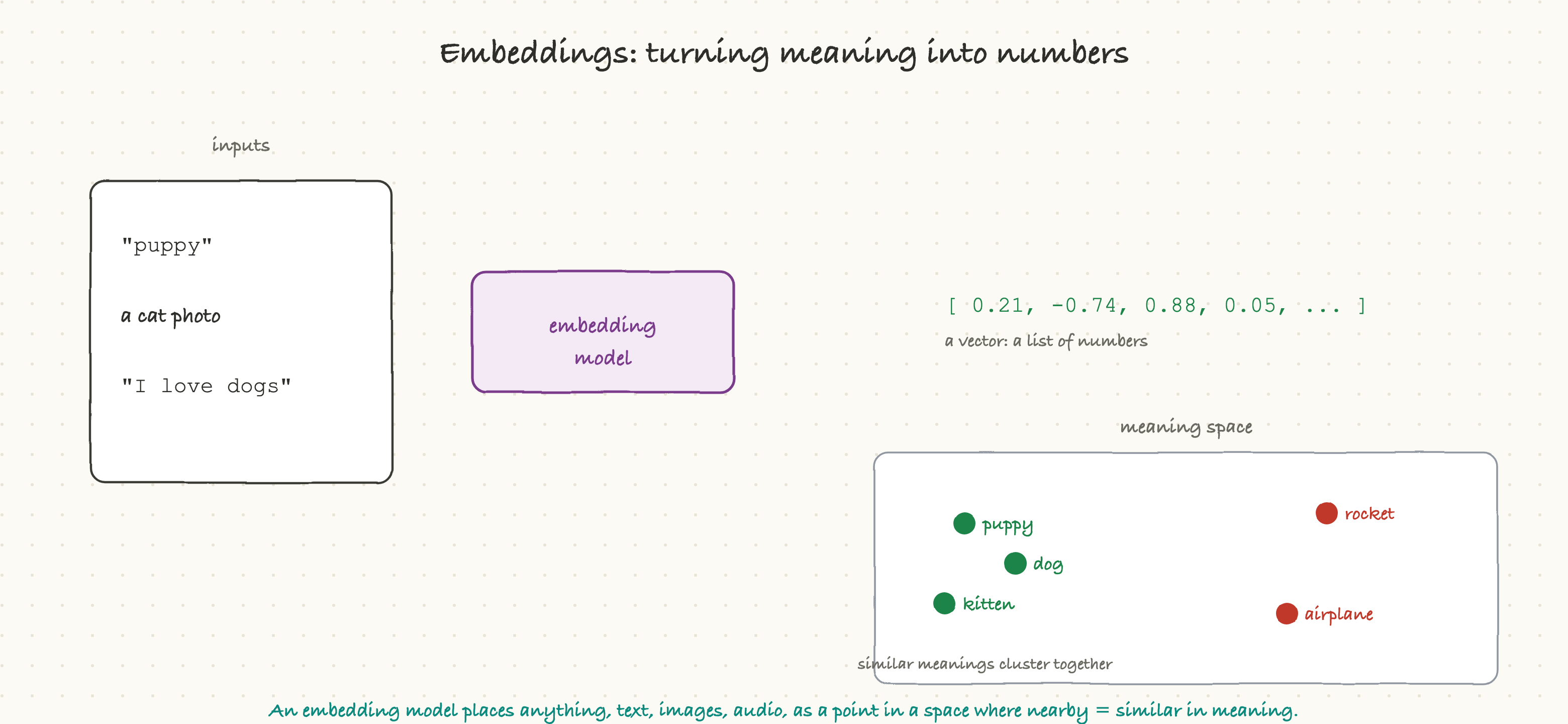
An AI model reads the content and outputs its vector, maybe a few hundred or a few thousand numbers. On their own those numbers are meaningless to a human. But here's the magic property: the model is trained so that things with similar meanings get similar vectors, landing close together in this high-dimensional "meaning space," while unrelated things land far apart. So "puppy," "dog," and "kitten" end up clustered near each other, while "rocket" and "airplane" cluster somewhere else entirely. The vector for "puppy" is close to the vector for "dog" not because they share letters (they don't) but because they mean similar things. Embeddings turn the fuzzy human notion of "similar in meaning" into concrete, measurable distance between points.
Similarity search: the one thing it does
Once your content lives as points in meaning space, a powerful new kind of query becomes possible: find the points nearest to a given point. This is similarity search, and it's the entire purpose of a vector database.
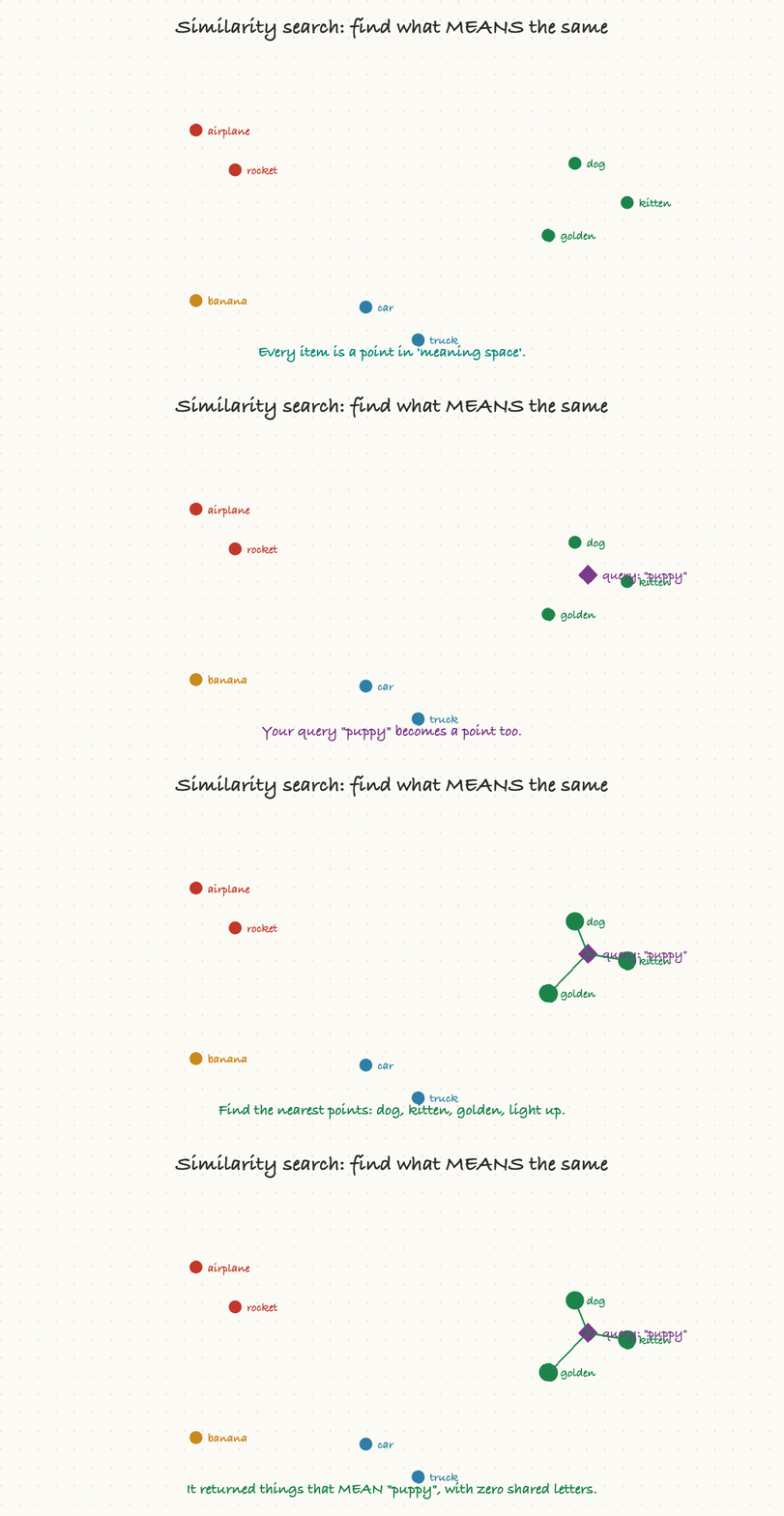
Watch what happens. Your search query, say the word "puppy," gets turned into a vector by the same embedding model, dropping it as a new point into the space. The database then finds the existing points closest to it, and those nearest neighbors are returned as the results: dog, kitten, golden retriever. The remarkable part is that it returned things that mean the same as "puppy" even though they share no letters with it. This is searching by meaning, not by spelling, and it's something none of the other databases in this series can do. A traditional search engine matches words; a vector database matches meaning.
How does it measure "closeness"? Usually by the angle between the vectors, a measure called cosine similarity.
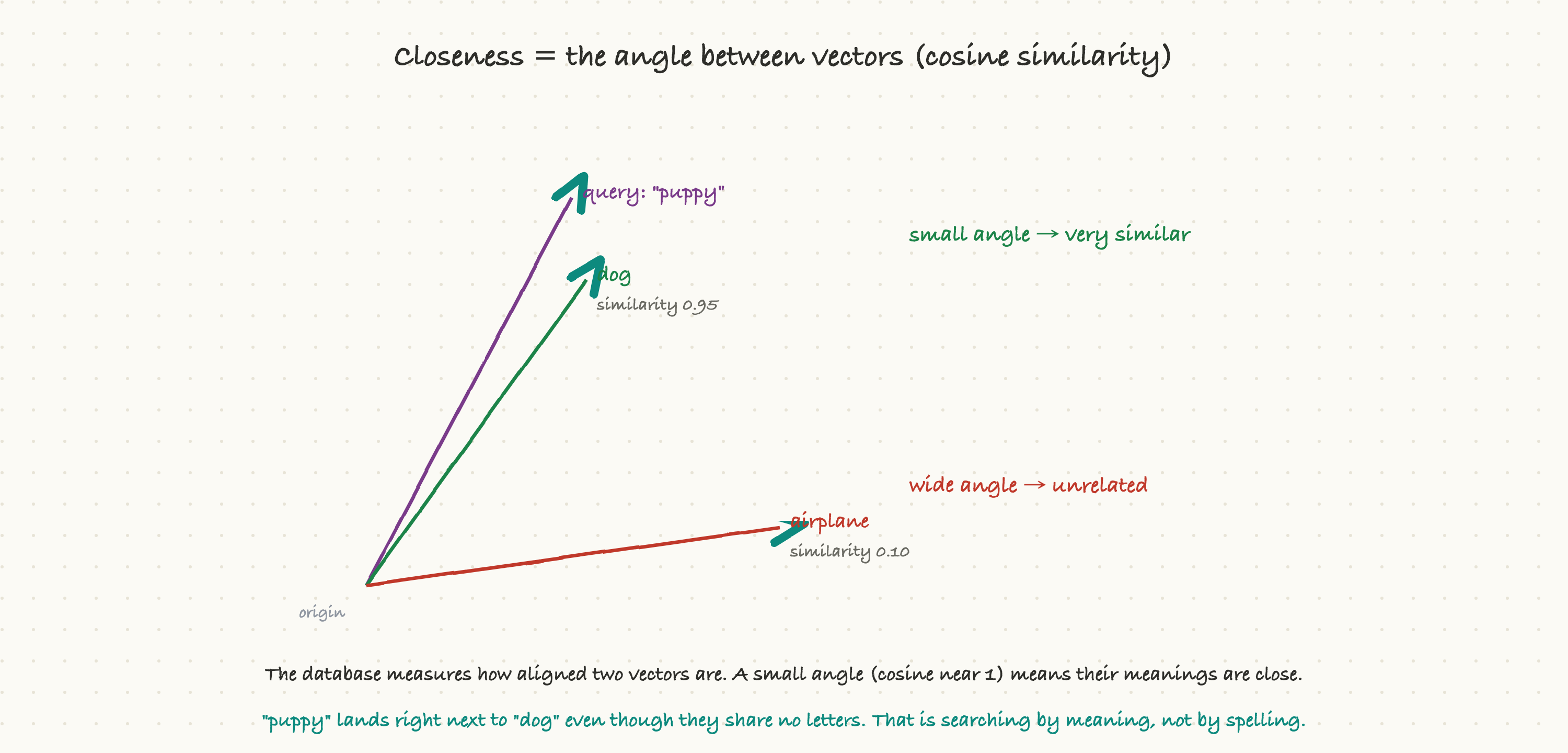
Two vectors pointing in nearly the same direction (a small angle) are very similar; two pointing in wildly different directions are unrelated. The database computes this alignment between your query vector and the stored vectors, and returns the ones most closely aligned. That's the whole idea: meaning becomes geometry, and similarity becomes a small angle.
The hard part: doing it fast
There's a catch, and overcoming it is what makes a vector database more than a pile of vectors. Finding the exact nearest neighbors is easy when you have a thousand vectors: just compare your query to every one of them. But real systems have millions or billions of vectors, and comparing against every single one for every search is far too slow.
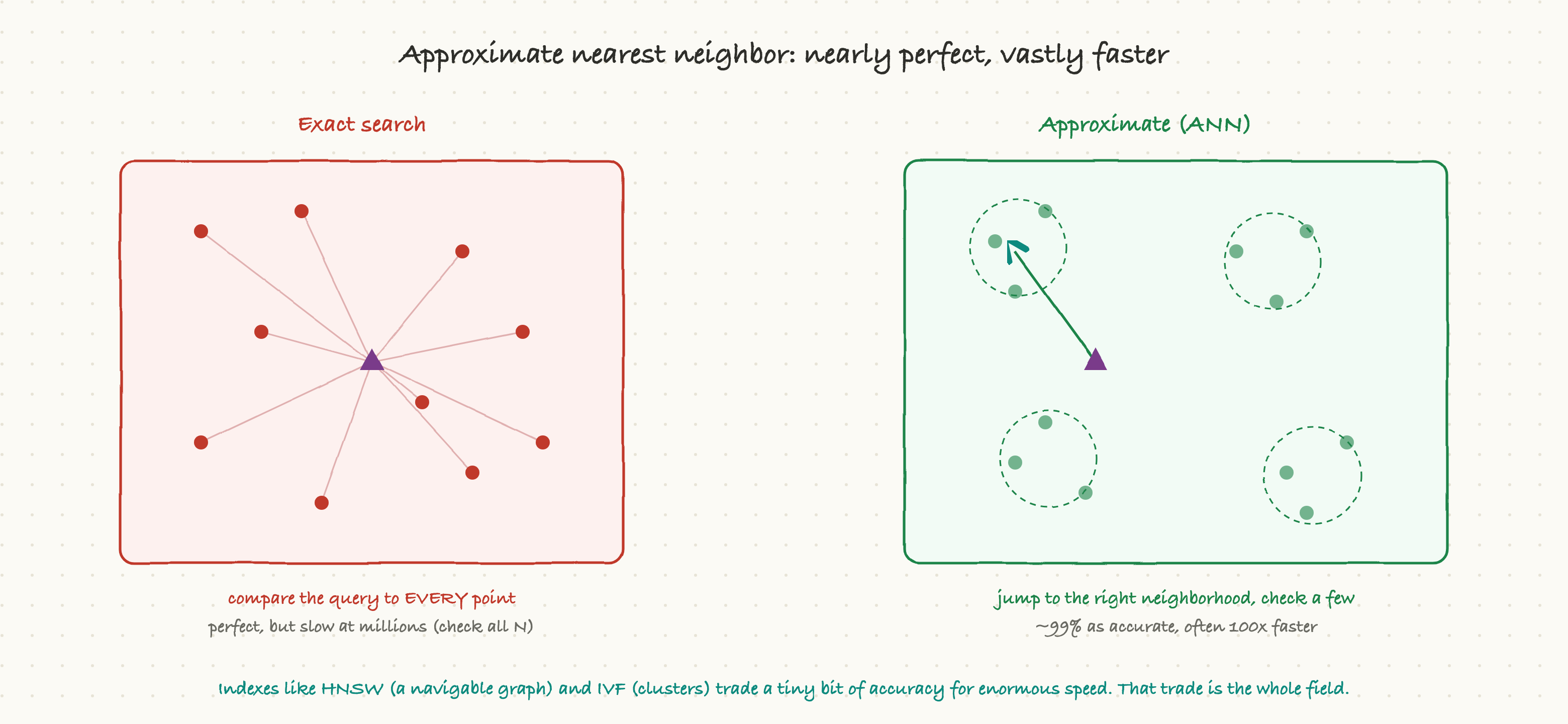
The solution is to give up a tiny bit of perfection for an enormous amount of speed, an approach called approximate nearest neighbor (ANN) search. Instead of checking every vector, the database builds a clever index that lets it jump almost straight to the right neighborhood and check only a few candidates there. Two common index types do this: HNSW, which builds a navigable graph you can hop through to home in on close vectors, and IVF, which groups vectors into clusters so you only search the nearest cluster. The result is typically about 99% as accurate as checking everything, but often a hundred times faster. That trade, almost-perfect results at a fraction of the cost, is the core engineering of every vector database, and it's what makes searching billions of vectors practical.
The killer app: RAG
The reason vector databases went from niche to everywhere is one specific use case that has reshaped how AI products are built: retrieval-augmented generation, or RAG. It's the technique behind nearly every "chat with your documents" feature.
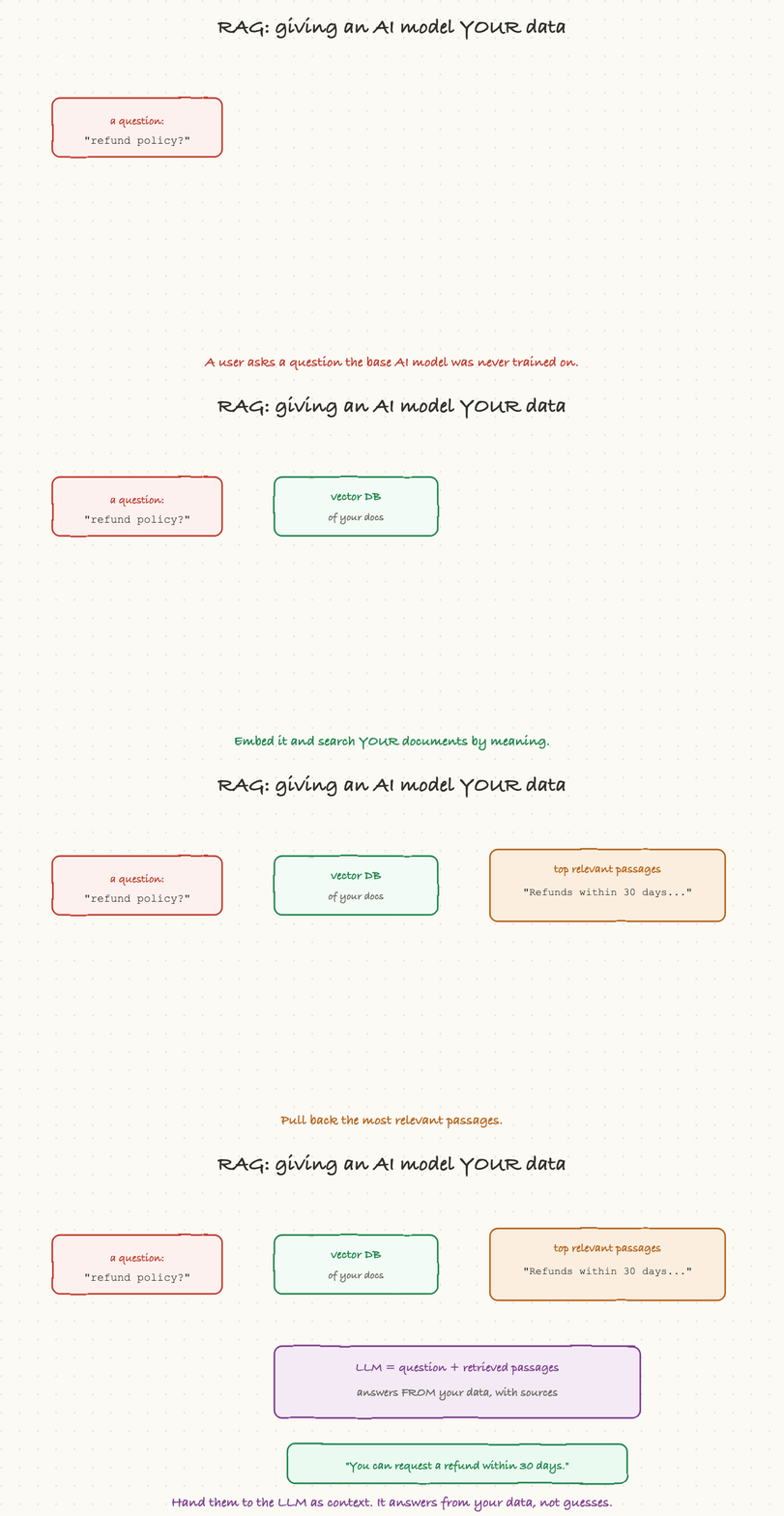
The problem RAG solves is that a large language model only knows what it was trained on, it has no idea about your company's internal policies, your product docs, or anything private or recent. RAG fixes that elegantly. When a user asks a question, you embed the question, use the vector database to search your documents for the most relevant passages, and then hand those passages to the LLM along with the question, saying in effect "answer using this." The model now responds based on your actual data, accurately and with sources, instead of guessing or making things up. The vector database is the "retrieval" half of RAG, the component that finds the right context to feed the model, and it's why these databases became essential infrastructure almost overnight.
Putting it together
Architecturally, a vector database fits into a system in a clean, two-phase way.
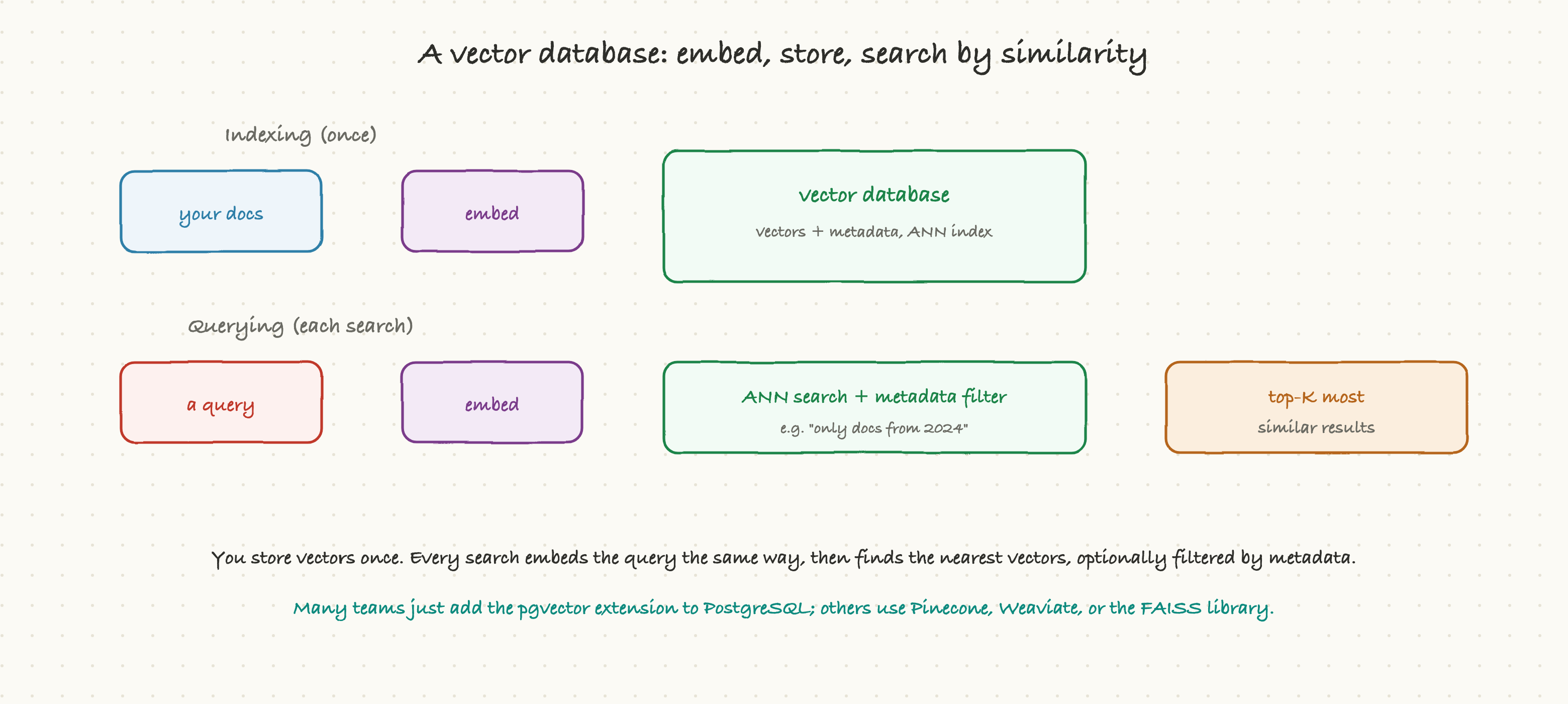
Once, up front, you take your content, run it through the embedding model, and store the resulting vectors (along with regular metadata like dates or categories) in the vector database, which builds its ANN index. Then, for every search, you embed the incoming query the same way and ask the database for the nearest vectors, often combined with a normal metadata filter ("only documents from 2024," "only this customer's data"). It returns the top few most-similar results. Notice that, like the search engine and the analytics warehouse before it, a vector database is usually a derived store, your real content lives elsewhere; the vectors are a searchable representation you can always regenerate. Many teams don't even run a separate system; they just add the pgvector extension to a PostgreSQL database they already have.
When to use one, and when not
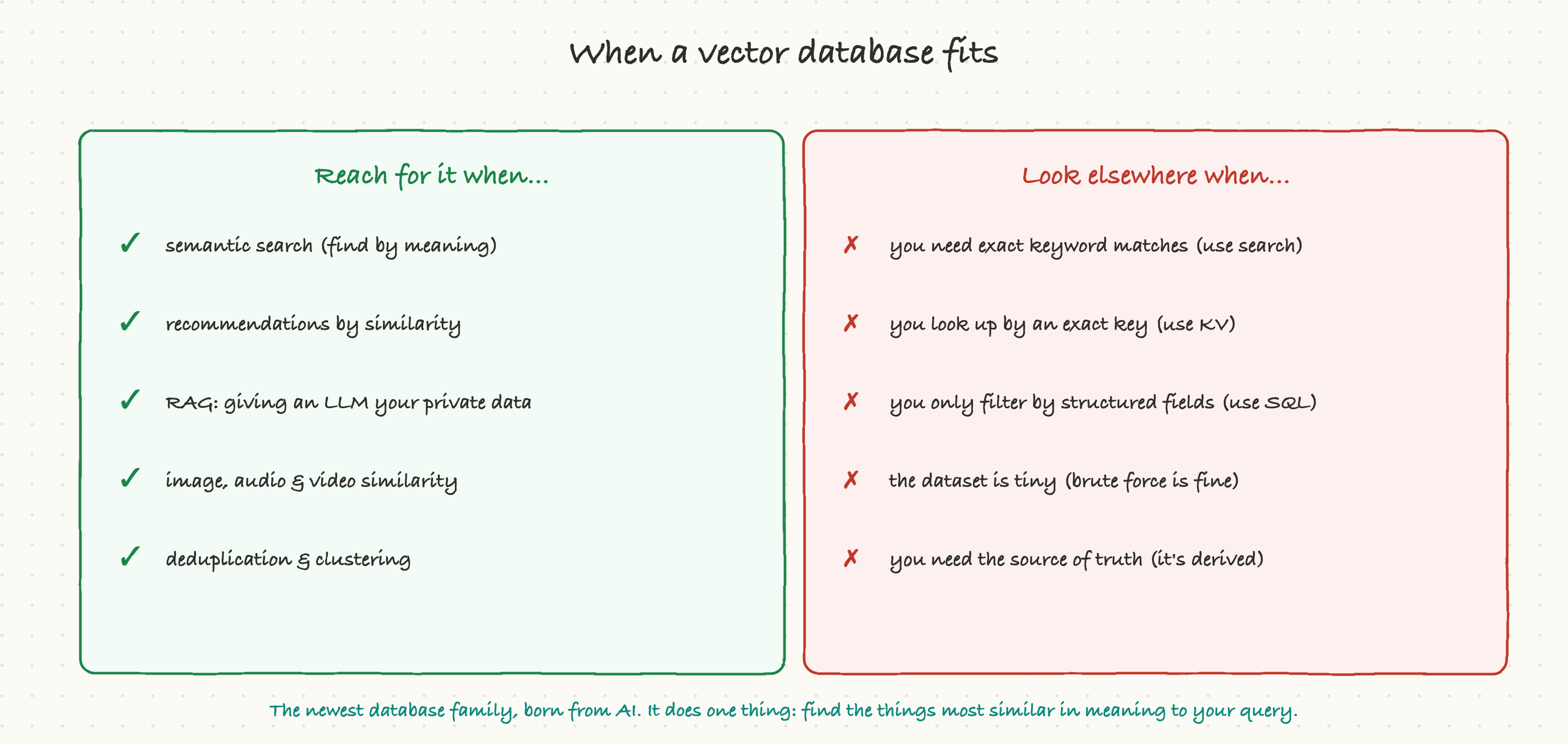
Reach for a vector database when you need to search or match by meaning: semantic search, recommendations based on similarity, RAG for AI assistants, finding similar images or audio, and deduplicating or clustering content. These are the jobs it was built for, and as AI features spread, more and more products need exactly this.
Look elsewhere when you need exact keyword matches (a search engine is better), exact key lookups (a key-value store), or filtering purely by structured fields (a relational database). And remember it's a similarity-search tool, not a system of record, your authoritative data should live in a real database, with the vectors as a derived index. The honest summary: a vector database does one thing, find the items most similar in meaning to a query, and the entire current wave of AI products is built on that one capability.
Why a TPM should care
Vector databases have gone from obscure to roadmap-critical faster than almost any technology in this series, so they're worth understanding even if you don't touch them directly:
- If your roadmap has AI features, a vector database is probably coming. Semantic search, recommendations, and especially "chat with our docs" RAG features almost always require one. Knowing that helps you anticipate the infrastructure, cost, and expertise a seemingly simple "add an AI assistant" request actually entails.
- RAG is usually the right answer to "can the AI use our data?" When stakeholders ask why a chatbot doesn't know about company-specific information, RAG (powered by a vector database) is the standard, far cheaper alternative to retraining a model. Understanding this lets you steer those conversations toward the practical solution.
- Quality depends on the embeddings and the retrieval, not just the LLM. When an AI feature gives mediocre answers, the culprit is often poor retrieval (the vector search surfaced the wrong context), not the language model itself. "Let's improve the retrieval" is frequently the higher-leverage fix, and knowing that helps you ask the right questions.
- It's still a derived store with real cost. Embedding millions of documents and serving similarity search at scale costs real money and compute. Treat a vector database like the other specialized stores in this series: powerful for its niche, an added operational and cost burden, and best justified by a genuine need to search by meaning.
The end of the journey: why we have so many databases
This is the last stop on our tour through the data systems, and it's worth stepping back to see the whole landscape we've crossed. We started with the relational database, the structured, trustworthy workhorse, and then watched specialist after specialist emerge, each born to handle a shape of data or a kind of question that the generalist couldn't. Document databases for whole, flexible objects. Wide-column for relentless write streams. Key-value for blazing-fast lookups and caching. Graph for connections. Analytical warehouses and lakehouses for understanding the business in aggregate. Search engines for finding by content. Time-series for the endless tick of metrics. And now vector databases for searching by meaning in the age of AI.
The thread running through all of it is the lesson from the very first article: there are so many databases not because of fashion or complexity for its own sake, but because "data" is not one thing, and the questions we ask of it are not one question. Each database in that intimidating architecture diagram is a different, hard-won answer to a different problem. A real modern system uses several of them together, each doing the job it's best at, a practice called polyglot persistence. And a TPM who can look at that diagram and read it as a story, who knows why each piece is there and what it's good and bad at, holds one of the most useful mental maps in all of software. That map is what this series set out to draw. I hope it serves you well.