How to Build a Program Roadmap


A program roadmap is a shared decision about where you are going, not a list of dates.
Most program roadmaps are a wall of bars on a timeline. Features down the left, months across the top, colored rectangles in the middle. It looks like a plan. It is really a guess dressed up as a commitment, and on a large cross-team program it falls apart the first time reality touches it.
I have built roadmaps for programs that spanned hundreds of teams, and the bar chart was never the hard part. Anyone can draw bars. The hard part is the thing the bar chart quietly skips: getting everyone to actually agree on where we are going, in what order, and how we will know we are making progress. A program roadmap that answers those three questions is worth something. One that just shows dates is decoration.
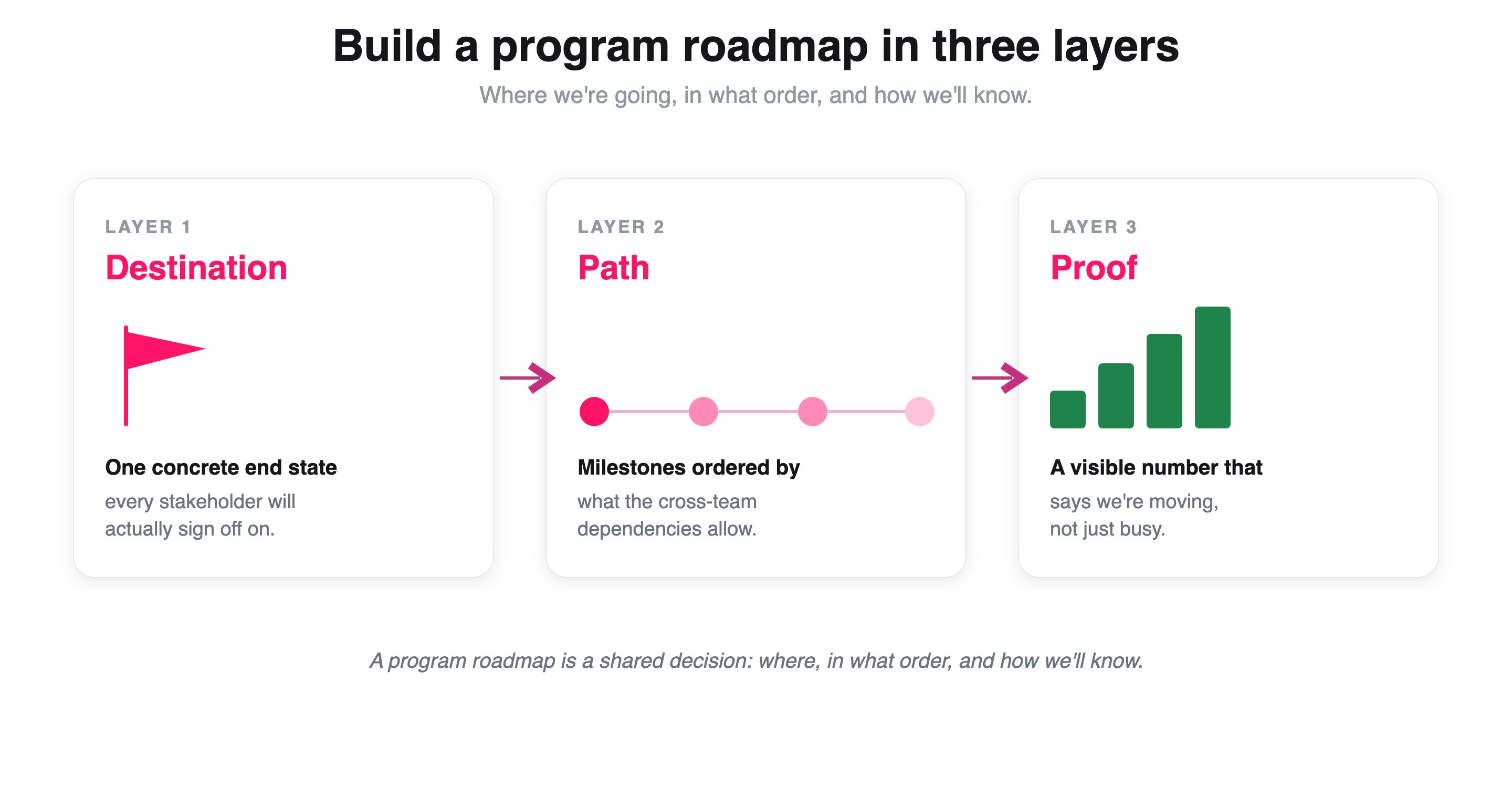
So I build every program roadmap in three layers, in this order: destination, path, proof.
Start with the destination, not the dates
The most expensive mistake I see is jumping straight to tasks and timelines before anyone has agreed on what done looks like. I lived the cost of this on a company-wide operating-model change. We had no shortage of opinions on how to do the work. What we did not have was a shared picture of the end state. The problem was never how. It was what. Until I pinned down a concrete, specific description of the finished state that every stakeholder would actually sign off on, every timeline we drew was fiction, because we were scheduling our way to a place we had not agreed on.
So the first layer of the roadmap is the destination, and it has to be concrete enough to argue about. Not "improve reliability." Not "modernize the platform." Those are directions, not destinations. A destination is "every product team operates its own services to this defined bar, and the central team no longer does it for them." It is specific enough that you can look at the world and say yes, we are there, or no, we are not. If your stakeholders cannot all describe the end state the same way, you do not have a roadmap problem yet. You have an alignment problem, and no amount of scheduling will fix it.
Then build the path, across teams, not within one
This is where a program roadmap stops looking like a product roadmap. A product roadmap mostly sequences work inside one team. A program roadmap sequences work across many teams that do not control each other, and the order is everything, because half your milestones cannot start until someone else's finishes.
So the second layer is the path: the milestones between here and the destination, laid out in the order the dependencies actually allow. On a large regional build I led, we could not just turn everything on at once, because the services were stacked on top of each other, one could not come up until the ones beneath it were already running. We had to lay out a strict, tiered sequence, build the foundation first, then the next layer, then the next. The roadmap was not a list of features. It was a build order. That is the real skill in program roadmapping: seeing the dependency graph clearly enough to sequence it, so the program flows instead of deadlocking.
And I treat dates with humility here. Near-term milestones I can commit to, because I can see the work. Far-term ones I hold loosely, as intent rather than promise, and I tighten them as they get closer. A roadmap that pretends to know the exact date of something nine months out is not confident, it is lying, and everyone reading it knows.
Make progress provable
A roadmap nobody can measure against quietly dies. The third layer is proof: a clear signal, in numbers, that tells everyone whether we are actually moving toward the destination or just busy. On that operating-model change, the breakthrough was turning the destination into a simple count, the number of activities that had moved from the old owners to the new ones. Suddenly progress was not a feeling or a status update. It was a percentage everyone could see, all the way up to the leaders watching the program.
The proof metric does two things. It keeps the program honest, because you cannot hide a flat line. And it makes the roadmap self-policing, because when progress is visible to everyone, teams do not want to be the ones holding it back. A roadmap with a real metric attached is alive. You review it, the number moves or it does not, and you adjust. A roadmap without one is a poster, printed once and ignored.
The roadmap is the alignment, not the artifact
Put the three layers together and the roadmap stops being a chart and becomes a shared decision: this is where we are going, this is the order we will get there, this is how we will know. The bars on the timeline are the least important part. I could lose the Gantt chart entirely and still run the program, as long as everyone agreed on the destination, the sequence, and the signal.
That is the reframe I would leave you with. A program roadmap is not a schedule you defend. It is an agreement you build and keep current. Get the destination right and the alignment follows. Get the path right and the program flows. Get the proof right and it stays honest. The rectangles on the timeline are just the part everyone looks at. The three layers underneath are the part that actually works.
How to cite this:
Gupta, A. (2024). How to Build a Program Roadmap. Ankur Gupta. https://ankurgupta.me/how-to-build-a-program-roadmap/
This work is licensed under CC BY 4.0 — you're welcome to share and adapt it, with credit to Ankur Gupta and a link back to this original post.