Leading Without Authority: The Operating System of a Technical Program Manager

Every technical program manager eventually runs into the same uncomfortable fact: you are accountable for outcomes you cannot command. The engineers do not report to you. The architects do not need your sign-off. The executive who set the deadline will not write a line of the code that meets it. And yet, when the program slips, the first question lands on your desk.
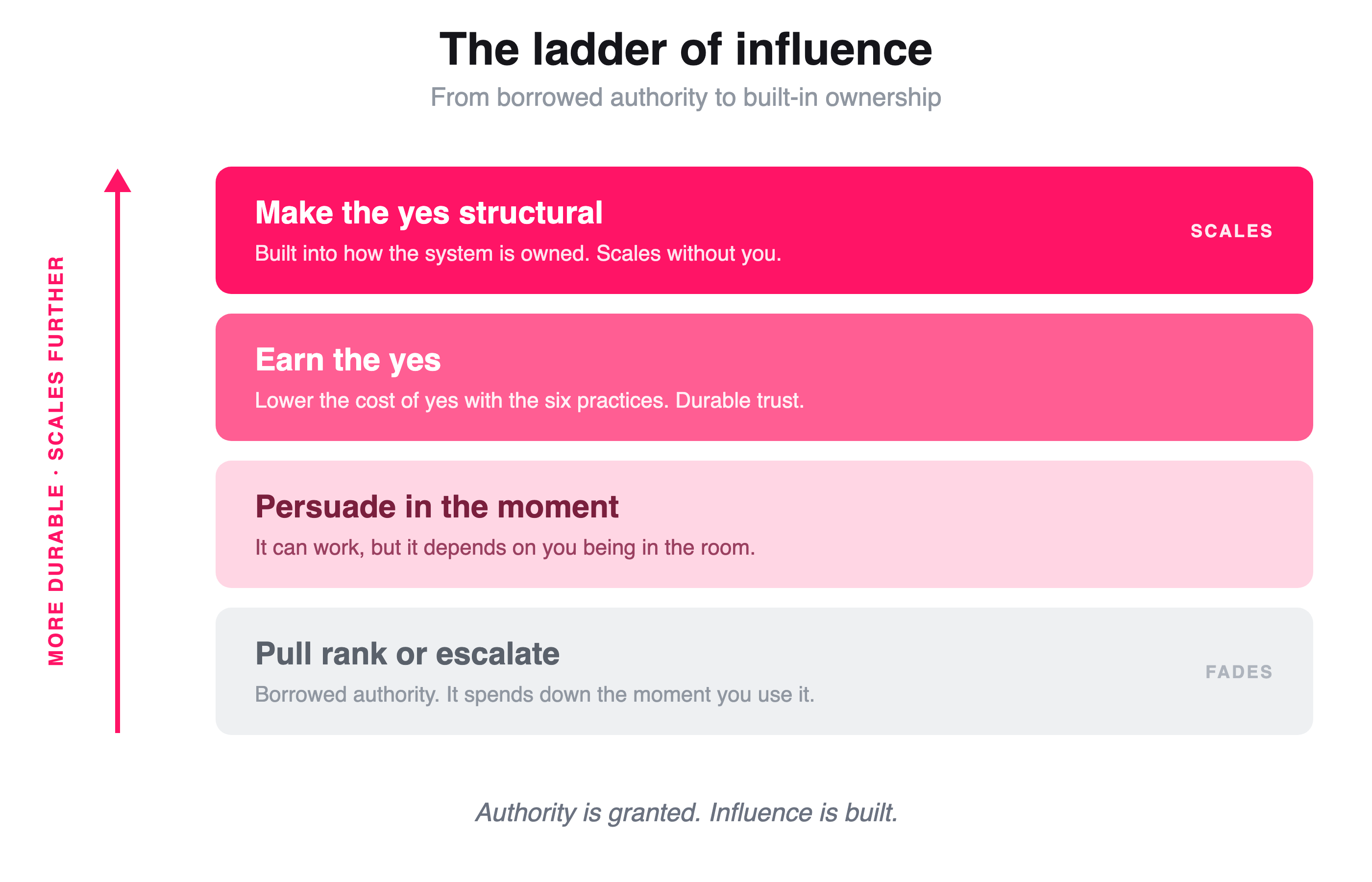
The usual name for this is "leading without authority." It is worth being precise, because it is easy to fake. Here is the test I use: if you had to pull rank or escalate to get something done, you did not influence anyone. You borrowed someone else's authority. Real influence is quieter. It is when people follow your recommendation because they want to, because they believe you are right and that you have their interests in mind.
After many years running cross-organizational programs, I stopped treating this as charisma and started treating it as a system. The system comes down to one idea.
The cost of yes
Every "no" is someone protecting themselves from a cost. Not usually a price in dollars, but in risk, effort, attention, or exposure. When you ask a busy team to change course, they are quietly asking a few questions. Do I trust the person asking? Am I convinced this is right? What is this going to cost me, and what happens if it goes wrong?
Influence is not winning those arguments. It is lowering the cost of yes until saying yes is the easy, obvious move. Most of the work is removing the specific cost that is making someone hesitate. What follows is the system I use, built from the ground up.
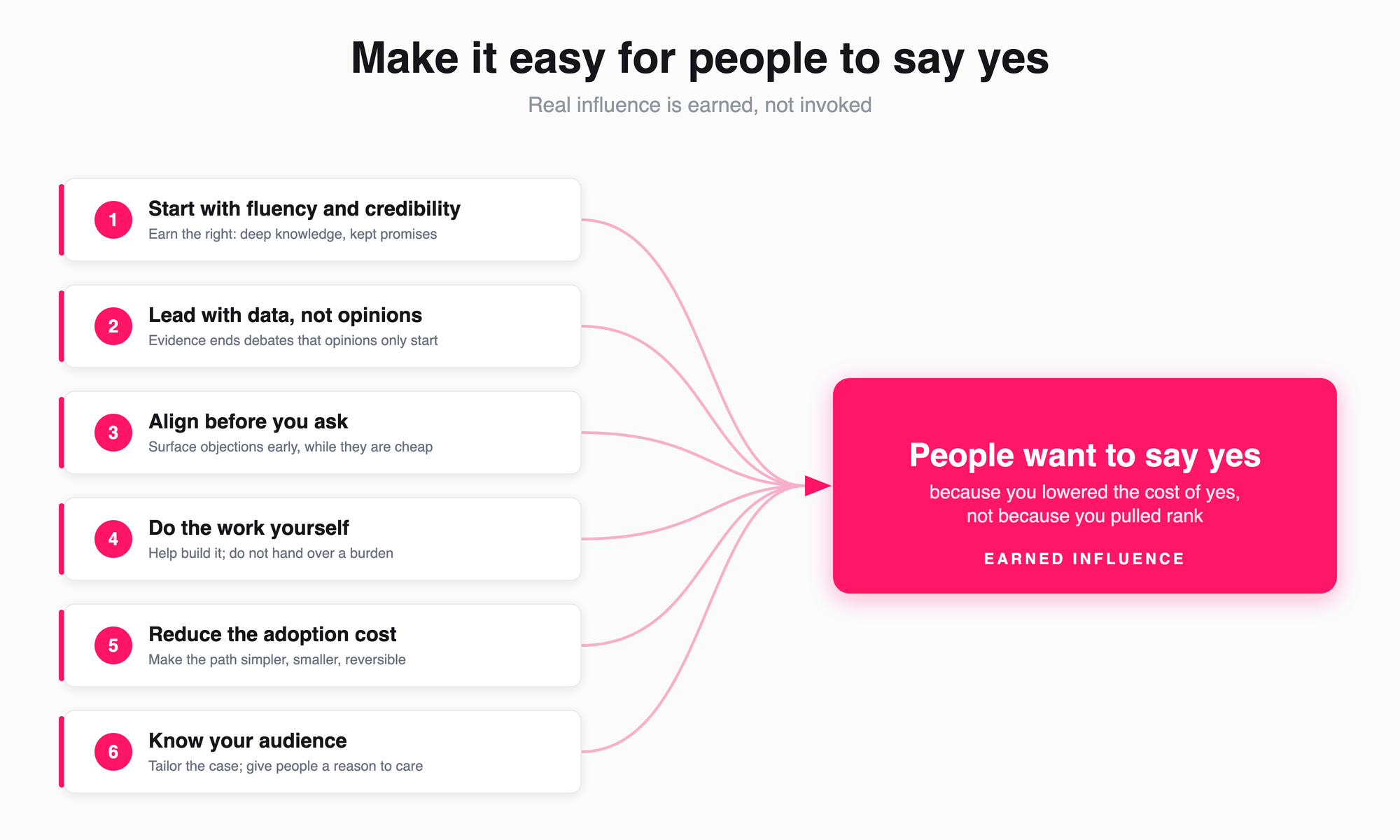
Start with fluency and credibility
Earn the right: deep knowledge, kept promises
Everything else rests on this, so it comes first. Before anyone weighs your recommendation, they weigh you. And they are really asking two things: do you actually understand this problem, and have you been right before?
The first is subject fluency. You have to know the domain well enough that your read of it is trustworthy: the systems, the constraints, the failure modes, the history of what has already been tried. Fluency is what lets you say something true that the room has not considered yet. Without it, no amount of technique helps.
The second is credibility, and it is the most valuable thing a TPM owns. Credibility is the interest you earn on every promise you kept. It cannot be requested or charmed into existence. It can only be accumulated, and a long record of saying what is true even when it is inconvenient is what turns your word into a reliable signal. Each practice that follows both spends a little credibility and earns more of it back.
Lead with data, not opinions
Evidence ends debates that opinions only start
People resist opinions and accept data. An opinion invites a counter-opinion, and now you are in a debate settled by volume or seniority, not merit. A number changes the conversation. It moves from "I think" to "here is what is true," and it lets the other person change their mind without losing face.
So I do not arrive with a position. I lay out the problem, the options, the trade-offs, and the one number people most often skip: the cost of doing nothing. Most teams over-weigh the risk of change and ignore the slow, compounding cost of the status quo. Naming it makes the right answer obvious. The goal is not to win the argument. It is to make the argument unnecessary.
One caution. Data earns trust only if you also show the numbers that do not flatter your case. The moment people sense you are cherry-picking, you are back to trading opinions, just with charts.
Align before you ask
Surface objections early, while they are cheap
Most of the "no" answers in a big meeting were earned days earlier, when someone was caught off guard. People rarely object to your proposal as much as they object to being surprised by it in front of their peers.
So I do the alignment in private, first. And I go in trying to understand the other team's world: their risks, their incentives, their constraints, and what they are afraid of losing. A change that looks obviously good from my seat may threaten a commitment they have already made. I resolve those concerns in small conversations, where adjusting costs a sentence, long before forcing a decision in the big room. By the time I ask for commitment, the decision should feel inevitable, because everyone who mattered has already been heard.
Do the work yourself
Help build it; do not hand over a burden
This is the practice most people skip, and it builds the most trust. It is easy to propose a solution and hand it to a team as a new obligation. It is much harder, and far more persuasive, to carry part of the load yourself.
Consider a planning tool that turned projected business growth into hardware needs. The first design asked every team to write custom code, and the pushback was immediate and fair. So I changed the design to lower the cost, and then I did the part that mattered. I sat with each team, learned how they forecast by hand, and helped them translate that judgment into a few simple formulas of their own. I helped implement, I followed through, and I gave them the credit. One team at a time, I collected sign-off until the whole ecosystem was on board. Every time you help someone succeed and let them own the win, you build the credibility that makes the next decision easier.
Reduce the adoption cost
Make the path simpler, smaller, reversible
Doing the work yourself does not scale, and it is only half the answer. The other half is designing the thing so it costs less to adopt in the first place. The same proposal can be a hard yes or a hard no depending on how much friction it carries.
So before I ask anyone to move, I attack the friction. A simpler design. Clearer ownership, so no one is agreeing to a vague new responsibility. A lower migration burden, broken into small reversible steps instead of one risky leap. Better tooling, so the easy path and the right path are the same path. Often the most persuasive thing you can do is not a better argument. It is a smaller ask.
Know your audience
Tailor the case; give people a reason to care
Everything so far is rational, and rational is necessary but not sufficient. People are not spreadsheets. The same data lands differently depending on who is hearing it and what they care about.
So I tailor the approach to the person. An engineer wants the trade-offs and the edge cases. A director wants the risk and the headline. Someone burned by a past migration wants to know what is different this time. And underneath the logic, you have to give people a reason to care, a picture of the better state on the other side that they would actually want to live in. The relationship and the vision are not soft extras. They are what makes the rational case worth saying yes to.
Own less, influence more
Every practice so far depends on you, on being in the room, carrying the load, spending your credibility. The most advanced form of leading without authority removes that dependency. Influence that needs your presence does not scale. Influence built into how a system is owned does.
For years, a platform team I was on owned a central ledger holding every team's compute capacity. It felt like control. It was actually a bottleneck: every change routed through us, and the teams using the capacity could not even see their own numbers. Moving ownership to them was obvious on paper, but everyone had a quiet reason to resist. My team liked being the gatekeeper. The product teams did not want a new burden. Infra feared a free-for-all. So I ran the same playbook one level up. I led with the cost of the bottleneck, aligned in private around what each group feared losing, made ownership a simple, and ran the migration myself.
The bottleneck disappeared, and the yes became permanent: no one had to be talked into the model again, because it was simply how the system worked. I had more influence over capacity after I gave the control away than I ever had while holding it. That is the move worth hunting for: ask what you are holding that the people closest to the work should own, and give it away on purpose.
The real lesson
"Leading without authority" sounds like a limitation. It is closer to a higher standard. Authority is a blunt instrument. It can force one team for one quarter, and it spends down the moment you use it. Influence, earned by lowering the cost of yes and then making that yes structural, makes people want to move in the same direction, and that scales almost without limit.
So treat the urge to pull rank as a warning light. When you feel it, the real work, finding the cost that is making someone hesitate and removing it, is still in front of you. Authority is granted. Influence is built, deliberately, one removed cost and one kept promise at a time.
How to cite this:
Gupta, A. (2026). Leading Without Authority: The Operating System of a Technical Program Manager. Ankur Gupta. https://ankurgupta.me/leading-without-authority-the-operating-system-of-a-technical-program-manager/
This work is licensed under CC BY 4.0 — you're welcome to share and adapt it, with credit to Ankur Gupta and a link back to this original post.