On Zee Business: Why AI Hallucinates, and How to Use It Responsibly
I joined a Zee Business India 360° panel (Feb 2026) on AI hallucinations: why models confidently make things up, how to verify their output, practical prompt techniques, and where AI regulation stands across the EU, US, and India.

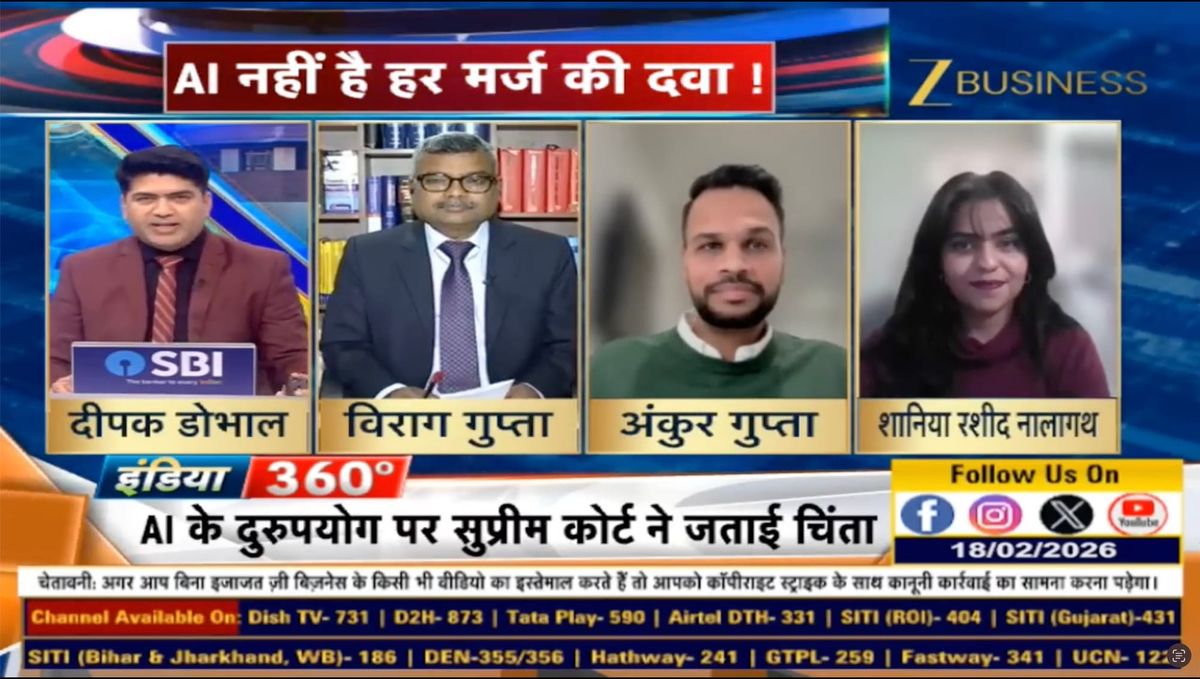
I joined a Zee Business "India 360°" panel on 18 February 2026, invited as an AI infrastructure expert alongside a Supreme Court advocate and a fellow AI specialist. The trigger was a Supreme Court observation about lawyers citing AI-generated case judgments that simply do not exist. The conversation quickly widened into something every AI user should think about: why these systems confidently make things up, and how to use them without switching off your own judgment. Here are the points I made.
What "AI hallucination" really is, and why it happens
AI hallucination is a real problem, and it is sneaky precisely because the answers sound completely right and arrive with total confidence. Ask a model who invented mobile phones in 2005 and it will happily invent a person and a backstory that never existed. It is not limited to legal work; it can surface in any article, any background fact, any topic. Even when I ask a tool to make up a bedtime story for my younger son, it produces a convincing fake instantly.
The reason sits in how these systems work. A large language model is, at its core, a statistical next-word predictor: given what you have typed, it guesses the most probable next word, then the next, like a very sophisticated game of fill-in-the-blanks. It does not necessarily "know" facts. So a hallucination is not magic, it is just a confident-sounding wrong answer, which is exactly what makes it dangerous.
How to use AI without getting burned
For an individual, the protection is limited but real. Whatever tool you use, Google, Gemini, ChatGPT, you will get useful output, and most of it may be right, but some of it can be wrong. The fix is unglamorous: cross-verify, especially for anything legal or health related, against multiple credible sources. The honest obstacle is that we have grown so used to instant answers that we do not want to spend the time checking. Use AI to research and to surface data, but keep your own judgment in the loop about whether that data should actually be used.
Make the model show its work
Two practical techniques I rely on. First, ask the model to cite its sources. When you write the prompt, explicitly tell it to list where the answer comes from; then you can go and check whether those sources are real and actually say what the model claims. I do this even for medical questions or any important input. Second, for domains where trust really matters, legal, medical, regulated information, the better pattern is to build agents that can only draw from a specific, vetted data set (a trusted legal or medical corpus) rather than the open internet, so every answer is grounded in, and cited from, that constrained set.
The regulation picture
Individuals can only do so much; responsibility also has to sit with the companies building these models, and with regulators. The landscape is uneven. The European Union passed the first comprehensive AI Act in 2024, the strictest so far, with a risk-based approach that sorts systems into unacceptable, high, limited, and minimal risk. The United States leans innovation-first and sector-specific, regulating AI largely through existing consumer-protection, civil-rights, employment, and data-privacy laws, plus executive orders. India has the IT Act, the IT Rules, and the Digital Personal Data Protection Act, and is building out its framework, but it needs to move faster: pass sensible initial regulations, and because this is a fast-evolving field, keep revising them as the technology changes.
The throughline of the whole panel was simple: AI is an enabler, not a substitute. It is a genuinely powerful tool, but the moment we let it do our thinking for us, we lose the one thing that catches its mistakes, our own judgment.
Aired on Zee Business, India 360° / Cover Story, 18 February 2026. The opinions expressed are the speaker's own and do not represent any employer.