
Highlights
Session Chair, IEEE CONIT 2026
I'm serving as Session Chair at the Sixth IEEE International Conference on Intelligent Technologies (CONIT 2026) in Hubballi, India, on June 20, 2026.
Senior Staff Technical Program Manager, AI Infrastructure at LinkedIn. 15 years across machine learning infrastructure, distributed systems, and reliability engineering.

Highlights
I'm serving as Session Chair at the Sixth IEEE International Conference on Intelligent Technologies (CONIT 2026) in Hubballi, India, on June 20, 2026.

Highlights
My paper on a replica-centric capacity-planning framework for GPU and Multi-Instance GPU (MIG) based AI inference platforms was accepted at IEEE MetroInd 4.0 & IoT 2026 in Rome, Italy.

Highlights
I spoke at the Budapest Data + AI Forum 2026 on why ML deployments fail in production and how to engineer reliability at scale. Session abstract, key takeaways, and links.

Highlights
I recently sat down with Business Standard for their Manager's Mantra series (BSmart). What started as a conversation about automation and managerial roles turned into a wide-ranging discussion: enterprise cloud strategy, the economics of AI infrastructure, how to build data platforms people actually use, modernizing legacy systems,

Highlights
I presented our paper "Operationalizing Site Reliability in Large-Scale Distributed Systems: Shifting Ownership Left" at IEEE CSNT 2026 (Al-Khobar, Saudi Arabia): predictive models that forecast failures to keep large-scale distributed systems reliable.

Highlights
OneIndia profiled my work on AI model deployment: cutting deploy times from days to hours, lifting success rates from roughly 60% to nearly 99%, and serving about 4x more requests per GPU.

Highlights
I joined a Zee Business India 360° panel (Feb 2026) on AI hallucinations: why models confidently make things up, how to verify their output, practical prompt techniques, and where AI regulation stands across the EU, US, and India.
System Design
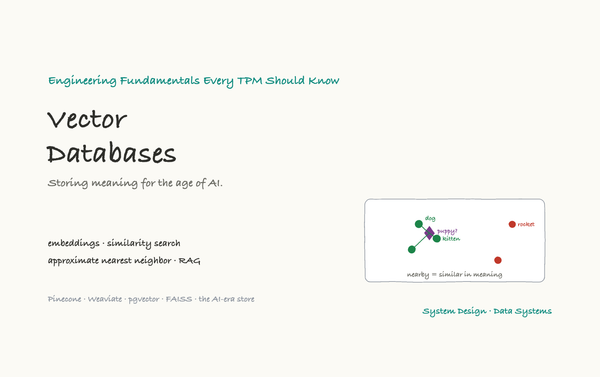
Every database we've met so far stores facts: a user's name, an order's total, a sensor's reading, a word in a document. The newest member of the family stores something stranger and more powerful: meaning itself. Vector databases are the data system

System Design
There's a kind of data that has quietly exploded in volume over the last decade, and you generate it constantly without thinking. Every time a server reports its CPU usage, every time an app records how long a request took, every time a thermostat notes the temperature, every

System Design
Type a few words into a search box and, in a fraction of a second, you get back the most relevant results out of millions or billions of documents, ranked best-first, with your typos forgiven and suggestions appearing as you type. We're so used to this that

System Design
Every database we've covered so far has one job: running an application. They store orders as they're placed, serve profiles as they're viewed, accept writes as they happen. This is the live, operational heartbeat of a product, and it's called OLTP, online

System Design
Every database family we've covered so far treats relationships as a secondary concern. Relational databases reconstruct them with joins at query time. Document databases mostly avoid them by nesting data. Key-value and wide-column stores barely acknowledge them. But for a whole class of important problems, the