The TPM Operating System Behind Large-Scale Program Execution
How a technical program manager actually runs a large program, from the first funding conversation to the hundredth status update.

A program is not a plan
Every failed program I have seen had a plan. Usually a good one. A clean deck, a timeline with tidy quarters, a list of milestones everyone nodded at in the review. Three months later the same program was late, the teams were confused, and nobody could say exactly where things stood.
The plan was never the problem. A plan is a snapshot, and a program is a living thing. A plan tells you what you intended on the day you wrote it. A program has to survive contact with reality: teams that shift priorities, dependencies nobody drew, a vendor that slips, a reorg that moves half your owners. A plan absorbs none of that. It just goes stale.
The best technical program managers I know stopped thinking of themselves as people who make plans. They think of themselves as people who run a system. Not software, but an operating system in the older sense: a set of standing structures and repeating routines that keep a large, messy effort moving in one direction without someone hand carrying every decision.
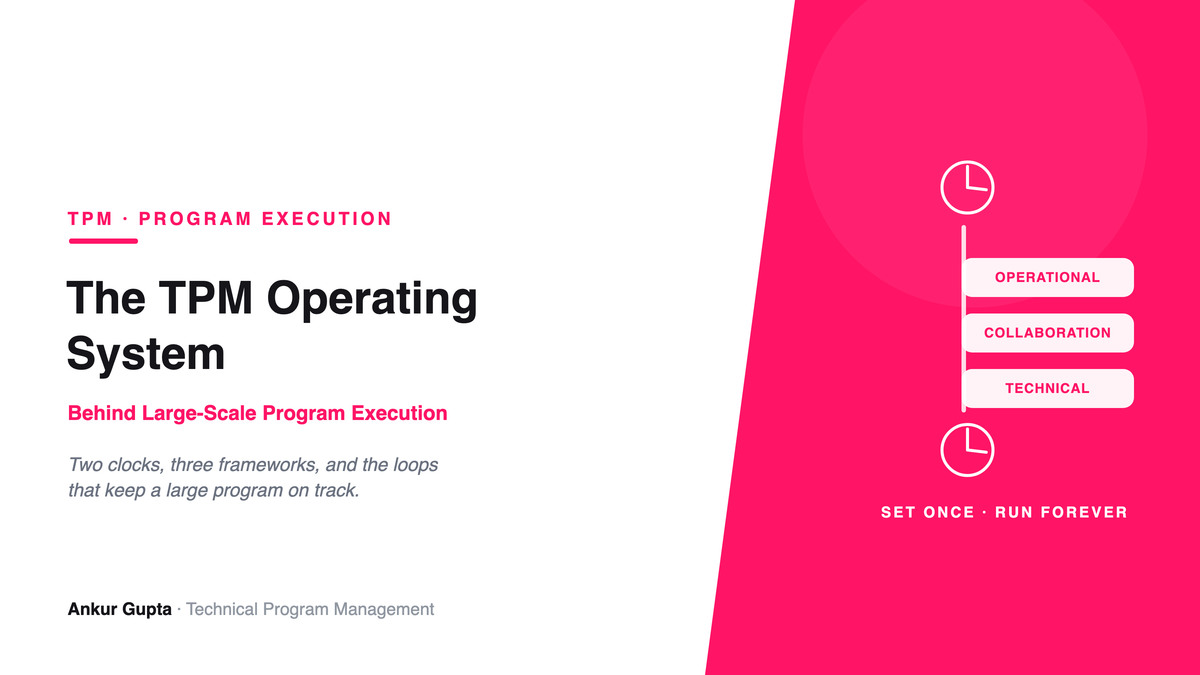
That is what this piece is about. Not how to draw a prettier roadmap, but how to build the operating system around it so the roadmap stays true. I will give you the whole thing, the parts you set up once and the parts you run forever, so you can take it and stand up a real program instead of a nice document. Two ideas hold it together. There are two clocks, the work you do once at the start and the work you repeat forever. And there are three lenses you look through at every step, so no part of the program surprises you.
Plan, project, program: three different animals
A quick clearing of terms, because mixing them up is where a lot of programs go wrong. A project is a single effort with a clear deliverable, usually one team: ship this service, migrate this database. A program is a set of related projects that only add up to something if they move together, a dozen teams whose combined work produces one outcome, like a new region coming online or a company changing how it handles reliability.
The mistake that hurts most is running a program like a big project. A big project says: here is the work, break it down, track the tasks. A program cannot be run that way, because the hard part is not the work inside each team. It is the space between the teams: the dependencies, the sequencing, the competing priorities, the decisions no single team can make alone. If you manage a program as one giant task list, you will track a thousand things and still miss the five that actually gate the outcome.
So the operating system has to hold three views at once. I call them the three lenses.
The three lenses
Every real decision in a program has three faces, and if you only look at one, the other two will surprise you.
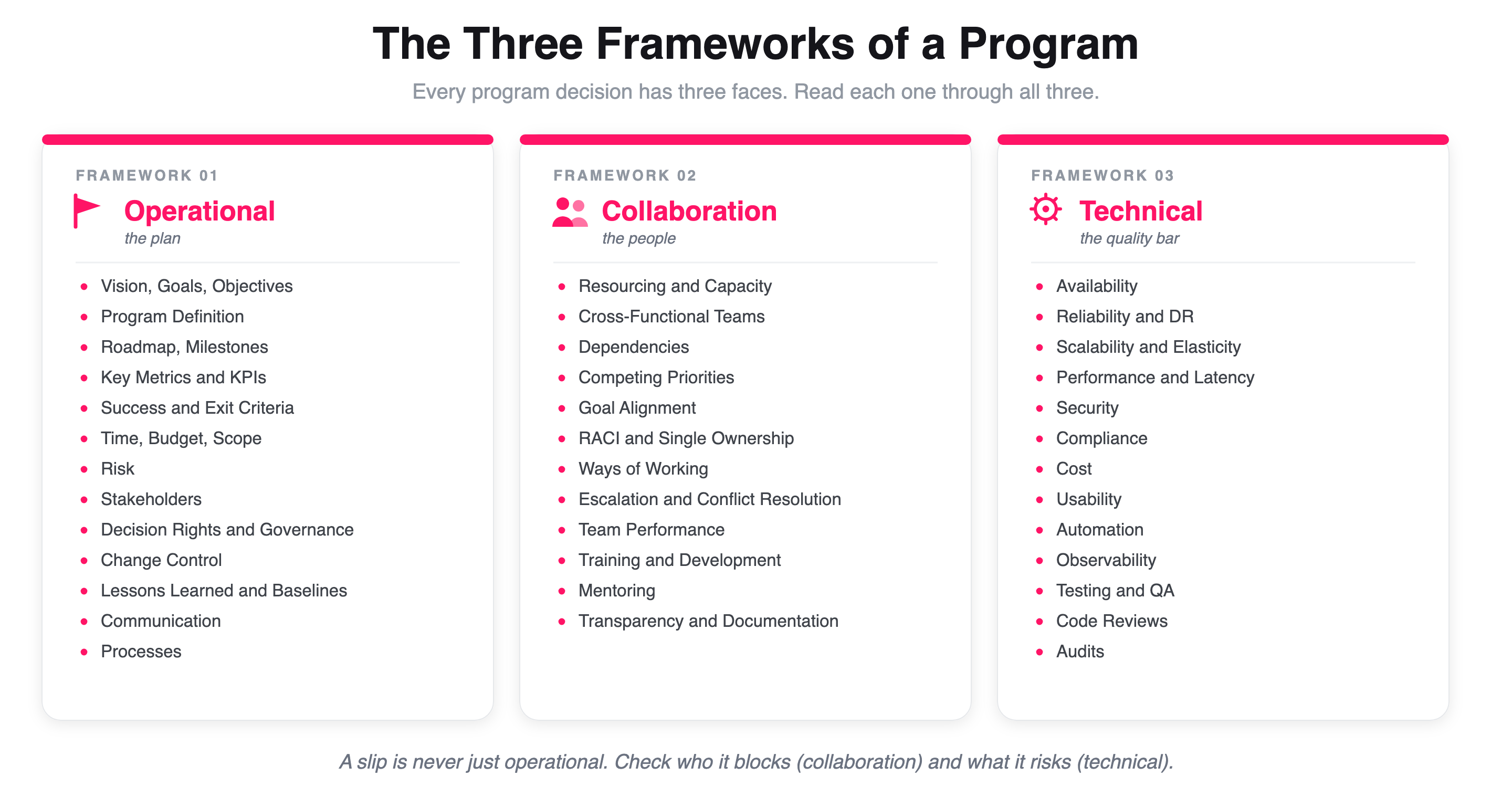
The operational lens is the plan itself: the vision it serves, the scope, the milestones, the metrics, the budget, the risks, how changes get approved. This is the lens most people mean when they say program management. It answers what we are doing, by when, and how we know it is working.
The collaboration lens is the people system: which teams are involved, who owns what, where the dependencies run between them, whose priorities compete with yours, who decides when there is a conflict, and how you keep a couple hundred people pointed the same way. This is the lens that is hardest to see on paper and the one that quietly kills more programs than any technical problem. In one company wide reliability shift I worked on, moving ownership from a handful of central teams to hundreds of product teams, almost none of the difficulty was operational. The plan was simple. The hard part was that hundreds of teams each had their own roadmap, their own manager, and their own reasons to deprioritize me. The collaboration lens was the whole game.
The technical lens is the quality bar of whatever you are delivering: will it scale, is it available, is it secure, what does it cost to run, can it be operated, is it automated and monitored, does it meet compliance. A TPM does not have to be the deepest engineer in the room, but you have to hold these questions, because a program that hits every date and ships something that falls over in production has not succeeded. It has just failed on schedule.
You do not run these lenses in sequence. You hold all three at every step. When a team says they will slip two weeks, the operational lens asks what it does to the critical path, the collaboration lens asks who downstream is now blocked and who needs to hear it, and the technical lens asks whether the thing slipping is load bearing for scale or security. Same event, three questions, one person asking all of them. That person is you.
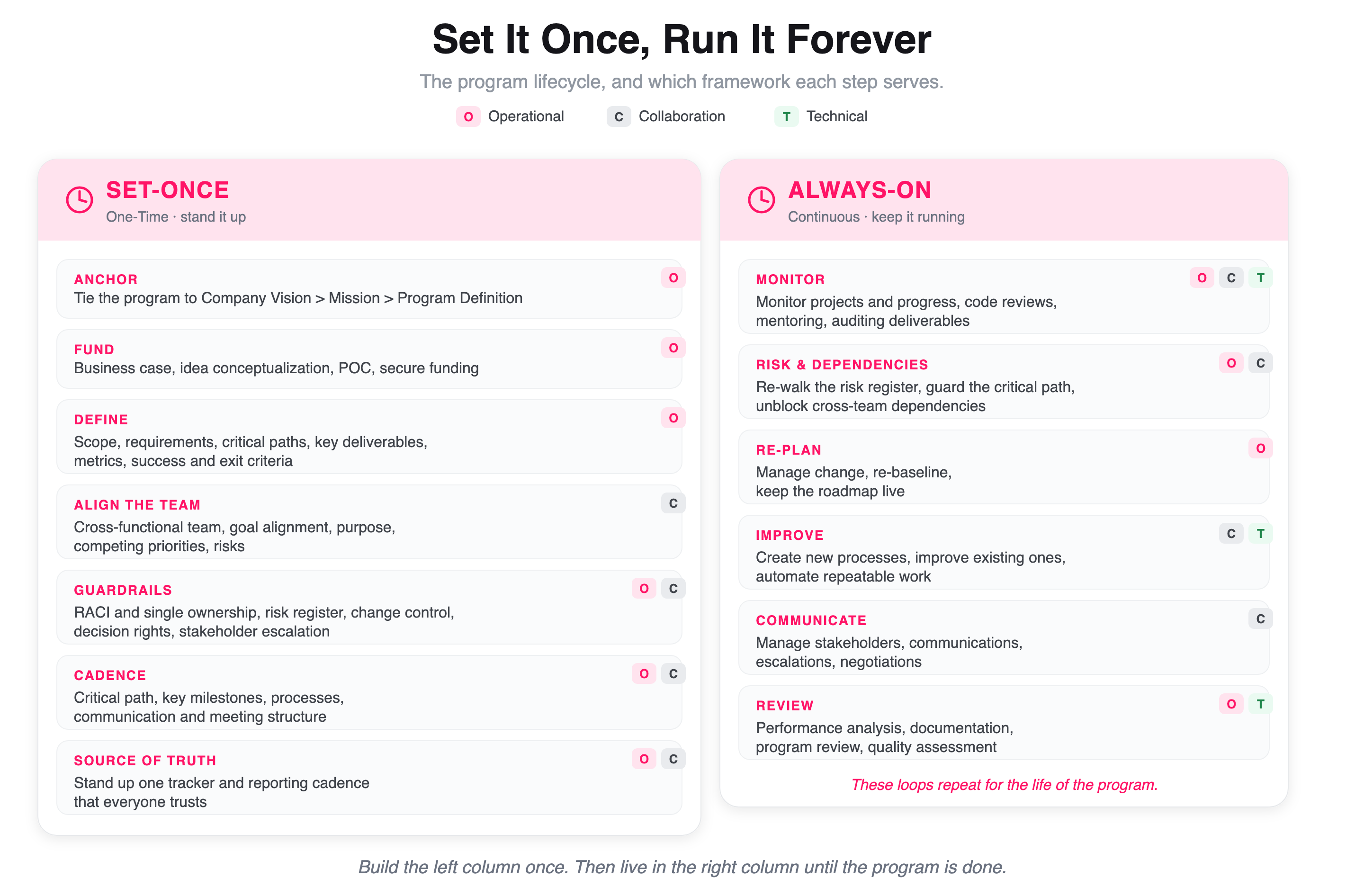
Set-once: standing up the program
Some parts of a program you build once, at the start, and then maintain. Getting these right is most of what decides whether the program is calm or chaotic later. Rushing this is the most common mistake I see, a TPM eager to show momentum starts tracking tasks before anyone agrees on what the program even is. Here is the order I use.
Start with why the program exists, in one sentence, tied to something above it. Every program should trace up to a company goal. Not migrate the databases, but cut the cost and risk of our data layer so we can grow past the current ceiling. If you cannot connect your program to something a senior leader already cares about, you will lose every priority fight later, because your work will look optional. Write the line. Get the sponsor to say it out loud.
Then earn the right to exist. This is the unglamorous part TPMs skip: the business case, the rough proof that the idea works, and the funding. Even inside a company, a program competes for headcount and budget against other programs. You need a defensible case: what it costs, what it returns, what happens if we do nothing. When there is real uncertainty, a small proof of concept buys the credibility to ask for the bigger commitment. I have watched good programs die at month six because nobody nailed down funding at month zero, and the moment budgets tightened, the program had no armor.
Then define the shape of the work: scope, the key deliverables, the requirements, and the two or three metrics that will tell everyone whether it is working, plus what done looks like so the program has an off-ramp. Be as clear about what is out of scope as what is in, because vague scope is how programs quietly triple in size while the deadline stays fixed. And pick outcome metrics, not activity metrics: not number of teams trained, but number of teams operating on their own without our help, because the first can reach a hundred percent while the real goal goes nowhere.
Then the people. Identify every team you depend on, name a single owner for each part, and get their managers to agree, on the record, that the work is on their roadmap. This is where you surface competing priorities early instead of discovering them in a slipped quarter. The most valuable question in program setup is a boring one: whose goals does this help, and whose does it get in the way of. Ask it before you start, not after.
Then the guardrails. Decide who is responsible, accountable, consulted, and informed for the big decisions, a simple version of what people call a RACI. Stand up a risk register, which is just an honest list of what could go wrong, how likely it is, and what you will do about it. Define how changes get approved so scope does not drift silently. And agree on the escalation path before you need it: when two teams are stuck, who breaks the tie, and how fast. Programs rarely fail from one big disaster. They fail from a dozen small stuck decisions nobody escalated because the path was unclear.
Finally, set the operating cadence: the critical path, the key milestones, and the routines that will carry the program. What meetings exist, who is in them, what gets reviewed, and how status flows, all anchored to one source of truth everyone trusts. A program with no cadence runs on the TPM's memory and adrenaline, which does not scale past a few teams and does not survive your vacation.
Get these built once and the program has a spine. The piece everyone asks about sits on top of that spine: the roadmap.
The roadmap: build it on the dependency spine
A program roadmap is not a product roadmap and it is not a task list. A product roadmap answers what to build. A program roadmap answers a harder question: how do many teams, with many dependencies, over many quarters, converge on an outcome without lying about dates. It is a commitment model held up by a dependency spine. Here is how I build one, in order.
Anchor it to outcomes. Start from the two or three measurable outcomes the whole program serves, the ones you set at the start. These sit at the top and never move. Everything below them is negotiable. They are not.
Slice the program into workstreams, each with one owner. A workstream is a coherent chunk of the outcome that one team, and one accountable owner, can carry. If two people own a workstream, no one does. Slicing is an art: too few and each is a black box, too many and you drown in coordination. I aim for slices where I can name the owner, the outcome, and the main risk in one breath.
Set milestones as outcomes, not tasks. A good milestone is a checkable change in the world: any team can request hardware and get an answer the same day, not build the request form. Task shaped milestones let a team be busy for a quarter and deliver nothing that matters. Outcome shaped milestones force the question of whether the work actually moved the goal.
Wire the dependencies and find the critical path. This is the part product roadmaps do not have, and the part that makes a program roadmap real. Map which workstreams need something from which others, and when. Somewhere in that web is a critical path, the one chain of dependencies that, if it slips, slips the whole program. Most of your attention belongs there. In a large region build I worked on, dozens of teams had work to do, but the entire timeline hung on one sequence of foundational steps that everything else waited on. Protecting that single path mattered more than anything else on the roadmap. The teams off the critical path had slack. The ones on it had none, and everyone needed to know which they were.
Stress test with risk and confidence. For each milestone, ask how confident you actually are and where the unknowns hide. Put buffer where confidence is low, not spread evenly. Then be honest about certainty when you publish. A simple habit from the product world helps here: instead of pretending every date is firm, sort work into what is committed and near, what is next and likely, and what is later and still a bet. It lets you show a real horizon without turning a rough guess into a promise you will be beaten with.
Sequence and commit only what you can defend. Lay the milestones on a timeline, but commit dates only for the near horizon where you have real confidence. For the far horizon, commit to outcomes and rough order, not exact weeks. A roadmap that commits to precise dates twelve months out is not brave, it is untrustworthy, and everyone reading it knows.
One more thing separates a senior TPM's roadmap from a junior one: it works at three altitudes. The same roadmap has to serve an executive, who wants three outcomes, the top milestones, and the top risks on one screen; the program itself, which needs the full picture of every workstream, dependency, and risk; and each team, which mostly cares what it must deliver in the next ninety days. Most roadmap failures I see are altitude failures, showing a vice president the two hundred row dependency view, or handing a delivery team the one line vision. It is one roadmap, rendered at the zoom level the audience can act on.
Always-on: operating the program
Once the program is running, your job shifts from building structures to running loops. These routines keep the operating system alive, and they repeat for the life of the program.
The status loop is the one everyone knows and most people do badly. The goal is not to collect updates. It is to catch slippage early enough to do something about it. Early in my career I ran status the way most people do, going team to team in a meeting and writing down what everyone said. It did not scale and it did not surface problems until they were already late. The fix that changed everything for me was to make status a number, not a conversation. On that company wide reliability program, I turned a vague weekly ritual into one shared tracker where each team's progress was a visible count, rolled up where directors and vice presidents could see it. Nobody wants to be the row that has not moved. The tracker did the chasing for me, and trouble showed up as a flat line weeks before it would have shown up in a meeting.
The risk loop is deliberately looking for what is about to go wrong instead of waiting for it to arrive. Walk the risk register on a cadence. Watch the critical path like a hawk, and keep cross-team dependencies unblocked. Ask the boring questions: what are you blocked on, what are you assuming, what would have to be true for your date to hold. Most slips are visible weeks ahead if someone is looking. Your job is to be the one looking.
The improvement loop is where a good TPM compounds. As the program runs you will see the same friction repeat: the same handoff that breaks, the same approval that takes too long, the same status assembled by hand. Turn repeating pain into a process, and repeating process into automation. On a platform program that replaced thousands of manual spreadsheets with a self serve system, the whole point was this loop, notice that hundreds of people were doing the same manual thing, and remove the thing. The same instinct applies to how you run the program, not just to what it builds.
The people loop is the part no tool will do for you. You are managing stakeholders who do not report to you, negotiating when priorities collide, escalating cleanly when they stay stuck, and often mentoring the more junior TPMs and engineers around you. Escalation deserves a word, because so many TPMs treat it as failure. It is not. A clean, early, unemotional escalation, here is the decision, here are the options, here is what I recommend, here is what I need from you, is one of the most senior things a TPM does. Sitting on a stuck decision to avoid looking like you could not handle it is one of the most junior.
Running under all of it: review the program honestly, document decisions so the knowledge does not live only in your head, and check the quality of what is actually being delivered, not just whether dates were hit. A program that ships on time and produces something nobody can operate has not succeeded.
How programs quietly fail
Programs rarely die in a dramatic explosion. They erode. The failure modes repeat, and once you have seen them a few times you can smell them coming.
The plan mistaken for the program. Someone writes a beautiful plan and believes the work is done. There is no cadence, no risk loop, no escalation path. The plan ages, reality drifts, and by the time anyone notices, the gap is a quarter wide.
The roadmap that is a task list in disguise. Every milestone is an activity, not an outcome. Teams are busy and on schedule and the goal is not moving, and nobody can see it because the roadmap measures motion instead of progress.
Dependencies discovered late. The team on the critical path learns in the standup that another team was supposed to hand them something last week. This is a pure failure of the collaboration lens, and it is almost always avoidable by wiring dependencies at setup instead of discovering them in flight.
No single threaded owners. Everything is owned by the team, or by two people jointly, which means nothing is owned. When something slips there is no one to ask, and the TPM ends up personally holding every thread.
The frozen roadmap. It was published once and never changed, so people stopped trusting it, because they know reality moved and the document did not. A roadmap that never changes is not stable, it is ignored.
Escalation treated as failure. Stuck decisions pile up because raising them feels like weakness. The program slows to the speed of its most conflict averse conversation.
Metrics theater. The dashboard is green because the metrics were chosen to be easy, not honest. Everyone senior can feel that it is green in a way that does not match reality, and trust quietly drains.
Build the operating system in this piece and most of these never get a foothold, because each one is exactly what a specific structure or loop is designed to prevent.
How you know it is healthy
You do not measure a TPM by how busy they look. A well run program feels calm from the outside, which fools people into thinking it was easy. Here is what health looks like.
Dependencies surface early, not in the standup where they blow up. Dates rarely surprise anyone, because slippage was visible weeks ahead and either absorbed or renegotiated in the open. There is one source of truth everyone trusts, so people stop asking what the real status is in side channels. Escalations get raised early and resolved fast, because the path exists and using it is normal. And teams can serve themselves from the roadmap without booking time with you, because it is legible at their altitude.
The deepest signal is subtle: the program keeps moving when you step away. If it only runs while you personally push every piece, you have not built an operating system, you have become one. The whole point is to build structures and loops that carry the work, so your attention is free for the few decisions that genuinely need you.
Take it and run
If you are standing up a program next week, here is the whole thing in one breath.
Set it up once: write the one sentence why and tie it to a company goal, earn funding with a real case, define scope and outcome metrics, name a single owner for every dependency and get it onto their roadmap, stand up a RACI, a risk register, a change process, and an escalation path, and set the operating cadence. Build the roadmap on the dependency spine: anchor to outcomes, slice into owned workstreams, write milestones as outcomes, wire the dependencies and guard the critical path, stress test with confidence horizons, and render it at three altitudes. Then run the loops forever: status as a number, risk hunted and not awaited, friction turned into process and automation, and people managed, escalated, and mentored with a straight back.
Do that, and you are not managing a document. You are running the hidden operating system behind a large program, which is the actual job. The roadmap is only the part everyone can see.
Related reading
More on the individual moving parts of this operating system:
- Leading Without Authority: The Operating System of a Technical Program Manager: the mindset this whole system runs on.
- Managing Dependencies Across Teams: making the dependency spine explicit, tracked, and owned.
- How to Build a Program Roadmap: a closer look at the roadmap that sits on top of the spine.
- Escalation Without Burning Bridges: how to run the escalation path this system depends on.
- Leading 200 Teams Without Managing a Single One: turning status into a self-policing metric at scale.
How to cite this:
Gupta, A. (2026). The TPM Operating System Behind Large-Scale Program Execution. Ankur Gupta. https://ankurgupta.me/the-tpm-operating-system-behind-large-scale-program-execution/
This work is licensed under CC BY 4.0 — you're welcome to share and adapt it, with credit to Ankur Gupta and a link back to this original post.